
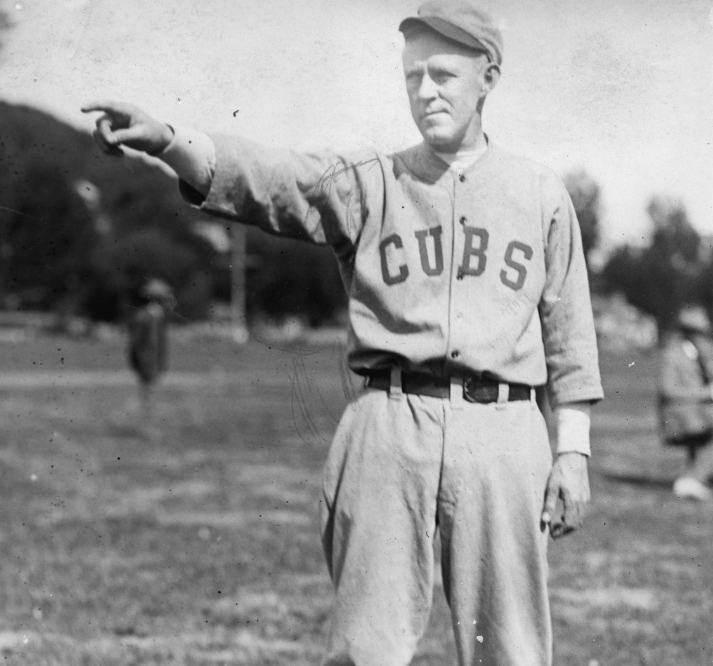

MLB HOFer Johnny Evers On Bathing With Pigs And Other Horrors Of Early Baseball
The Human Crab lived up to his nickname with his complaining
It’s a matter of tradition that most people believe that the generations that come after them have things much easier than they ever did. While this may or may not be true, it’s hardly quantifiable. However, that doesn’t prevent the constant reminders. This includes sports like baseball. Hall-of-Fame Johnny Evers, who was famously known as “The Human Crab’ for his irritable personality, was really convinced that players had a much easier time than he did during his career, as later in life he recalled such degradations as having to bathe with pigs and cows while serving as a big league star.
During the course of 18 big-league seasons (1902–1917; 1922; 1929), Evers was primarily known for his time spent with the Chicago Cubs, with whom he spent the first 12 years of his career. The middle man in the famed double-play trio with shortstop Joe Tinker (Evers did not get along with him off the field) and first baseman Frank Chance, they were immortalized by a famous poem by Franklin Pierce Adams. His prickly nature gave him a reputation he carried throughout his life.
Evers was a ferocious winner. He played in four World Series; a key cog in three teams that won titles. Playing primarily during the Dead Ball Era, his numbers are slight by modern standards. He finished with a combined batting average of .270, 12 home runs, 536 RBIs and 324 stolen bases. He was also a stellar defensive player, and his 15.4 career dWAR is still 15th best all-time among players who predominantly played second base during their career. He was elected to the Hall of Fame in 1946.
Evers firmly believed that what he accomplished was in spite of the conditions he had to endure as a player. Not only that, once he retired, he came to see the next generation of players as spoiled and entitled. He was not shy about comparing what he had to face against the luxuries of those who made a living off the diamond. One of his rants ended up in an article that appeared in a number of papers, including the February 10, 1931 issue of the Shamokin News Dispatch.
Evers’ bitterness towards what he saw as a major disparity was obvious:
“What a cinch they have nowadays. And look at the dough they get. Today, everything is hunky dory for the ball player who makes the big league grade. Fine hotels. Excellent grub. Best trains. Pullman accommodations. Taxis to the ballparks.”
While his playing days were essentially over following the 1917 season, it is interesting to note that his final big league action occurred in a solitary game in 1929, a mere two years prior to him making these comments.
Evers could hardly contain himself about what he believed were the horrible conditions he had to put up with as a player:
“What a difference from the old days. Why, do you know, when I used to play with the Cubs we had to take a bath with cows and the pigs in that old West Side Ball Park in Chicago. No needle shower baths for us in those days.”
Although he clearly felt at a disadvantage, the old second sacker wasn’t giving an inch when comparing the quality of play between the generations:
“And if I do say it myself, we played as good ball — if not better — than they do today. We played more scientific ball, at any rate.”
If nothing else, Evers couldn’t stand what he perceived to be entitled attitudes and behaviors from the current players he was watching:
“It used to be an honor to break into the big leagues. However, a lot of fellows who are signed up take it as a matter of course. They don’t seem to feel the pride in our uniforms that we used to in the old days. Today, they play for a big batting average, knowing that when they talk salaries it’s their batting average that governs their pay to a large extent.”
He was also largely disappointed with what he felt was a lack of passion from big players. He saw far too many he believed were happy with simply having made a big league roster:
“Nowadays, it seems you either come a ballplayer or a stool pigeon. A stool pigeon is just what a lot of fellows in uniform develop into. This type sit on the bench month in and month out, and don’t seem to care whether they are in the lineup or not. They’d have to keep me out of the lineup. That’s the way we all used to be — fighters for our place on the team.”
While what he saw as major differences between the attitudes and playing conditions of different eras of ballplayers rankled Evers, one can only imagine his distress if he knew how the game evolved in the years following his death in 1947.