
ML-E1: Which machine learning algo & python library to use for which real world use-case?
Here we’ll not only cover which ML algo to try, but which specific off-the-shelf python library to use for real world problems.
Like product demand prediction, churn prediction, automated customer service, recommendation, weather prediction, time-series, credit card fraud, spam, security, people tracking, self-driving, grocery checkout and more.
ML series menu: E1 E2 E3 E4 E5 E6 E7 E8 E9
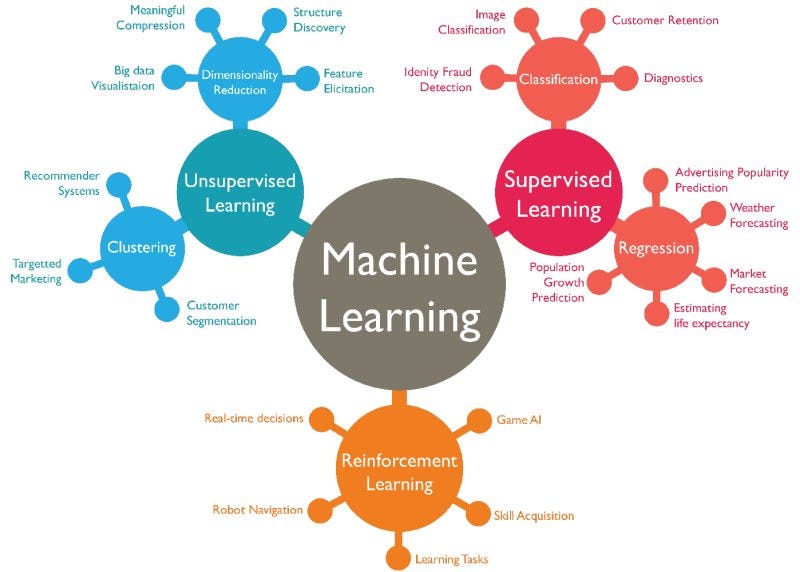
Customer Churn Prediction
- Machine Learning Algorithm: Gradient Boosting Machines (GBM)
- ML Library/Module: XGBoost, specifically the
XGBClassifierclass
Customer churn prediction, which aims to identify customers who are likely to stop using a product or service, is a common use case of machine learning in business. Gradient Boosting Machines (GBM) are often used in churn prediction for their high performance and flexibility.
In Python, XGBoost is a library that provides an efficient and flexible implementation of the GBM algorithm. The XGBClassifier class is used for classification tasks, such as predicting whether a customer will churn (leave) or not.
In customer churn prediction, a GBM model is trained on a dataset containing customer usage data, demographics, past purchase behavior, etc., with churn (yes/no) as the target variable. The GBM algorithm builds an ensemble of weak prediction models, typically decision trees, in a stage-wise fashion. It generalizes these weak models by allowing optimization of an arbitrary differentiable loss function, making it flexible for various tasks.
GBM models are effective for customer churn prediction because they provide a robust method for capturing non-linear relationships between features and the target variable, and for handling different types of variables (continuous, ordinal, categorical). They also offer several regularization parameters to prevent overfitting, making them powerful tools for predicting customer behavior.
Recommendation Systems
- Machine Learning Algorithm: Collaborative Filtering
- ML Library/Module: Surprise, specifically the
SVDclass
Recommendation systems have become a crucial part of many businesses that thrive on user interaction, such as e-commerce and media streaming sites. Collaborative filtering is a commonly used machine learning algorithm in recommendation systems. It uses the behavior of similar users to predict the preference of a user towards an item.
Python’s surprise library is often used to implement collaborative filtering due to its user-friendliness and wide variety of algorithms. Specifically, the singular value decomposition (SVD) class can be used to make predictions. This method utilizes matrix factorization, where the user-item interaction matrix is factored into lower dimensional matrices representing latent user and item factors. These factors can then be used to predict the interactions (ratings) that users would give to items.
In real-world applications, the algorithm first computes the similarity between different users or items based on their past interactions. If a user A has rated items similarly to user B in the past, then the items that B has rated highly but A has not interacted with will be recommended to A. This is effective because it leverages the collective wisdom of users. SVD, as part of collaborative filtering, improves the efficiency of this process by reducing the dimensionality of the user-item interaction space, thus reducing the computational complexity while still maintaining key information.
Product Demand Prediction
- Machine Learning Algorithm: Time Series Forecasting (ARIMA)
- ML Library/Module: Statsmodels, specifically the
ARIMAclass
Product demand prediction is vital for effective inventory management and preventing product wastage. A commonly used method for this kind of problem is Time Series Forecasting, specifically AutoRegressive Integrated Moving Average (ARIMA), a statistical method for analyzing and forecasting time series data.
The Python library statsmodels has a module for ARIMA that is very effective. The ARIMA class uses historical data to predict future values by combining autoregression, differencing, and moving average components. It is particularly useful when data shows evidence of non-stationarity.
In practice, the ARIMA model utilizes the temporal dependencies inherent in time-series data, that is, it assumes the future values of the series are a function of its past values. This is useful in product demand prediction as demand often follows a temporal pattern. For instance, certain products might show increased demand during specific seasons, holidays, or events. The ARIMA model can capture these patterns and provide reliable future forecasts. The integration component of ARIMA helps make the series stationary (mean, variance, and covariance are constant over time), which is a common assumption in many time-series forecasting methods and helps improve the performance of these models.
Automated Customer Service
- Machine Learning Algorithm: Natural Language Processing (NLP) using Transformers
- ML Library/Module: HuggingFace Transformers, specifically the
BertForSequenceClassificationclass (or new LLMs like GPT)
Automated customer service via chatbots or voice assistants is becoming increasingly prevalent. This often involves Natural Language Processing (NLP), with Transformers being a popular choice due to their ability to understand the contextual relationship between words in a sentence.
The HuggingFace’s transformers library is an excellent choice for this use case. More specifically, the BertForSequenceClassification class is often used to develop models for text classification, a common task in automated customer service systems. This class is based on the BERT (Bidirectional Encoder Representations from Transformers) model, a transformer-based machine learning technique for NLP pre-training.
BERT, as implemented by BertForSequenceClassification, works by looking at the context of a word based on all its surrounding words (to the left and the right of the word) in a sentence. For a customer service application, this could involve classifying an incoming customer message based on its content and determining the appropriate response. For example, if a customer asks about a refund policy, the BERT model could classify this message under the “Refund Policy” category and trigger an appropriate pre-determined response.
This approach leverages the power of Transformer models to understand the context of words and sentences. The model is trained to minimize the error in predicting a word based on its context. This pre-training step allows BERT to capture a lot of general language understanding, which can then be fine-tuned with just one additional output layer to create a system for a specific task like sequence classification, making it ideal for automated customer service applications.
Stock Market Prediction
- Machine Learning Algorithm: ARIMA (Autoregressive Integrated Moving Average)
- ML Library/Module: statsmodels, specifically the
ARIMAclass
Predicting stock prices is a complex task and many factors can influence the movement of stock prices. However, certain machine learning algorithms such as ARIMA (Autoregressive Integrated Moving Average) can be used to analyze time-series data and make predictions.
The Python library statsmodels provides a comprehensive suite of statistical models that can be used to implement ARIMA among other algorithms. The ARIMA class provided by statsmodels can be used to fit an ARIMA model to the time series data.
In the context of stock market prediction, the ARIMA model is used to analyze the historical prices of a stock and make predictions about future prices. The AR part of ARIMA indicates that the evolving variable of interest is regressed on its own lagged (i.e., prior) values. The MA part involves modeling the error term as a linear combination of error terms occurring contemporaneously and at various times in the past. The I (for “integrated”) indicates that the data values have been replaced with the difference between their values and the previous values.
ARIMA models are effective for stock market prediction because they are able to capture a suite of different standard temporal structures in time series data. The ARIMA model can also be modified to include other factors such as the effect of holidays, weekends, and other events, making it a versatile tool for stock market prediction.
Weather Prediction
- Machine Learning Algorithm: Random Forest Regression
- ML Library/Module: Scikit-learn, specifically the
RandomForestRegressorclass
Weather prediction is a classic regression problem where the aim is to predict a continuous quantity. Random Forest Regression is a versatile machine learning algorithm that can handle such tasks very effectively.
Scikit-learn, a popular machine learning library in Python, offers the RandomForestRegressor class which can be used for this purpose. A random forest is a meta estimator that fits a number of decision tree regressors on various sub-samples of the dataset and uses averaging to improve the predictive accuracy and control overfitting.
In the context of weather prediction, variables such as temperature, humidity, wind speed, etc., from previous time steps can be used as features to predict the weather. The Random Forest Regression model takes these features as inputs and makes predictions about future weather conditions.
The strength of the Random Forest Regression algorithm lies in its ability to handle a large number of features and to model non-linear relationships, which is common in weather data. Additionally, it provides a measure of feature importance, which can be beneficial for understanding which features are most influential in predicting the weather.
Credit Card Fraud Detection
- Machine Learning Algorithm: Isolation Forest
- ML Library/Module: Scikit-learn, specifically the
IsolationForestclass
Credit card fraud detection is a critical task for financial institutions. It’s a form of anomaly detection, where the goal is to identify rare events that raise suspicions by differing significantly from the majority of the data. Isolation Forest is a machine learning algorithm well-suited for such tasks.
Scikit-learn provides the IsolationForest class which is frequently used for anomaly detection problems like fraud detection. The Isolation Forest 'isolates' observations by randomly selecting a feature and then randomly selecting a split value between the maximum and minimum values of the selected feature.
In the context of credit card fraud detection, each transaction would be considered an ‘observation’. The algorithm works by isolating each of these transactions and assessing how easy it is to separate it from the others. Fraudulent transactions are often significantly different from normal ones, so they are easier to ‘isolate’.
The Isolation Forest algorithm is particularly useful because it is capable of handling high dimensional datasets, and unlike other anomaly detection methods, it doesn’t require a normal data distribution. Furthermore, the algorithm has a low computational cost, making it a robust and efficient solution for credit card fraud detection.
Spam Detection
- Machine Learning Algorithm: Naive Bayes Classifier
- ML Library/Module: Scikit-learn, specifically the
MultinomialNBclass
Spam detection, especially for emails, is a common problem solved using machine learning. A popular approach to spam detection is the use of Naive Bayes classifier, an algorithm that applies Bayes’ theorem with strong (naive) independence assumptions between the features.
The Scikit-learn library in Python includes the MultinomialNB class, a specific implementation of Naive Bayes which is suitable for classification with discrete features (like word counts for text classification). This makes it ideal for spam detection as emails can be converted to a set of words (or 'bag of words') and the frequency of occurrence of each word can be used as features for our classifier.
In spam detection, an email is classified as spam or not based on the probability calculated by the algorithm. Each word in the email contributes to the email being spam or not, and these contributions are assumed to be independent of each other. For example, the word “free” might be commonly used in spam emails and will contribute towards an email being classified as spam.
The Naive Bayes classifier is popular for spam detection due to its efficiency and scalability, handling large datasets and high-dimensional feature vectors with ease. Its assumption of feature independence is usually not a problem for spam detection because even though this assumption is violated, the classifier still performs well.
Security — Intrusion Detection
- Machine Learning Algorithm: Support Vector Machines (SVM)
- ML Library/Module: Scikit-learn, specifically the
SVCclass
Machine learning can play a vital role in cybersecurity, particularly in intrusion detection systems that identify unauthorized access to a network. Support Vector Machines (SVM) are often used due to their effectiveness in high-dimensional spaces and their ability to classify non-linearly separable data.
Scikit-learn provides an SVC class which implements Support Vector Classification, an application of SVM. It works by mapping input vectors to a high-dimensional feature space where a hyperplane is constructed that maximizes the margin between the two classes in the training data.
For intrusion detection, the feature vectors could be network traffic attributes such as protocol type, service, flag, source bytes, destination bytes, etc. The SVM model uses these features to classify network traffic as normal or an intrusion.
SVMs are effective in intrusion detection due to their ability to find the optimal decision boundary (hyperplane) that maximizes the separation between different classes (normal and intrusive activities). This makes SVMs effective even when the classes are not linearly separable in the original space. Furthermore, SVMs are less prone to overfitting and are able to handle high-dimensional data well.
People Tracking
- Machine Learning Algorithm: Convolutional Neural Networks (CNN)
- ML Library/Module: TensorFlow, specifically the
Conv2Dclass
People tracking, in the context of surveillance and autonomous vehicles, is a common application of machine learning. Convolutional Neural Networks (CNNs) are widely used for this task due to their exceptional performance in processing image data.
In Python, TensorFlow is a powerful library for creating and training neural networks, including CNNs. The Conv2D class is often used for creating convolutional layers in a CNN.
In a people tracking system, images or video frames are input to the CNN, which then identifies and tracks people within the frame. The convolutional layers of the CNN are responsible for feature extraction in the input images. These features could be edges, textures, or even parts of objects (like legs, hands, etc. in the context of people tracking).
CNNs are particularly effective for people tracking because they automatically learn and extract hierarchical features from raw input data. This ability to learn and generalize from the data allows CNNs to accurately identify and track people across various scenes and lighting conditions. The convolution operation also provides translational invariance, which is essential for tracking objects across different locations in an image.
Self-Driving Cars
- Machine Learning Algorithm: Deep Reinforcement Learning (DRL)
- ML Library/Module: TensorFlow, specifically the
keras-rlmodule
Self-driving cars are a fascinating application of machine learning. Deep Reinforcement Learning (DRL) is a common approach used in the development of self-driving vehicles due to its ability to learn complex behaviors without requiring explicit programming.
TensorFlow, a leading machine learning library, provides support for reinforcement learning through its keras-rl module. This module integrates seamlessly with the rest of TensorFlow and Keras and provides the necessary functionality for developing DRL models.
In the context of self-driving cars, the reinforcement learning agent learns how to drive by interacting with the environment. The agent takes actions (accelerating, braking, turning), observes the outcome (changes in the environment, including the car’s position), and receives rewards (positive for desired outcomes such as staying on the road, and negative for undesired ones such as colliding with an obstacle).
DRL is effective for self-driving cars because it allows the model to learn directly from raw sensor inputs (such as camera images and LIDAR readings) and to optimize its actions based on complex reward signals. This way, the model can learn complex maneuvers and driving strategies that might not be anticipated during explicit programming.
See also YOLO, below.
Automated Grocery Checkout
- Machine Learning Algorithm: Object Detection (YOLO: You Only Look Once)
- ML Library/Module: Darknet
Automated grocery checkout systems require robust and fast object detection models to identify various items. YOLO (You Only Look Once) is a popular choice due to its real-time object detection capabilities.
The original implementation of YOLO is in the Darknet framework, which is not a traditional Python library, but it can be interfaced with Python for high-level operations. Python wrappers for Darknet also exist, allowing Python developers to utilize the power of YOLO models.
In automated grocery checkout, the system needs to identify and classify the items in a customer’s cart. For this purpose, a YOLO model is trained on a dataset of grocery items. When a customer places an item in front of the camera, the system uses the trained YOLO model to detect and classify the item in real time.
YOLO’s strength lies in its single pass approach to detection. Traditional object detection systems scan the image multiple times at different scales and locations to detect objects. YOLO, however, looks at the image only once, making it much faster while still maintaining a high level of accuracy. This speed and accuracy make it an excellent choice for real-time applications such as automated grocery checkout.
Medical Image Analysis
- Machine Learning Algorithm: Convolutional Neural Networks (CNN)
- ML Library/Module: TensorFlow, specifically the
Conv2Dclass
Medical image analysis, which includes tasks such as disease detection from X-rays or MRIs, is an important application of machine learning. Convolutional Neural Networks (CNNs) are particularly effective for these tasks due to their ability to process and extract high-level features from image data.
In Python, TensorFlow is a commonly used library for creating CNNs, with the Conv2D class used for creating convolutional layers. CNNs consist of multiple convolutional layers followed by pooling layers, fully connected layers, and finally a classification layer.
In medical image analysis, a CNN could be trained to detect the presence of a disease in an X-ray or MRI. The CNN receives the medical image as input and passes it through its layers, each of which identifies specific features in the image. As the image moves through the layers, the CNN learns to recognize increasingly complex features. By the time the image reaches the final layers, the CNN can identify high-level features indicative of the disease.
CNNs are highly effective for medical image analysis due to their ability to automatically and adaptively learn spatial hierarchies of features directly from images. Additionally, they can manage 3D images that have spatial correlations along the depth, width, and height, which is commonly required in medical image analysis.
Language Translation
- Machine Learning Algorithm: Sequence-to-Sequence (Seq2Seq) Models
- ML Library/Module: OpenNMT or TensorFlow, specifically the
tf.keras.models.Sequentialclass
Language translation is another impressive application of machine learning, and Sequence-to-Sequence (Seq2Seq) models have been a breakthrough in this field. Seq2Seq models are designed to convert sequences from one domain (like sentences in English) into sequences in another domain (like the same sentences translated into French).
OpenNMT is a general-purpose neural network-based toolkit that is commonly used for machine translation tasks. It provides functionalities for both training and inference, and can handle multiple forms of sequence-to-sequence models, among which machine translation is a key application. In the context of machine translation, an OpenNMT model is trained on pairs of sentences, where each pair consists of a sentence in the source language and its translation in the target language. The trained model can then generate translations for new sentences in the source language. The appeal of OpenNMT comes from its flexibility and ease of use. It allows users to customize various aspects of the model architecture, training process, and inference process, all while providing sensible default options. It’s implemented in both PyTorch and TensorFlow, allowing users to choose based on their preferred framework. The end result is a robust, customizable, and high-performing solution for machine translation tasks.
TensorFlow offers a high-level API for defining and training Seq2Seq models via the tf.keras.models.Sequential class. These models are typically made up of an encoder and decoder. The encoder processes the input sequence and compresses the information into a context vector, and the decoder uses this vector to generate the translated output sequence.
For a language translation task, the Seq2Seq model would take a sentence in the source language as input, the encoder would process the sentence and create a context vector representing its semantic information. The decoder would then use this vector to generate the sentence in the target language.
Seq2Seq models are highly effective for tasks like language translation because they can handle sequences of variable lengths, and the encoder and decoder components can be designed to capture the semantic dependencies between words in a sentence. Additionally, these models can be trained end-to-end, making them a robust solution for language translation tasks.
Voice Assistants
- Machine Learning Algorithm: Long Short-Term Memory Networks (LSTMs)
- ML Library/Module: TensorFlow, specifically the
tf.keras.layers.LSTMclass
Voice assistants are becoming increasingly common in our daily lives. One machine learning model that plays a crucial role in this technology is the Long Short-Term Memory Network (LSTM), a type of Recurrent Neural Network (RNN) that is effective for sequence prediction problems.
TensorFlow provides the tf.keras.layers.LSTM class, which is used to implement LSTM layers in a neural network model. These layers are capable of remembering information for long periods, making them effective for tasks that involve understanding the context in a sequence of data.
In the context of voice assistants, LSTMs can be used for speech recognition (converting spoken language into written text), natural language understanding (understanding the user’s intent), and text-to-speech synthesis (converting the assistant’s response into spoken language). Each of these tasks involves sequence data — spoken words over time in the case of speech recognition and text-to-speech, and sequences of words in the case of natural language understanding.
LSTMs are a great fit for these tasks because of their ability to handle long sequences and their capacity to remember context. This allows voice assistants to not only recognize spoken words and convert them to text, but also to understand the context of the conversation, resulting in a more accurate and natural interaction.
Disease Prediction
- Machine Learning Algorithm: Random Forests
- ML Library/Module: Scikit-learn, specifically the
RandomForestClassifierclass
Disease prediction, particularly for chronic diseases like diabetes or heart disease, is a crucial application of machine learning in healthcare. Random Forests are often employed for this task, as they perform well with a variety of data types and don’t require much tuning to produce a good model.
Scikit-learn’s RandomForestClassifier class offers an efficient implementation of the Random Forest algorithm in Python. It allows for the easy fitting of models and scoring of data, along with numerous options for customization.
In disease prediction, a Random Forest model is trained on a dataset with patient details as features (such as age, gender, cholesterol levels, blood pressure, etc.), and disease presence (yes/no) as the target. The model then learns to identify patterns and correlations in the feature data that lead to the presence or absence of the disease.
Random Forests are well-suited for disease prediction as they can handle a mixture of feature types (both categorical and numerical), deal effectively with missing data, and resist overfitting by providing an ensemble of decision trees. Each tree in the forest is trained on a different subset of the data, and their predictions are averaged (in the case of regression) or voted on (in the case of classification), reducing the chance of overfitting to the training data and improving generalization to new data.
Did I leave any major use-cases out?
Or any dead-obvious ML approaches to any of these?


