
Mitch McConnell Tried Skipping Over the Two Longest-Waiting Judicial Nominees. They’re Both Black Men.
Cory Booker, a Black senator, took notice.
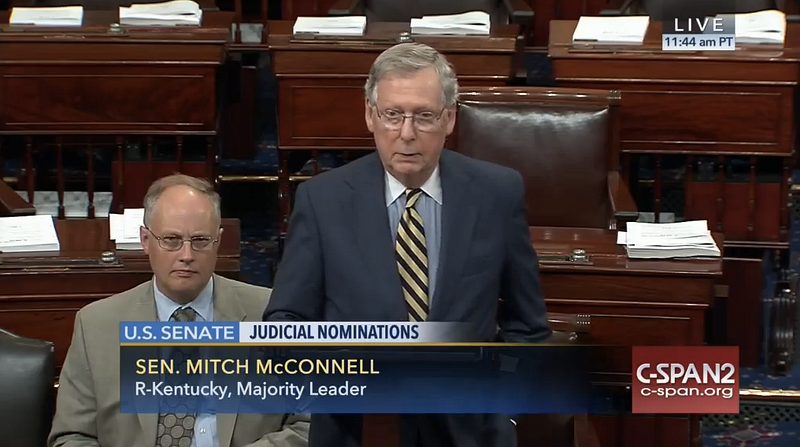
Senate Democrats took to the Senate floor on Wednesday to ask for votes on noncontroversial pending judicial nominees. With 90 current vacancies on the federal judiciary — and 32 judicial emergencies — Democrats were asking for something to help alleviate a judicial vacancy crisis manufactured by the Republican leadership’s obstruction. But they were also asking for something that could have been done in just minutes.
Sen. Heidi Heitkamp, D. N.D., asked that the Senate consider 20 district and circuit court nominees pending on the floor — all who advanced out of the Senate Judiciary Committee with overwhelming support. Majority Leader Mitch McConnell objected to her request.
Instead, McConnell proposed that the Senate consider a “bipartisan package” of four nominees: one from California (a state with two Democratic senators), one from Utah (a state with two Republican senators), and two nominees from Pennsylvania (a state with one senator from each party). From a majority leader who’s been slow-walking judicial nominees since taking control of the Senate in January 2015, this package may have seemed like progress. But Sen. Cory Booker, D. N.J., was there to wonder why McConnell had skipped the next two nominees in line.
One of them was Julien Neals of New Jersey who was nominated in February 2015 and who’s been waiting for a vote on the Senate floor for more than 10 months. The other was Edward Stanton III of Tennessee, who was nominated in May 2015 and whose nomination also has been waiting for more than 10 months on the Senate floor. Sens. Lamar Alexander and Bob Corker of Tennessee, both Republicans, wanted Stanton confirmed last year.
Neals and Stanton are both Black men — a fact that wasn’t lost on Sen. Booker, who objected to voting on McConnell’s bipartisan package of four nominees. Booker pointed out that Neals has been waiting the longest, and that Stanton was next. “I single those two out not just because one of them is from New Jersey,” Booker said, “but if you look at the list of the next 15 judges, these are the only two African Americans on the list.” Booker said he was sure this was just a coincidence, but went on to describe why the perception alone of skipping two African-American nominees was troubling.
At a time that this nation is looking at our judicial system as needing to confront issues of racial bias. At a time that judicial organizations of all backgrounds are pointing out the need for diversity on the federal court, what is being suggested right now is that we come up with a bargain to skip over the two longest-waiting district court judges, who happen to be the only two African Americans on the list of the next 15 — that to me is unacceptable. Especially when you look at the qualifications of these two judges. Especially if you look at their wide bipartisan support within the Judiciary Committee. The perception alone should be problematic to all of us in this body, and so I would like to object to this offer, especially given the tensions that exist right now in our country, the urgency for diversity on the bench, and the clear qualifications for these men, and finally the fact that they have been waiting since May and February of 2015.
Booker was followed by Sen. Tammy Baldwin, D. Wisc., whose nominee to the 7th Circuit would fill a seat that’s been vacant for more than six years. Baldwin was followed by Sen. Mazie Hirono, D. Hawaii, whose district court nominee would have also been skipped over in McConnell’s bipartisan package. And Hirono was followed by Sen. Elizabeth Warren, D. Mass., whose district court nominee would be the first openly LGBT judge to sit on a court in the First Circuit. One by one, they were shot down.
Warren was followed by Sen. Alexander, the Tennessee Republican, who acknowledged McConnell’s bipartisan package — but didn’t acknowledge that his own nominee, Edward Stanton III, would be skipped over. Nearly a year ago in September 2015, Alexander urged the Senate to “speedily confirm him.” On Wednesday, he didn’t even mention Stanton’s name.
Booker then came back to the floor with one simple message: Justice delayed is justice denied.
Without judges on the federal bench, justice is denied for the woman who was fired on account of her gender. Without judges on the federal bench, justice is denied for the transgender individual seeking to access a restroom or other public accommodation. Without judges on the federal bench, justice is denied for the criminal defendant who deserves a speedy trial before a jury of their peers — fundamental constitutional ideas. The longer the Republican leadership delays filling our country’s judicial vacancies, the longer justice is denied for Americans across our country.
Booker asked for votes on just Neals and Stanton — the two African-American nominees next in line — who would themselves represent a bipartisan package (New Jersey has two Democratic senators, while Tennessee has two Republicans). His request was objected to.


