
Mission Log: When a New National Geographic Doc Shows the Clear but Uncredited Influence of Your Medium Essay
It’s not the first time that a film production has shown the obvious influence of my online content.
Let’s imagine for a moment that you’re a geeky sort of writer who just happens to be a wee bit of an “authority” on a variety of subjects: Giant movie monsters (à la Godzilla, King Kong), DC and Marvel comics, Bruce Lee flicks, and the prehistoric migration of Homo sapiens out of Africa into Asia — to name a few.
Now let’s imagine that sometimes you get lucky and two seemingly unrelated subjects, like King Kong and Out of Africa Migration Theory, overlap, allowing you to construct original think-pieces like this first installment of a 2-part essay you published to your Medium page in 2018:
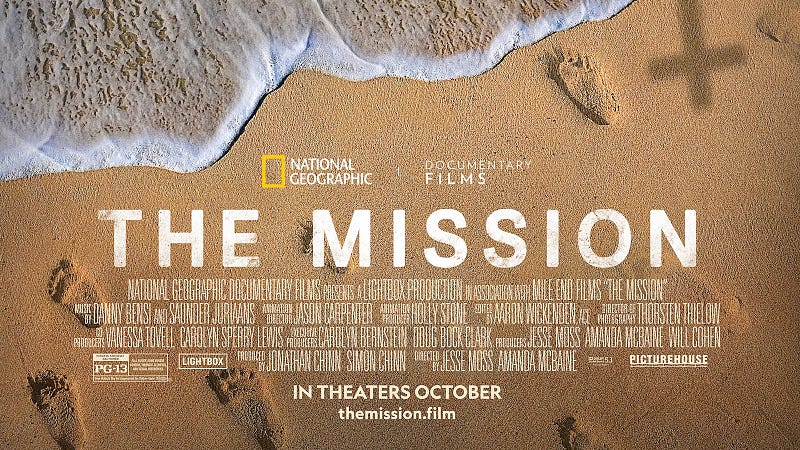
While you’re still wearing your Thinking Cap™, let’s imagine that some award-winning filmmakers happened across your 2-part essay. (Well, it appears that they did.) And let’s say that they found it to be helpful in fleshing out the narrative of The Mission, a documentary about the late John Chau that they were working on for National Geographic Films.
John Chau, you’ll recall, was that adventurous young evangelical fanatic who met his sad and much-too-early demise on India’s North Sentinel Island back in 2018. The young man’s tragic death was the inevitable result of a crazed effort to carry Christianity to one of the world’s oldest and last remaining hunter-gatherer groups.
Bows and arrows were involved.
Anywho, after the production’s completion, The Mission made its big screen debut at Colorado’s Telluride Film Festival. This was in late August 2023. Two months later, it was available for streaming on Disney Plus and Hulu.
But let’s imagine that you didn’t know any of this — which will probably be easy because you didn’t.
No, you came to learn of The Mission’s existence in late December, a few days before Christmas. And not because anyone involved reached out to say that your authoritative voice on two seemingly unconnected subjects had a small but still noticeable impact on the production.
“Let’s imagine for a moment that you’re a geeky sort of writer who just happens to be a wee bit of an ‘authority' on a variety of subjects…”
You found out about it by chance really, because you have a Disney Plus account and National Geographic docs are part of the D+ platform. And documentaries — along with Marvel superhero flicks and TV shows (naturally)— are kinda your jam.
And hence it was, about 20 minutes or so into The Mission, that a really obscure King Kong-related factoid was mentioned by author John Goodheart, a man who’d tried but, perhaps luckily, failed to reach Sentinel Island several years before the dearly departed Chau.
The obscure factoid he mentions is what your essay is all about.
And afterward, you begin to see the seeming influence of your essay on the narrative of The Mission like Neo staring at the cascading digital code work of the Matrix.
Now let’s fast forward and imagine that when the documentary comes to a close, you sit alone in front of the ‘tele’ as the credits creep up the screen halfway expecting to see your name included there, preceded by something like, “Special thanks to…”
But it doesn’t happen.
(Silly rabbit. Trix are for kids.)
So now here’s the $64,000 question: What would you do?
Wait, let’s try that again, but this time in a breathy, intense Keanu Reeves voice, like when, as officer Jack Traven, he quizzes the insane Howard Payne in Speed:
“What…would you do?”
Well, if you’re anything like me, you’d type out an anger-fueled NastyGram™ — uh, I mean you’d type out a nicely worded composition like this, where you bring the proverbial receipts.
Finger-pointing
Quite frankly, this isn’t the first, second, or even the third time that something that’s come out of the American film industry has shown the uncredited influence of my online content. But I’m gonna ixnay doing a deep dive here on those previous purloinings.
To keep this short and sweet (for the sake of my sanity), I’m making an effort to keep my keystrokes on this in the range of 1,500 words. And I’m off to a pretty good start!
pur·loin | pərˈloin | verb : (FORMAL • HUMOROUS) gerund or present participle: purloining; to steal (something).
Concerning the present film in question, what really made my Spider-Sense start to tingle was when a short clip taken from King Kong hit the screen.
By itself, I wouldn’t have made much of it. But after that little-known factoid mentioned by Goodheart, the filmmakers’ choice of this particular clip seemed a bit sus.
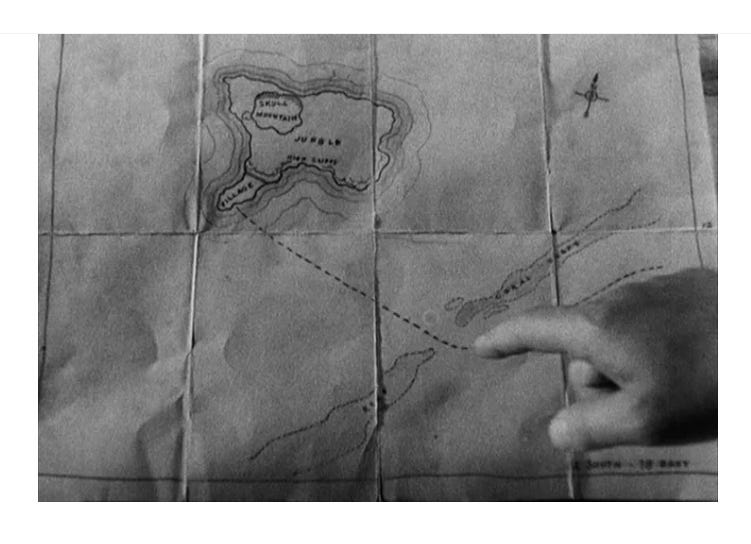
The segment chosen seemed to not-so-faintly echo a screenshot from the film that I’d used for my piece on Medium (as shown above).
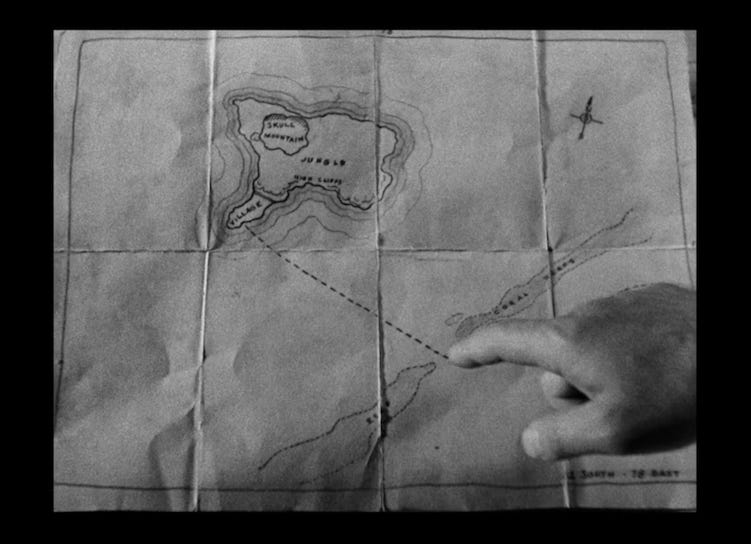
The scene features a hand-drawn map showing the assumed maritime route to Skull Island, the home of the humongous ape in the beloved science-fantasy classic. Adventurous filmmaker Carl Denham, played in the film by actor Robert Armstrong, points the way.
This make-believe island home of King Kong was loosely based on India’s very real Andaman Islands, a small chain to which the now infamous Sentinel Island is linked.
In 1923, Merian C. Cooper, one of Kong’s creators, traveled on a yacht that would make landfall on a less life-threatening part of the Andamans. A yacht owned by film director and producer, Edward A. Salisbury, whom Cooper was working for at the time as a cameraman.
The hunter-gatherer tribal folk that Cooper saw living there would later partly inspire the native inhabitants depicted in King Kong (1933). But the tribal folk themselves would appear in an earlier cinematic effort produced by Salisbury, Cooper’s boss, which we’ll dig into here a bit later.
And I quote
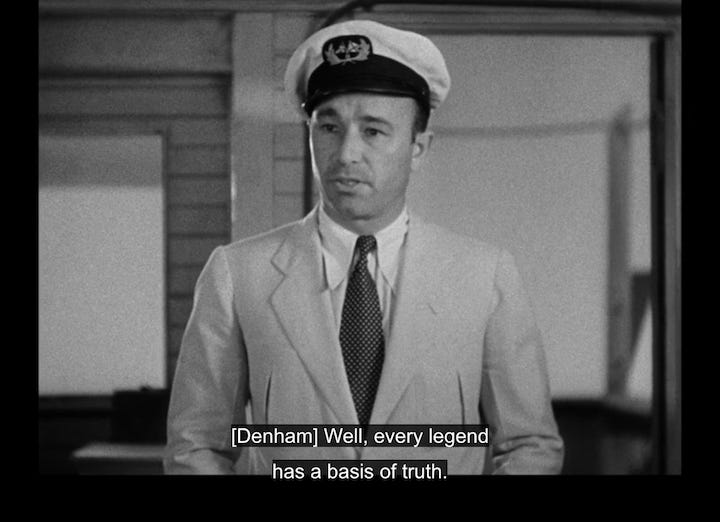
Despite that reference to the little-known connection between King Kong and the Andamans by Goodheart, and even the use of the map sequence in the early part of The Mission, I didn’t completely think that my essay had had any bearing on the narrative development of the film.
A minute or so later, though, when a particular bit of dialog from King Kong emanated from the screen, I had to start second guessing my inner doubting Thomas.
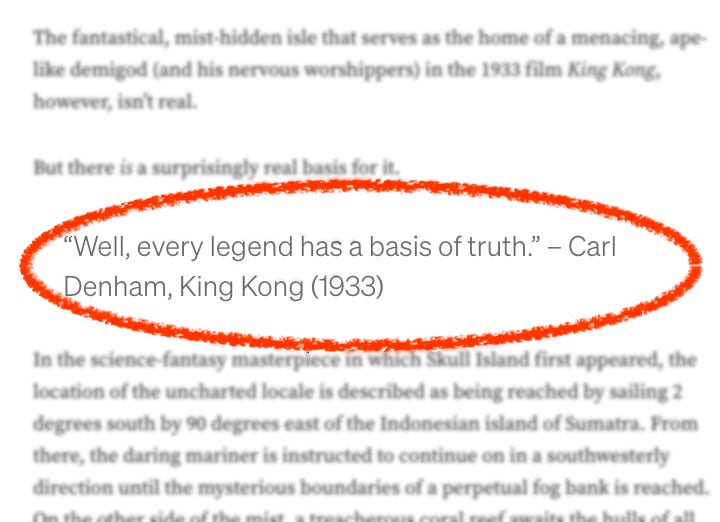
“Well, every legend has a basis of truth,” a line spoken by Carl Denham in this sequence, was used in the intro portion of my essay as an enlarged block quote.
The dialog resonated with me at the time because the piece that I was working on was written to reveal the unknown anthropological facts behind King Kong’s cinematic fiction.
Of course, I also thought it was totally feasible that the use of that same bit of Carl Denham dialog could have been merely a cowinkydink.
You know, “great minds think alike” and all that.
Well, ain’t that a beach
But then there’s this other saying. A thoughtful turn on a popular quote taken from author Ian Fleming’s Goldfinger, which tells us that “once is chance, twice is a coincidence, three times is a pattern.”
A few more seconds later in my viewing of The Mission, the pattern that suggested my work may have indeed influenced part of it’s narrative became much more apparent.
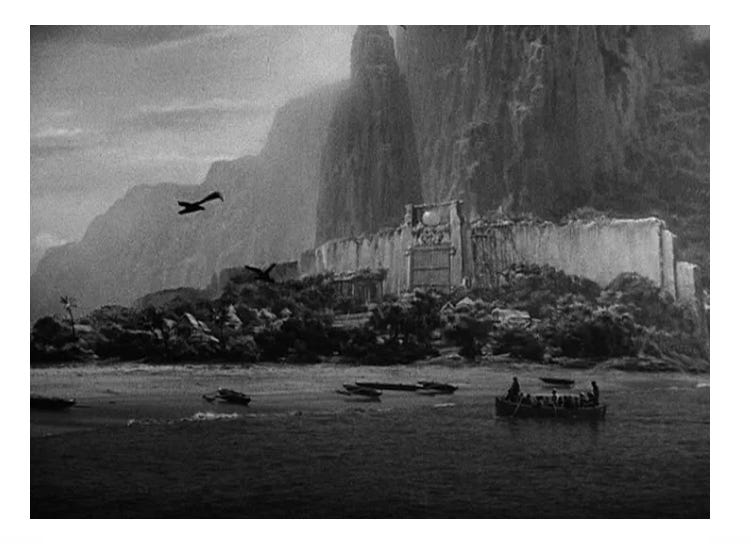
It was here that yet another sequence from King Kong that I’d made a screenshot of for use in my essay appeared on the screen, framed on either side by a few seconds of additional film footage.
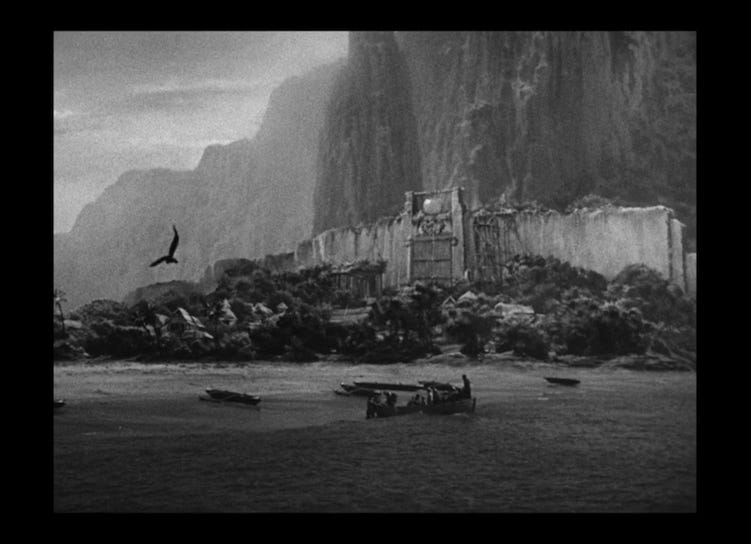
The clip was an establishing shot of the beach at Skull Island. Nearing the shoreline is a dinghy filled with Denman and several of his crewmen. The massive gate made by the island’s tribal people looms in the background. Fluttering in the sky above is the blackened form of a seagull.
And upon seeing this particular scene selection, I couldn’t help but begin to feel as if I (through my work) had been used as an unpaid and uncredited researcher, production assistant, and storyboard creator.
“Once is chance, twice is a coincidence, three times is a pattern.”
Gnawing at me
The nagging sense that my work had informed parts of the narrative of The Mission would intensify later on in the film, around the 48-minute mark. It was at this point in the doc that the title card of Edward A. Salisbury’s 1956 film Cannibal Island popped up on the screen.
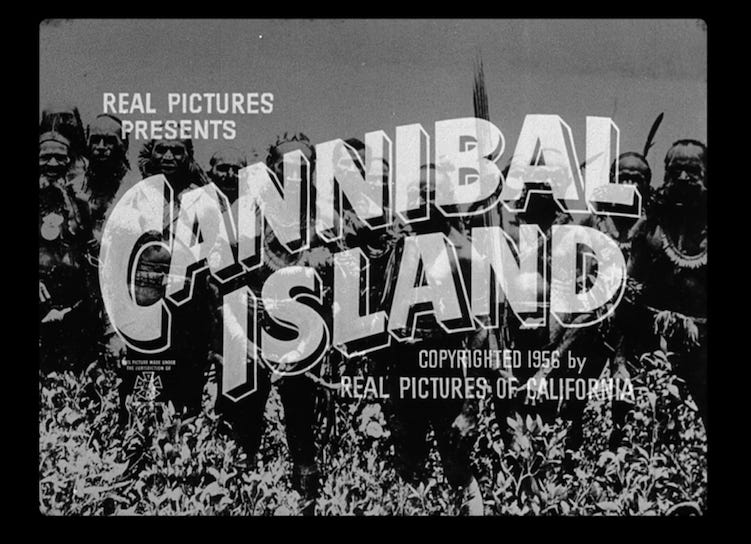
Despite the 1956 copyright date, Cannibal Island was derived from old footage that was shot by Cooper around 1923, during their expedition to the Andaman Islands and the islands of the South Pacific.
That footage made its first appearance in 1931, though, as the silent film Gow the Killer. But after advances in sound technology, it was later retitled and then rereleased, with narration added, as Cannibal Island.
Oh, and the title card was the basis of still another image that I’d made a screenshot of for use in my essay.
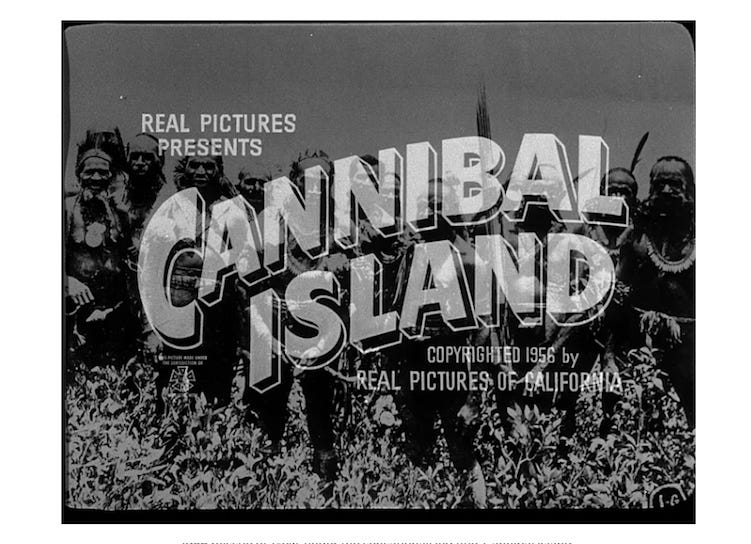
Mind you, before my piece was published, no existing media had detailed the links between King Kong, Cannibal Island, their respective filmmakers, and the Andaman Islands.
Those connections had only been laid out in my work. It’s what motivated me to write my friggin’ essay, because I’d found the answer to a then-85-year-old mystery about the tribal folk of Skull Island.
The research and the writing that went into producing the essay was a typical labor of love. I was glad to share my findings with anyone who’d also find the subject matter to be of interest.
But it depressed me to think that far more had been taken from my efforts than I ever would’ve intended.
Shot through the heart
Two more film clips from Cannibal Island used in The Mission would drive nails into the coffin of whatever doubts I was having about whether or not my work had been used as a reference.
The first featured a shot of an Andaman Islands woman wearing the skull of her deceased husband on a woven cord hung from her neck; the seemingly bizarre act was part of an ancient mourning ritual.
Though it was the same woman whose image was also featured in my piece, the clip didn’t as neatly align with the image of her that I had used, so I’m only mentioning it here.
The other film clip used, though, was an exacting one which more clearly reflects a connection to what I allege was its source material.
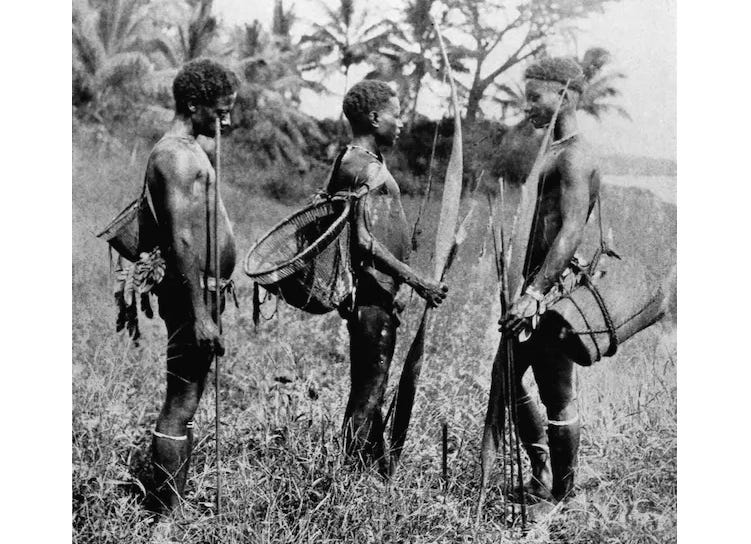
The clip starts with a wide shot of several Andaman Islanders. It then cuts to a shot of three males with baskets slung over their shoulders. The men are shot in profile. A spear is held in the right hand of one of the men while the other two carry bows and arrows.
Although framed by a longer segment, the “money shot,” for lack of a better term, reflects yet another image featured in my essay.
My version, though, came from a photo published in The Sea Gypsy, a book co-authored by Edward Salisbury and Merian Cooper in 1924.
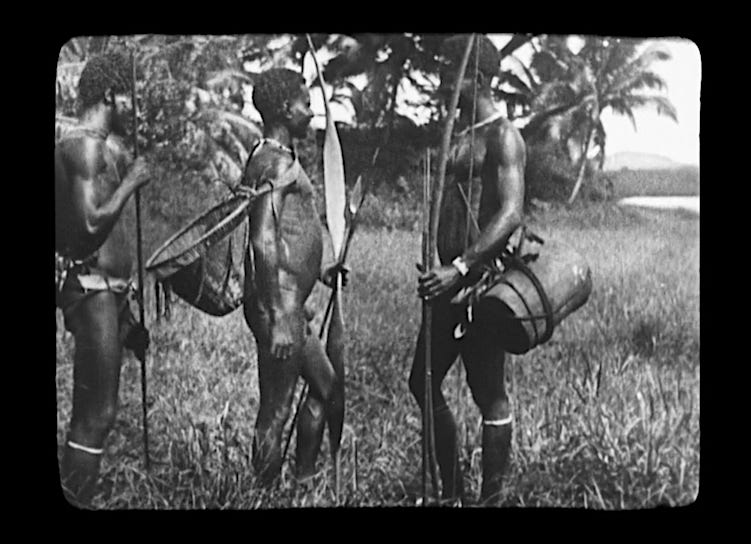
The photo was one of my favorite images chosen for the essay, and it was rather jarring to see a clear echo of my selection also showing up on screen in the doc.
But at least it helped to show that my judgement on visual storytelling was pretty sound.
Mission Accomplished?
Now, no matter how well I may think I’ve laid out my case here for the court of public opinion, proving that my work was heavily used as a reference for The Mission is almost impossible. Fully mindful of this, I’ve asked myself more than a few times, What’s the point?
I still don’t know that I have a clear answer.
Also, I’d be lying if I said that I didn’t feel somewhat flattered that my nerdy work had a small but noticeable impact on the production of a National Geographic documentary.
Nonetheless, I cannot put aside also feeling as though parts of my intellectual labor were just taken and my name was wiped away from it.
Not being credited for what is so clearly the result of my efforts is an awful, awful feeling.
Also awful to me is the thought of possibly accusing the filmmakers of something that could well be the result of coincidence.
Okay, no.
The likelihood of two separate works sharing similarities such as these could in no way have come about by coincidence or accident. One would have to have been a point of reference for the other. And my essay was published on Medium five years ago.
Moreover, when conducting a keyword search in Google using King Kong and Andaman Islands, my essay is the trusted engine’s top ranked search result.
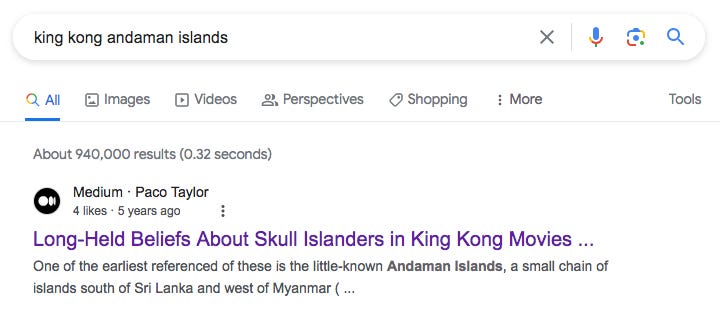
And so, having been split by conflicted feelings about this, it seemed like the best thing I could do — to get on with my creative life —is just state my case in writing as thoughtfully as possible.
I wrote this out to give myself space, so to speak.
Even the space to be wrong.
But regardless of whether I’m right or I’m wrong in this (I’m not wrong), what I decided I wasn’t going to be on the matter is silent.
It’s the proverbial squeaky wheel that gets the grease.
And I want my goddamned grease.
Paco Taylor is a writer from Chicago. He loves old history books, Japanese giant monster movies, hip-hop, comics, Kit Kats, and kung fu flicks.