
Missing Minorities in the Media
Let’s Talk about Underrepresented Minorities
As a Chinese Canadian growing up in the 90’s, my media upbringing was white-washed. Basically the erasure of “other” cultures and adoption of mainstream Western culture was the goal. My favourite daytime TV shows like Saved by The Bell and Boy Meets World featured mainly all-white casts. My first encounters with romance were always between two heterosexual white people like Pretty Woman or How to Lose a Guy in 10 Days. Even anime characters like Pokemon and Inuyasha had Caucasian faces. Surely, the minority representation has improved in the last 20 years? Let’s turn to our biggest influence, Hollywood, to verify.
The Diversity Report Card
In the 7th year of publication, UCLA’s Institute for Research on Labor and Employment (IRLE) publishes an annual Hollywood Diversity Report that examines trends for the top 200 films across global box offices including the extent to which women and minorities are represented both in front of and behind the camera. The report’s highlights conclude that although there have been micro-gains in representation, people of colour and women remain underrepresented for every industry employment front. Here are some other jarring summary statistics from the 2020 report:
- The CEO/chair for the 11 major and mid-major studios were 91% White and 82% male. Senior management teams were 93% White and 80% male and Unit heads were 86% White and 59% male.
- 3 out of 10 lead actors are people of colour (tripling since 2011 when the report was first published from 10.5 to 27.6% in 2019). Actual U.S. minority representation is 40.2%
- In 2019, 67% of all top film roles were filled by Caucasians while Latinx (4.6%), Asian (5%), and Native (0.5%) groups remain underrepresented
- Only 1.5 out of 10 film directors are people of colour, the same goes for women
- Only 1.4 out 10 film writers are people of colour
- People of colour constitute for majority of ticket sales in 2019 for eight of the ten top ranking films
- The least diverse films (less than 11 percent minority casts) reported the lowest median global box office in 2018 and 2019. Median return on investment peaked for films with casts between 31–50% minority in 2019
What does this mean? Darnell Hunt, the report’s co-author asks an important question:
Are we actually seeing systematic change, or is Hollywood just appealing to diverse audiences through casting, but without fundamentally altering the way studios do business behind the camera?
Representation is gradually improving for minorities and women but real power is securely fastened in the laps of Caucasians and males. The bottom line shows that more diversity in casts correlate with higher dollar returns. In other words, diverse audiences want more diversity served on their media platters. Makes sense right?
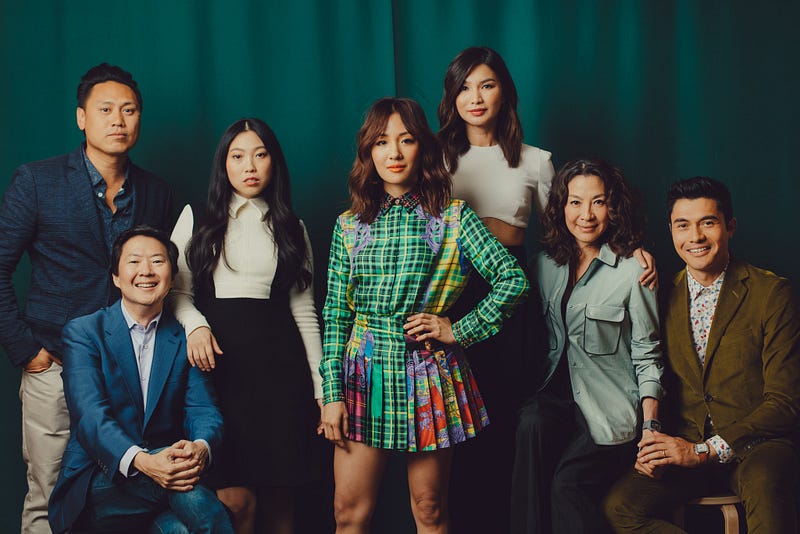
In 2018 (only two years ago!), Crazy Rich Asians and Black Panther made box office headlines for being full minority casts (Asian and Black, respectively). I remember seeing both movies but Crazy Rich Asians was special because of my ethnic background. I took my mom to see the movie with me because we both have a giddy sense of pride seeing Asians project in official establishments like the theatres (in fact, I take her to as many Asian movie screenings as I can because it is such a feel-good moment for the both of us). After the movie on the streetcar ride to our dinner spot, we talked about all the references to Asian culture. It felt like a small victory, one where the world could finally see that we were more than martial arts heroes or the nerdy sidekick with an accent. Most importantly, that we were humans too, capable of complex emotional development, kicking ass at lead roles, and orchestrating cinematic masterpieces. It was a reminder that we all yearn to belong to something bigger than ourselves.
Some Final Thoughts
Growing up in cosmopolitan Toronto, I’ve always felt a bit like a black sheep when it came to matters about my identity. Fitting in has left me internally unbalanced. Here are my thoughts about disrupting what we perceive as normal and creating new spaces for belonging.
- Consistent with the Black Lives Matter movement, being silent does not maintain peace, it perpetuates racism, discrimination, and ignorance. Initiate discussions about representation with friends, families and at work. You will find that you are not alone in your experiences.
- Taking up space is not selfish. When we demand our own space we are also validating our self-worth and acknowledge the value of different cultures. This includes holding organizations and people responsible for misrepresenting, appropriating, and excluding voices from the narrative.
- When we highlight cultures and give them platforms to express their uniqueness and their talents, we do not diminish other cultures. Rather, we enrich the world with new perspectives, ideas, thoughts, and moments that transform humanity collectively.
We are heading in the right direction, but there is a long way to go and much work to be done to level the playing field.