
Minimizing your team’s meeting creep is a constant battle: Here’s how to stay on top of it

Last year, there was a period where I realized that some of my direct reports and their team members were starting to consistently be in more meetings than I was. As happy as I was — and am — that the team is so integrated into and valuable for successful cross-functional project work, it helped me identify that they were becoming the victims of meeting creep.
Some of the team did not even seem to be aware that this was happening to them. Instead of reflecting, some even defended that they like to be in the meeting — without camera on, silently working in the background on other things — in case a relevant topic comes up.
It’s an interesting thought — because we often learn how to say “no” to meetings, but once we’re in a recurring series we find it increasingly hard to say “no more” and extract ourselves from them, or challenge the organizer if the meeting scope changes and we’re no longer needed.
Meeting creep is definitely here to stay, so a regular reflection is needed to make sure it’s not happening to you or your teams. And, no, the onus is not fully on the meeting organizer — even though they play a critical role. It’s the responsibility of all team members to stay on top of their schedules and learn to balance their workload, priorities, and drive impact for the company.
What is meeting creep?
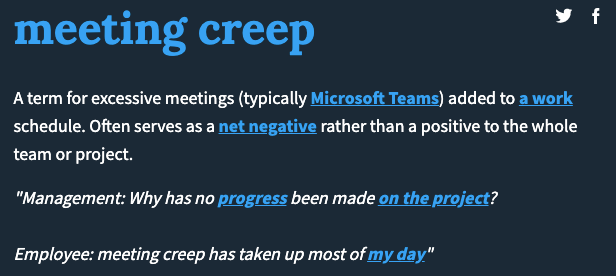
According to Urban Dictionary, meeting creep is,
“a term for excessive meetings (typically Microsoft Teams) added to a work schedule. Often serves as a net negative rather than a positive to the whole team or project.”
If you’re a meeting organizer, your role is pivotal in helping to prevent meeting creep in your company, department or team.
What should meeting organizers do to prevent meeting creep?
Most of the tips below about how organizers can prevent meeting creep are going to be “common sense” type topics. What I find interesting, is that although there seems to be almost universal understanding of what the best practices are when it comes to organizing meetings, still people do not follow what they themselves hope for.
What is important in an organization is that leaders take the best practices for meetings and constantly refresh them with their teams. A meeting guidelines document will do nothing but create frustration if it is not a living document.
What’s needed is an initial commitment from the team, and then it’s on the leaders to remind everyone constantly what was committed to, so that organizers can receive positive peer pressure to plan, run and follow up on meetings in the most appropriate way.
The below tips is not an exhaustive list of ways organizers can have a more efficient and effective meeting. It reviews only how some of the organization topics can help minimize all team members’ meeting creep.
1. Create an agenda and send it out in advance
Share the agenda in advance with all participants, outlining the topics and time allocated to each. The agenda should also include an objective. Not just a series objective, but an objective for this particular meeting in the series.

Having a clear agenda and objective helps participants see if they are really going to be necessary for the session, and help identify cases where they may be able to politely extract themselves.
2. Be selective with participants.
This is the #1 tip for meeting organizers to help minimize meeting creep: ensure that only the necessary individuals attend the meeting. Include those who have a direct stake in the topics being discussed or those who can contribute valuable insights. Avoid inviting people out of courtesy or habit, as their presence may not be essential and can contribute to meeting creep.
Organizers can also assign roles & responsibilities to the meeting invite. So everyone knows why they have been included. This added transparency helps ensure that those a meeting organizer needs will be there, while helps the organizer themselves identify if someone can sit this one out.
3. Implement Timekeeping Techniques
Either the meeting organizer or a designated timekeeper should monitor and enforce time limits. Even if all the participants are necessary for the core content — they aren’t needed if topic discussions go on forever. Or if the meeting gets off track. Minimizing unnecessarily long meetings also helps participants manage their time better and reduce unproductive time in meetings.
4. Embrace async
Not all discussions require a formal meeting. Leverage other communication channels, such as email, chat messages, or collaborative platforms, to address minor updates or gather input asynchronously. By utilizing these channels effectively, you can reserve meetings for more critical or complex discussions, reducing the likelihood of meeting creep.
By implementing these best practices, you can minimize meeting creep and create a more productive and efficient work environment for your team.
5. Conduct a meeting audit
If you’re an organizer with several recurring meetings, task yourself with doing an annual audit. It will take you only about 5–10 minutes once per year, but will likely save the company much more time than that.
When doing an audit, write down your meeting goals, typical agenda, ways of working (ex. do you send out an agenda, pre-read, or minutes afterwards), and who is invited and why.
This may help you as the organizer identify that a couple people in the series aren’t really needed anymore. Perhaps the project changed mid-way through and that different scope required different expertise. Share your audit with the meeting participants and they can ask themselves a similar question, “Am I really needed anymore in this series?”.
What should all team members do to minimize meeting creep?
Your presence in every meeting should provide value to the company. Especially when a recurring meeting series is involved, that is a continuous drain on your resource of time. It needs to provide ROI.
So, evaluate whether your presence in a meeting series is truly necessary. Is your input or expertise required for the topics being discussed on a regular basis?
When the answer to that is no — that means you have a meeting in your calendar that you need to find a way to extract yourself from. Here are some ways you can try to go about that:
1. Review the agenda before the meeting
If the meeting organizer takes the time to send out an agenda beforehand — read it! This may be your proof that your presence is not needed in the meeting and by aligning with the organizer ahead of time, you may be able to excuse yourself, at least from this particular iteration in the series.
2. Take advantage of teachable moments
After one of the meetings in the series where it was really clear that your input and/or expertise was not used, ask the organizer if you can have a couple minutes after the meeting ends. Use the recent meeting as a teachable moment to show them your rationale for why you are no longer needed in this meeting series.

If you do this immediately following the meeting, then they have it fresh in their mind that you were not necessary for that meeting (and hopefully this helps educate them so this situation can be prevented from happening to someone else).
3. Suggest alternatives
If your input isn’t needed on a recurring basis, but is from time-to-time, that’s also not a good enough reason for you to be included on every meeting invite in the series.
Again, talk to the organizer and propose an alternative. For example, it might be possible that they just send you the minutes afterwards so you can stay up-to-date with the project, and they invite you only to some specific meetings in the series.
Alternatively, you can propose to provide your input before or after the meeting via email or MS teams. Or, if the organizer is sending out an accurate agenda, then you can make your own judgement as to whether your input is going to be needed or not for a particular session.
4. Find a replacement
No, this is not just about shifting the meeting creep to some poor, unsuspecting soul in your team. This is about considering if your level of expertise is needed in this project, or if this meeting’s goals could be equally or better achieved by a different member of the team.
Perhaps you are a department head and someone from your team is needed as a spokesperson. That spokesperson does not always need to be the department head, it can also be one of the more junior team members who then learns how to effectively act as a spokesperson, represent and report back. If you set the right conditions for them to succeed, then you might just be offering a good project to help them grow, while saving your expertise for where it’s really needed.
This last one may be the most common situation leaders face — when a project leader is not sure who they should invite from a particular department, so they default to a department head. But a few meetings into the series, it’s clearer for the department head who would be a better candidate to represent the team. Perhaps it’s someone closer to the topic, perhaps it’s the person who will have to execute the project work, etc. But then the leader feels it is difficult to extract themselves from the series without sending a subconscious signal of “your meeting is not important enough for me”.
Above all, the main thing to remember in these three situations is to be a conscientious colleague with the meeting organizer. Don’t just stop attending the series or drop out of the meeting — those approaches can come off as extremely rude. Communicate directly and individually with the organizer, so they understand you want to help them achieve their goals in the most efficient and effective way possible.
Minimizing meeting creep is a never-ending battle. Staying on top of it requires educating your team on best practices and teaching them how to say not just “no” to initial meeting invites, but how to extract themselves from meetings later down the line if and when needed.
It can be difficult to enact change in a large organization, as each company tends to have it’s own unique meeting culture. Nevertheless, best practices tend to be commonly accepted. If you’re noticing this issue in your company, I suggest starting small. Once you have the buy in and social proof from one team or department, the change can start to cascade throughout the entire organization.
The key is really not just to start change, but to maintain it. It will always be a constant battle. And judging by the number of guides and tips for efficient meetings out there, it’s a battle most companies wrestle with at some point in time. So staying on top of it is the key to ensuring meeting creep never gets fully out of hand.