
Mindfulness Made Easy: The Backstory You Need to Know Before Starting
Uncovering the roots of mindfulness. The first step to a successful practice
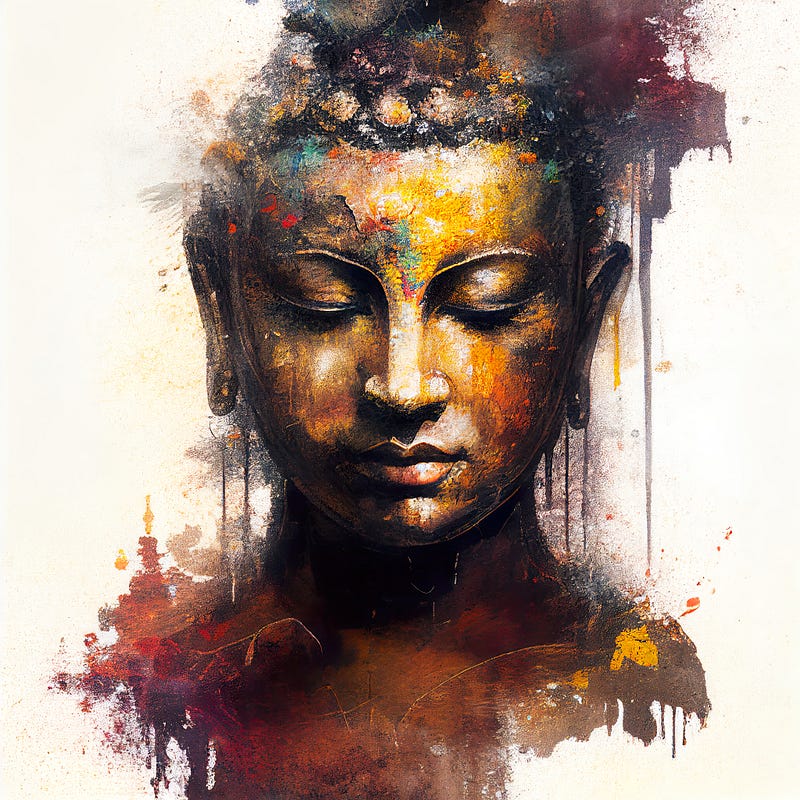
History provides the basis for creating and maintaining a powerful mindfulness practice.
A long time ago, mindfulness was practiced widely throughout Asia.
This was the time of the Buddha.
Some 2,500 years ago. At the time, the Buddha gave mindfulness knowledge in the form of lectures.
Given to householders, like you and me, and monks.
The Buddha was a cross between Eckhart Tolle and Sir Emond Hillary on steroids. He gave lectures while trekking all over India, Pakistan, Afghanistan, and beyond.
The Buddha died from eating rotten pork at the request of a devotee. After this time, mindfulness has continued to flourish through lectures from Buddhist monks and other lay practitioners.
The reason why we know the mindfulness teachings are from the Buddha because his close disciple, Ananda, memorized the Budda’s lectures. These lectures were later written down in what came to be known as the Pali Cannon.
What is the source of mindfulness?
There are 2 discourses by the Buddha that for the basis for modern-day mindfulness. They are:
The latter text is the same as the first sutta but had the 4 Noble Truths added.
The suttas are written in a language called Pali.
The following sources have been used:
- The Buddha’s Four Foundations of Mindfulness by the president of the Buddhist Association of the United States, Bhikkhu Bodhi.
- The Four Foundations of Mindfulness by Sayadaw U Silananda.
- Ṭhānissaro Bhikkhu from the Metta Forest Monastery: The Great Establishing of Mindfulness Discourse Mahā Satipaṭṭhāna Sutta (DN 22) and The Establishing of Mindfulness Discourse Satipaṭṭhāna Sutta (MN 10).
What does Satipaṭṭhāna mean?
Satipaṭṭhāna defines what makes up mindfulness:
- Sati = Mindfulness
- Paṭṭhāna = Foundation
- Upaṭṭhāna = Presence
What are the foundations of mindfulness?
A mindfulness practice consists fo 4 parts.
#1 The Body
Awareness of the breath in the abdomen.
#2 Sensations/Feelings
Sensations are recognized as being:
- Pleasant
- Unpleasant
- Or neither-pleasant-nor-unpleasant (neutral)
Note reference to feelings is not emotions. But they acknowledge the judgment of them being pleasant, painful, or neutral.
#3 The Mind
Awareness of the presence and absence of 8 mental states:
- Lust/without lust
- Aversion/without delusion
- Delusion/without delusion
- Cramped/scattered
- Developed/underdeveloped
- Surpassable/unsurpassable
- Concentrated/unconcentrated
- Bound/freed
#4 Buddhist Teachings
The Buddha’s mindfulness teachings are:
- 5 aggregates — They are desire, ill will, dullness, drowsiness, restlessness, worry, and doubt.) Be aware of the negative influence they have on your spiritual journey.
- 6 pairs of sense bases — They are the 5 senses plus the mind. Refers to the physical senses (ear, eye, nose, tongue, skin, and mind) and the qualities (sound, sight, smell, taste, touch, and desire/thought.) Be mindful of the destructive sense of stimuli that may entangle you in worldly life.
- 7 factors of enlightenment — Those being mindfulness, investigation of phenomena, energy, rapture, tranquility, concentration, and equanimity. These qualities assist in bringing about enlightenment. These qualities unfold in the sequence as listed.
- 4 noble truths — They are the truths of suffering, its origin, its cessation, and the path. They contain the essence of the Buddha’s teachings.
The 5 aggregates and 6 pairs of sense bases focus on the nature of your feelings and the internal process of external stimuli. Contemplation is required on how these affect your spiritual journey.
As this process of reflection and learning develops, you proceed to cultivate the 7 factors of enlightenment.
“The Four Establishments of Mindfulness are the foundation of our dwelling place. Without them, our house is abandoned; no one is sweeping, dusting, or tidying up. Our body becomes unkempt, or feelings full of suffering, and our mind a heap of afflictions. When we are truly home, our body, mind, and feelings will be a refuge for ourselves and others.”
Although Mindfulness has its roots in Buddhism, you don’t have to be a Buddhist to practice mindfulness. As Deepak Chopra so eloquently puts it:
“Christ wasn’t a Christian and Buddha wasn’t a Buddhist and Muhammad weren’t Muslim. These people were having the experience of unity consciousnesses and universal consciousness and they spoke of it in words.”
The knowledge from Buddha on Mindfulness provides you with a basis to practice. Various practitioners have gone on to expand and adapt the teachings of modern times.
Here’s how it works:
- Focus attention on the now (Eckhart Tolle) — Be intensely conscious of the here and now, the present moment. Identify the gap in your thought stream by directing your attention to the now.
- Observing thoughts (Dr. Jon Kabat-Zinn) — Attend to the stream of thoughts through observation of your thoughts. Allow your thoughts to arise and pass on their own, without intervention.
- Noting/Labelling (Mahasi Sayadaw) — Label all mental and physical movements. Whether it be sitting, lying, standing, or walking. When breathing, you mentally say when the belly is expanding “rising rising” and when the exhaling and the belly deflates “falling, falling”.
- Beware of the breath (Ajahn Chah) — Observe your inhalation and exhalation. Don’t change your breath. Allow your breath to find its rhythm. Maintain your resolve to stay aware of the breath, with no other agenda.
“Realize deeply that the present moment is all you have. Make the NOW the primary focus of your life.”
— Eckhart Tolle
The modern lifestyle doesn’t encourage you to be mindful of social media, violent movies, and disruptive technologies.
You can decide to take ownership and responsibility for your physical and mental condition if you wish to be content and happy.
The time to be Mindful is now, as tomorrow will never come.
Join my email list of +1,000 people to receive your FREE Zen Checklist