
Mind Your Models: Relating Mind and Consciousness to the Physical World
How we think about mind and consciousness has long been tied to our models of the physical world, and very often cutting-edge science and technology. That is, we model our ideas about mind based on our models of the material world, and, as I pointed out in my recent article on the dangers of using quantum mechanics to support spirituality, one has to be very careful in how you go about it.
In this article, I take an eclectic and casual look at how the modeling process has changed over the last century or so. It’s hardly exhaustive — more like a highlight reel than a history.
Believe it or not, in the 19th century the science of geology was hot. Geologists had been working on the strata of the Earth and were determining the age of the planet, leading to a scientific revision that posited a much longer history than the Biblical account of creation. Darwin then took the geological timeline and used it in support of the theory of evolution. Geology was a big deal.
Sigmund Freud’s psychoanalytic theory is closely related to the geological model. There are different strata in the psyche, from the conscious ego down to the unconscious id. And just as dinosaur bones and our forgotten ancestors are discovered in the fossil record, so long-forgotten memories can be recovered from the unconscious, to be put on museum display in the analyst’s office.
Although Freud’s ideas remain popular in the public imagination, psychology was soon gripped by other models on loan from science and technology. With the advent of the telephone, the brain/mind became like a central switchboard, with neurons acting the part of connecting wires. Exactly who would be the ‘operator’ was an open question.
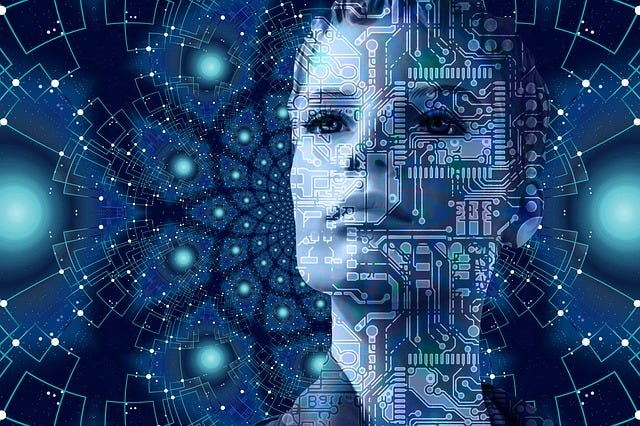
The reader will probably anticipate that after a few further revisions, the brain/mind became like a computer, a more sophisticated and faster version of the telephone switchboard model (and one which did not require an operator). The lightning fast computations of the printed circuit were analogous to the transmission of electrical signals across the synapses between neurons. This model allowed for vastly more complex patterns of connection, and ‘brain as computer’ remains a popular idea — as is its inverse, artificial intelligence, or ‘computer as brain’.
More recently, the internet has provided an even more complex, nodal model for the brain. Terrence McKenna speculated that the internet might even be conscious — although that was back in 1998 and thus far we haven’t heard much from it.
All of the above models assumed a generally materialistic viewpoint wherein mind emerged from matter. Yet as alternative models of mind and consciousness emerged, they also tended towards using science and technology as models.
In the 1960s, one alternative model was that of the television — which we have to remember was still a relatively new phenomenon at the time. The idea was that the brain is not the producer of mind or consciousness, but the receiver of it. Just as programs don’t originate within a television set, mind does not originate from the brain. That of course suggests the question of where mind does originate. Many explanations are possible, from a personal soul or spirit apart from matter to consciousness and/or mind as a field — like electromagnetism or gravity.
Because it is in concert with the field theories of quantum physics, the model of consciousness as a field remains quite prominent. In its various forms, the field can be described as pristine awareness (“I am”), but can also include content like ideas, tendencies and habits, memories, and even personalities. In fact, there are so many interesting variations that a separate article, if not a book, is required.
Another relatively recent model is the hologram. Holograms encode all the information of the whole in each part, so that if you cut a holographic image in half, you still have the entire image. Holographic models have been used to explain the workings of the brain (rather unsatisfactorily, in my opinion) but also mind and consciousness. For example, a holographically encoded Cosmos could be used to explain psychic phenomena, because information about other places and times are available anywhere and at any moment — provided you know how to read out from the hologram.
Each of these models has some utility, and perhaps validity. I’m inclined to think of them as useful without necessarily considering them to be ‘true’, although some (like fields) might be close enough to have operational value.
That’s a big stumbling block for most theories of mind that are modeled on material processes — while the theories work in the physical world well enough to make technological advances, their correlates in the world of mind and consciousness are often stuck at the stage of being interesting ideas.
Yet we live in the physical world, and it does seem to offer itself as an example. We’ve always used it, going back at least to the Katha Upanishad, where a chariot is the technology used to model the condition of the soul, mind, and senses.
Like a cat chasing its tail, there’s always a bit of circularity in these models…
If we use the physical world as we discover it (geological strata, for example), we have to admit that our scientific understanding of the natural world is still conditioned by the nature of our minds. The explanation can be verifiable and useful, but there’s no guarantee or even likelihood that it’s the only way to see things: thus we project our mind onto matter, then use the material to model the mind.
When we use human-created technologies like computers or the internet as the basis for our model, then we are obviously using an externalized version of our minds. Yes, the internet is a model for at least some aspects of our minds — how could it possibly be otherwise, given that our minds created it?
Models of mind, brain, and consciousness are interesting, and often useful. Considering that the brain is like a television, a receiver rather than a generator of mind, is useful in that it helps to pry us away from a strictly materialistic conception of mind arising from matter. Likewise with seeing consciousness and/or mind as field(s) rather than localized ‘in our heads’.
But even the best models should be treated provisionally. The fact that we haven’t settled on a single model and that we keep generating new ones should remind us that it’s wildly difficult for mind and consciousness to become their own objects.
Perhaps the best approach is to follow the wisdom traditions: meditate and experience, rather than trying to intellectually understand. Otherwise, we’re looking at the finger that points to the moon, rather than the moon.
Which is another good model.
Here’s an interesting discussion between my dissertation advisor, Allan Leslie Combs, and Deepak Chopra…


