
Mind-Blowing Life Lessons Cleopatra Taught Us Unknowingly
A Convincingly Manipulative Lady Who Ruled An empire and the hearts of the two most powerful men of her time.


Cleopatra was born in 70 or 69 B.C to Ptolemy XII, the descendant of Ptolemy I Soter, who was Alexander The Great’s general and the founder of the Ptolemaic reign of Egypt. Her mother was rumored to be the King’s half-sister as well as his wife. As strange as Cleopatra’s early life is, it cannot hold a candle that would surpass the next.
In 51 B.C., upon the natural demise of their father, Ptolemy XII, the Egyptian throne passed to 18-year-old Cleopatra and her 10-year-old brother, Ptolemy XIII. Throughout Egyptian history, it was a practice for siblings to tie nuptial knots and rule side by side, however, the case of Cleopatra would stand out as an anomaly.
Becoming the Sole Ruler of Egypt
Soon after being declared co-rulers, Ptolemy XIII and his advisors tried to remove Cleopatra from the equation, leading her to flee to Syria in 49 B.C. But not one to give up, she raised an army of mercenaries and returned the next year to face her brother’s army at Pelusium.
This civil war was happening parallel to another civil dispute in Rome. Gnaeus Pompeius Magnus was a Roman politician and general who was at war with Julius Caesar.
His advisors urged him to seek refuge in Egypt, which was only three days’ sail away, and whose new king, Ptolemy XIII, was indebted by the companionship and the help Pompey had given to his father, Ptolemy XII. However Ptolemy XIII’s companions feared that using Egypt as his base would put the Egyptian empire at war with Caesar, so on his arrival, Pompey was ambushed and killed.
When Caesar arrived in Egypt a few days after, he was appalled. He turned away from the man who presented to him Pompey’s head and Pompey’s seal ring was given to him, he cried. Caesar in his grief called both siblings to him, asking them to disband their forces and reconcile.
However, Ptolemy XIII paid no heed to his words and arrived heading his army. Cleopatra was smart; she had heard that Caesar tended to involve himself in affairs with royal women, so she arrived at the palace unarmed, ready to talk in person with him.
When her brother heard of this, he tried to rouse the crowd to riot but his efforts were useless as Caesar easily calmed the frenzied crowd and declared that the siblings from here on then rule side by side.
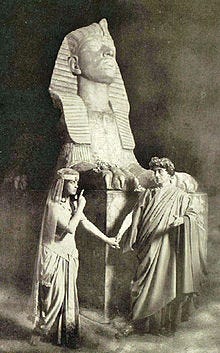
Ptolemy XIII remained unsatisfied, and decided instead to attack Caesar and his troops, sieging him and Cleopatra in the Palace for about a year. Eventually, Caesar’s reinforcements arrived and Ptolemy XIII in an attempt to flee from them drowned in the Nile. The aftermath of this war saw Cleopatra’s absence as most probably she had been pregnant with Caesar’s kid, who would be known as Caesarion (Little Caesar).
Cleopatra’s intellect and charm had secured her the title of the sole ruler of Egypt, and the trust and help of the world’s most powerful emperor.
Reinforcing Her Powers
Cleopatra was on a visit trip with her son Caesarion when Julius Caesar was murdered in March 44 B.C. She was forced to go back to Egypt and having lost her main support system, she had to make moves to secure her position.
She is believed to have killed her younger brother Ptolemy XIV so she could replace him with her son Caesarion as her co-regent, who was then called Ptolemy XV.
Moreover, Cleopatra had by the time strongly identified herself with the goddess Isis, the sister-wife of Osiris and mother of Horus. This was consistent with the ancient Egyptian tradition of associating royalty with spirituality to secure the position of kings and queens.
Being well-learned and smart, she was fluent in a dozen languages and was renowned for her “irresistible charm”.
Mark Antony
Since her co-regent Caesarion was only an infant, Cleopatra was stronger than ever. However, following the murder of Caesar, she needed to build an alliance with one of the factions fighting for Rome’s throne. She chose to side with Mark Antony and Octavian, who had been allies of Caesar, and with her support, they won and chose to rule together.
Mark Antony soon invited Cleopatra to the Sicilian city of Tarsus. She sailed in an elaborate ship, dressed in the robes of Isis. Antony, who associated himself with the Greek God Dionysus, fell in love at first sight.
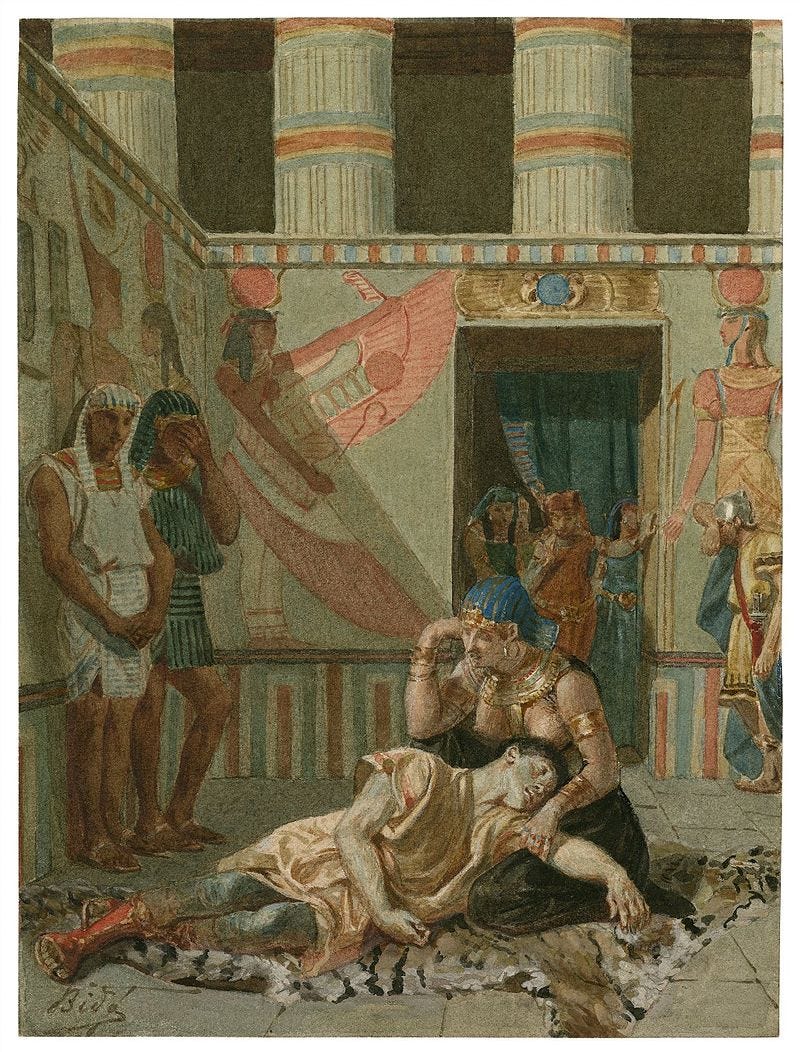

He vowed to protect Egypt and Cleopatra’s crown and when she returned to Egypt he shortly followed her. Cleopatra would later give birth to their twins, Alexander Helios (sun) and Cleopatra Selene (moon).
Cleopatra’s diplomacy and charm allowed Egypt to prosper under her rule, and though her romance with Antony would come to a tragic end, her legacy will never be forgotten.
Takeaways From Queen of Nile
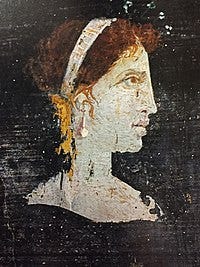
My aim in the writing this piece was never to flaunt Cleopatra’s strengths. In fact, I merely wanted to highlight how she utilized her weaknesses as a power in her favor. Even though Cleopatra and I live in different times, her actions and whole life is a good reminder of the following
1 — Power can be dangerous:
Cleo had to ascend the throne when she was only 18. Running a wealthy empire came at a lot of expense. She indeed was bewitching but not every time. It is believed that she had a role to play in the death of her three siblings. All the power is not always glam and one needs to sacrifice
2 — Holding onto Demeanour is crucial:
There is a major conflict if Cleopatra settled well in the beauty standards of Egypt. Nonetheless, whether she had it or not, she equipped herself with elongated clothing and ornaments to create an aura of her own. This signifies how crucial it is to carry oneself well.
3__ Owning one’s Identity:
In the era in which she ruled, women were seen as beautiful objects only. She not only defied the conventional stereotypes but controlled major parts of the land dominated by men. Her actions declared that gender can never restrict a capability in any human!
4 — Focussed on Responsibilities
She had a strong acknowledgment of her worth which led her to believe that she deserves nothing but the best. Despite Roman propaganda focused to defame her as a horrible woman, she pursued Julius Ceasar. She knew very well how important it was to form a strategic alliance with him to save her people.
5 — Living in the Time
Her ability to make quirky decisions seems indeed very planned. Regardless of them, she proved herself to be a great stateswoman by executing them just at the right time. Her rule teaches us to network with people who can motivate us for our own motives on the basis of mutual benefits.
I am a fan of 5 of her traits and would love to know if you could know some other ones!
Want to follow up more from me and other amazing writers on Medium?
Hop on the chance to join: