
Millennials Just Became the Poorest Generation in History
Why, as a Gen Z kid, this terrifies me.

Born anywhere between 1981–1996, Millennials are the generation squeezed between Gen X and Gen Z. If you’re anywhere between 25 and 40 years old this probably concerns you.
According to the most recent data from the Federal Reserve, Millennials currently own around 5.1% of all the wealth in America. Since 2016, Millennials have been the largest generation in the workforce. They currently make up approximately 35% of the entire working population.
Unfortunately, this may actually just be the result of far more worrisome trends in the job market and education system.
The easy explanation for this would be to say that Millennials are still too early on in their careers and haven’t had enough time for their investments to grow. They haven’t hit their peak earning years and have not been invested in the market enough for compound interest to really take place. This is all true but back in 1989 when the Baby Boomers were around the same age as millennials are today, they were responsible for 21% of all US wealth at the time. Now there may be some differences, but that is over four times as much wealth as Millennials own currently. So what happened in the last 30 years?
“After all, Millennials are just lazy and eat too much avocado toast.”
— Baby Boomers (Probably)
Now before anyone takes any offense, let’s take a deeper look into the unfortunate situation that Millennials find themselves in.
The Plight of Millennials
Millennials may just be a victim of circumstance
A large number of millennials experienced the great recession during the very beginning of their careers. Getting a job is hard enough during a recession and many that start their careers during one are forced to make do with much lower salaries. Pay cuts and layoffs are seen commonly and happen very quickly during recessions but pay raises or promotions happen very slowly during economic booms.
According to the National Bureau of Economic Research, starting a career during a recession leads to, on average, a 9% decrease in annual earnings that doesn’t disappear for almost ten years. If that wasn’t bad enough, 70% of an individual’s wage growth also occurs during the first ten years of their career. In reality, the cost of a lower salary compounds with an individual much further into their career.
Education is too damn expensive
Millennials have faced another problem years before they even start their first job. A common prerequisite for that first job has been some sort of educational degree. According to a study conducted by the College Board, the cost of education has increased over 200% in the past 30 years. For the past few decades, the price of getting a degree has increased far more than any reasonable comparisons.
In many cases, the price of education is too high and most are left with no choice but to take out student loans. Millennials that graduate with student loans owe more than $30,000 on average. Even though salaries may have increased slightly over the last 10 years, it can’t even begin to match the explosive growth in student debt. It’s not just the price of education. Millennials own less homes than any other generation before them compared at the same age.
Once again, Millennials are getting the short end of the stick here. An education has been hailed as the safest and effective way in finding a successful career and providing for ourselves. I also used to believe this as my parents have drilled worshiping education into me since birth.
Despite how my parents raised me, education simply isn’t valued the same as it was in past generations. In 1980, only around 20% of people in America had a college degree whereas today, almost 40% of the US population holds at least a bachelor’s degree. Looking back during our parents generation, education was not only considerably cheaper but also far more uncommon than it is today.
Having a college degree thirty years ago easily enabled anyone to demand a higher salary but the sad reality today is that the labor market is much more saturated with graduates that are more educated than ever. What worked for past generations simply doesn’t work anymore and future generations will have to figure out a different path to success.
All of these factors have given employers the power to pay Millennials less even while they are doing the same exact work as previous generations. The benefits of having a college education have shrunk immensely in the eyes of recruiters. A four year bachelor’s degree is now a dime a dozen and no longer has the power to command higher salaries. More people are entering the workforce while also being more educated than ever. Many companies are able to be pickier with who they recruit and also pay less for that position since the labor pool has increased so much.
I’m not a Millennial but this terrifies me
I’m scared. As bad as it may have been for the Millennials, I can’t imagine it being any easier for my generation(Gen Z). After just graduating and experiencing first hand how difficult it can be to secure a job, the world has been turned upside down with the worst pandemic of the 21st century. The story unraveling for Gen Z looks all too familiar to the one before us.
The price of education is not stabilizing anytime soon. Tuition at many private universities today across America can cost more than $50,000 each year. The bachelor’s degree will soon no longer be seen as a positive on your resume but simply another line to be expected. Many of my peers have balked at their post graduate job prospects. They choose to delay their graduation instead by pursuing higher education in hopes of better opportunities and sinking even more funds into the education machine.
Unfortunately, Gen Z has also been given their Great Recession in the form of the Coronavirus pandemic. Due to the nature of the pandemic many small businesses have shut down and job openings in many larger companies seem nonexistent. Many new graduates are accepting much lower pay in their first jobs and are grateful to just be employed during these crazy times.
I’m not saying we shouldn’t be grateful, but it feels all too familiar to the wealth gap Millennials are faced with today.
Changing the narrative for Gen Z
I enrolled in a private four year institution and regret spending so much money on my college degree. For most people, less expensive options such as public or community colleges and trade schools would be a much better investment than burning money on a degree from a private school. Let me tell you now and save you a few hundred grand, the prestige you receive from a private school degree is not worth it.
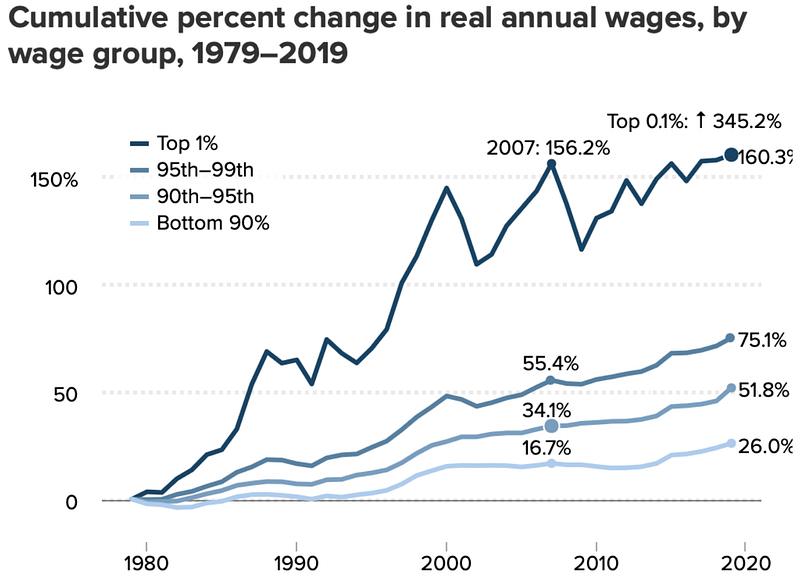
Another interesting point is that although, on average, we’ve seen wage stagnation during the last decade, the story is completely different in some industries. In fact, according to social security data, the salaries for the top 1% of earners increased over 160% over the last 30 years whereas the bottom 90% of earners only saw about a 26% increase. The majority of these top earners emerge in industries where highly specialized individuals are in demand. Unsurprisingly, these industries include technology, healthcare, and finance so if you’re undecided about a career path then these might be better options to choose for a better salary
One of the easiest ways to increase your salary by more than 50% is to switch companies regularly especially early on in your career. This doesn’t mean to jump ship every few months. Moving around companies every few years allows you to consistently receive pay raises far more easily than rising up in one company. In my experience, peers that I have seen move around companies in their first few years always tend to demand higher compensation as they are distinguished to be in demand and best performers which employers tend to value highly.
On the other hand, if you stay with the same company your loyalty will only be rewarded incrementally. In most cases your salary will only increase as a percentage of your initial base salary. This basically caps your potential to earn at a much lower ceiling. Many times, people will feel too comfortable in their roles and stop growing as much. Instead, moving to a new company can provide the opportunity at starting out with a much higher base salary and better projects.
So even though we all might be victims of circumstance, it doesn’t mean you can’t do anything about it. We all have the ability to build our own future and take a proactive approach to make the most of our situations.
The Mini Post-Grad Survival Guide
A 5-day email course with tips on budgeting, investing, and productivity for 20-somethings. Sign up for free.


