
Millennials and Zoomers: Why We Laugh at Dumb Stuff
America’s generation Z is often characterized by a birth into a post-9/11 world, raised by newly developed technologies and the internet, as well as a multitude of nationwide crises and other social movements that have risen to prominence in the past two decades. With the rise of the widespread use of smartphones and social media, communication and humor has evolved in a particular way that has never been seen before.
Beginning with the first recognizable social media site created in 1997, Six Degrees was a simple website, allowing its users to connect with friends, family, and acquaintances as well as send messages to one another. Although its functions were simple, it eventually paved the way for future social media sites as the most basic form of online social networking. The creation and popularization of MySpace in the mid-2000’s greatly contributed to the boom of social networking, being ground zero for the invention of blogging. With each user having power over their own blog to share thoughtful posts, cool videos, or even just simple surveys, it popularized the usage of online bulletin boards, which would eventually come to inspire Facebook timelines.
The rise of blogging itself from MySpace was revolutionary, prompting many of its users to share inane stories and thoughts online for any stranger to see, encouraging individuals to connect with anybody willing to hear their innermost thoughts and feelings, and giving rise to the culture of oversharing intimate details to strangers online. This trend carried onto Facebook as it eventually dethroned MySpace as the most used social media platform in the late 2000’s, with Instagram and Twitter coming in close behind it.
As years went on, the movement of sharing progressively more intimate information about ourselves has become an integral part of many people’s lives in the United States, specifically with individuals from more recent generations. These individuals, typically born into the Millennial generation or Generation Z, seem to have become well accustomed to expressing much of what is on their mind — so much so that the generations born prior to them may feel uncomfortable with the amount and content of information that is shared.
While those previous generations have valid concerns about strangers hearing intimate details about one’s life, that is not to say that there has not been any good to come out of it. With the power of simply being one in billions behind a computer or phone screen, there is a certain feeling of safety that comes with the ability to remain anonymous until we choose to reveal the information we want others to see.
What specifically makes older generations so uncomfortable with the content that younger generations now share is that many of these common, casual conversations they have touch upon topics that they were predominantly raised to otherwise believe are taboo, shameful, or not desired by society, resulting in them rarely addressing these issues. However, with free, unbridled access to such a vast network of resources to share thoughts that they might be otherwise afraid of bringing up in person, users of the internet have brought up these topics that were previously perceived to be uncomfortable to create a debate within a community of like minded individuals, assuring many that there are always others who have felt and thought the same as them. Specifically, while discussion about gender, homosexuality, and mental health have been deemed to be topics that should be swept under the rug in the past, they are topics that are now widely accepted or commonly addressed in conversation by American society. The rise of usage and popularity of social media by Millennials paved a way for future generations to create a conversation about the world around them.
The growing discussion about mental health over the past few decades comes from a multitude of reasons — especially with the help of forums and blogs to discuss individual experiences — but seems to have originated and boomed ever since reports and research have come out detailing the rising rates of mental health disorders among Millenials. In the American Psychology Association’s (APA) 2019 survey, “Stress in America,” it is detailed that 56% of Millennials state good mental health — a sharp drop compared to 70% of Boomers reporting good mental health. Additional surveys show that many in this generation feel this way as an effect of workplace burnout and financial strain, both factors that have come to be prevalent since the 2008 Great Recession, as well as feelings of loneliness and need for perfectionism resulting from the rising popularity of social media adding to the fold.
With the help of social media sites and younger celebrities speaking about their struggles with their depression, anxiety, and substance abuse, Millennials have been encouraged to be the first generation to seek mental health treatment actively, creating a more active discussion about mental health disorders and normalization of seeking treatment for themselves. (need something to bridge this) However, talks of mental health have also spawned an unlikely, new brand of humor that baffles many older individuals. Plagued by financial insecurity and consequences of Boomer excess, Millennials have developed a brand of fatalistic humor as a way to cope with their incomprehensible, bleak existence. Dark and surreal jokes embracing their shared, widespread feeling of dread and failure became a commonplace of their generation.
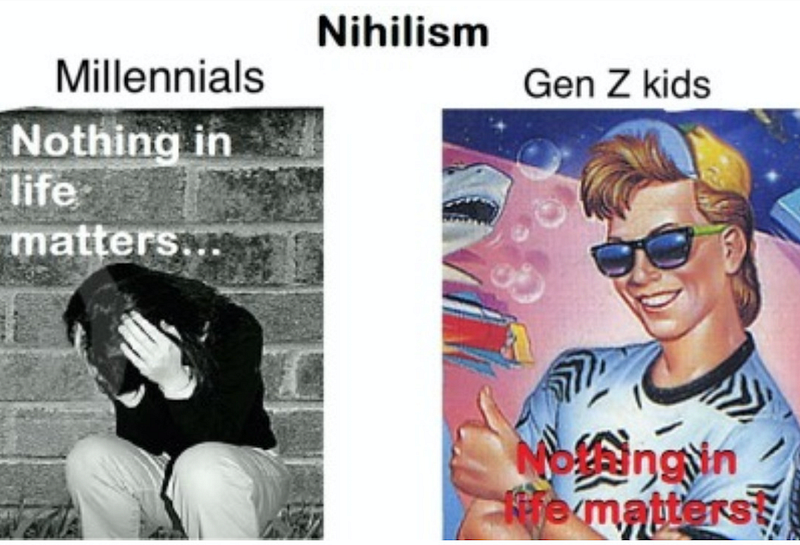
The following generation, Gen Z, seemed to adopt the same nihilistic, absurdist humor of Millenials by making light of the current state of nationwide and world affairs, and apply it to the rapidly growing online culture that they have grown accustomed to since birth. This generation has been described as “native creatures to digital communication tools,” for the fact that many of them do not know a period of life without the internet. Their exposure to a vast network of information being readily available to them at a young age, allowing for their thirst for knowledge to be easily quenched and promotes the growth of communication with millions of other online strangers and exposing them to countless other experiences, opinions, and resources that were otherwise unavailable to previous generations so easily. Such access to so many resources may have resulted and motivated Gen Z to be the most educated generation yet, far surpassing previous generations’ statistics on percentage educated, especially in the United States.
With social media feeds and timelines highlighting ads and news of hot topics, it is nearly impossible to avoid hearing about any form of breaking news one way or another — let be cultural and social movements, scientific breakthroughs, politics, or even simply celebrity gossip. The prominence of the amount of information that is exposed to the average user online is reflected in the amount of Millennial and Gen Z that take part in actively advocating for change with a “liberal set of attitudes and an openness to emerging social trends,” as stated by a report by Pew Research Trends. With exposure to the world’s countless tragedies and horrors of inequality, violence, and corruption — particularly by their own government and on their own people — being often shared and widespread connectivity between strangers with shared passions online, there is no surprise that Gen Z’s urge to share information and educate others on current social and political issues comes from a feeling of outrage and helplessness with the current state of their world that has been shaped the generations prior to them.
While the 2008 economic crisis primarily paved many Millennials’ attitudes and lifestyles, Gen Z grew up facing the horrors of mass shootings, the looming doom of climate change, the stress of separation and deportation of immigrant families, and rise of sexual harassment reports among other things, it is no doubt that this generation shares much of the Millenials’ sentiments and outlooks on the current state of worldly affairs. However, while Millennials grew to adapt to their struggles (as they have primarily occurred well into their teenage and adulthood), Gen Z has been observed to have grown up with the issues that have defined their generations, causing them to grow numb from the shock of grisly events.
To put it into perspective, the Columbine shooting that occurred in 1999 shook the nation to its core, becoming to be known as the deadliest shooting in US history at the time and resulting in a number of security measures being implemented at many public schools and calls for stricter measures for gun control. It left behind a legacy of fear, a new era of school shootings coverage, and a number of copycat incidents inspired by the massacre. Following the incident, there were few shootings throughout the 2000’s copying the Columbine shooter, with numbers and reports of shootings throughout the United States rising every year since the 2010’s. Growing up, I became accustomed to hearing about shootings so often that it just seemed to be another weekly occurrence I became numb to the shock of the news, and there is no doubt that others in my generation feel the same way. School shootings are only the tip of the iceberg for events and movements that previous generations had to adapt to, while Gen Z were forced to grow up with them as the norm.
The constant exposure to stressful experiences throughout Gen Z’s lives reflected in their humor as well, latching onto the similar style of humor that Millennials have created, and shaping it to have its own style as well. They also relish in dark, self deprecating humor as well, making light of the suffering and hardships they know they will inevitably experience throughout their life in an attempt to make their experience slightly more bearable and bringing comfort to one another with their shared experiences. Increased exposure to more news also gave way to more content for the generation to process and cope with, giving way to an increased diversity of memes on the internet.
An observation by Limor Shifman in her book “Memes in Digital Culture” states that “meme genres play an important role in the construction of group identity and social boundaries.” Expanding upon the topic of more diversity found in memes floating in the internet, group identity and beliefs seem to play a large role in the type of meme created and redistributed by its consumers. With the reach of the internet extending to every nook and cranny of any topic that might come to mind for anybody, there’s no surprise that there is an available community for nearly niche interest ever, as well a subdivision for memes that undoubtedly comes with it. No matter how niche or serious of a topic, Gen Z is the exact type of generation to make light of nearly anything that comes their way. This creates an interesting discussion about the virtually universal take of humor on anything being available appealable to at least one type of audience that shares a similar view with the individual that creates the meme in the first place — allowing an easily widespread feeling of validation and belonging for anybody, no matter how terribly received it may be for others. The growth of Gen Z on the internet has definitely produced a culture of inclusivity, no matter where one might go.
On the topic of inclusivity and memes, the cultivation of nearly incomprehensible memes that take a form akin to hieroglyphics or simply a jumble of distorted sounds that have only appealed to a small number of users before have grown to be a popular take on modern comedy and result of Gen Z’s evolving humor from its predecessors. Brushing aside the why and how of memes and diving into the what, the bizarre cult of “dank memes” have derived from previous models of comedy that have rocked the internet since the popularity of social media sites. To define the term, “dank memes” refers to a joke or reference that has been so played out to exhaust its comedic value to the point where it regains hilarity in irony.
A meme referred to as Loss is a good example of a meme that has been repeatedly driven to the ground to the point where it has risen up to become the most unlikely of references one might expect in a simple set of lines. Originating from a comic called “Ctrl+Alt+Del” that has been known to embody hallmark, cringy stereotypes of video gamers in the past decade, a four panel comic strip was released in 2008 depicting the main character of the comic rushing to a hospital, only to discover his girlfriend had suffered from a miscarriage.
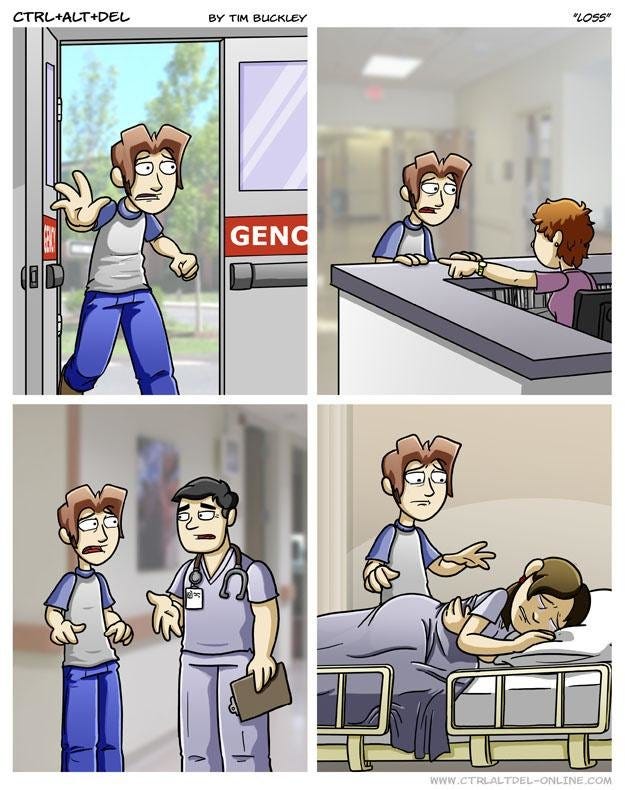
While the subject of miscarriage is not something that is taken lightly, the drastic, dark turn of the normally lighthearted comic was prone to ridicule and mockery from both its fans and other comic and game communities for its poorly executed attempt at creating drama within “Ctrl+Alt+Del.” Following the creation and backlash of Loss for the author’s failure to understand the audience and subject matter, Loss was further memed after its author’s infamous, pretentious defense for the strip, which further fueled the ordeal to be parodied and mocked. Following a deeper look into the popularity of Loss, modern, Gen Z meme culture on the internet enjoys breaking down memes to its barest essence — as for the reason why, one can only wonder whether it is due to the new wave of minimalism that has been making its rounds in this generation’s aesthetics, to further baffle historians in the future who will examine the purpose of memes, or for some other unknown reason. Nonetheless, the internet managed to break down the comic strip to its bare bones of the following, depicting the vague position of characters either standing up or laying down by this: | || || |_. The breakdown of the meme only prompted a new wave of parodies to the original script, ramping up to the point where many people took it upon themselves to find and share the most subtle references to Loss in their daily and online lives as possible, in attempt to ruin someone else’s day over the unexpected ambush of the terrible meme.


A further look into the minimalist style of memes can be found in the recent trend of playing the first few notes of songs, such as “Welcome to the Black Parade” by My Chemical Romance or “Replay” by Iyaz, to watch a mix of horror, nostalgia, and smiles appear on the faces of the generations who grew up with those songs, reflecting the idea that a large part of modern memes are created and distributed with the goal to evoke an emotional response from its consumers.
This can also be seen in a variety of other recent trends as well, with the shortening of certain jokes to the point where they become near incomprehensible. In the following Tiktok, a user called Ryan Beard observes the evolution of humor throughout different generations:


