
Military Strategy for Business
The art of survival and success in compelling environments
A few years ago, we went to Greece as a team of speakers to attend the Internal Audit Congress organized by IIA Greece in Thessaloniki. I gave a speech at the congress on information security auditing. At the end of the congress, our Greek colleagues presented us with some gifts as a sign of our good relations. My gift was a lovely statue of the goddess Athena. For me, as an army veteran, it was much more than a simple sculpture, it was the sign of a strong idea. I will explain my reason in the following.
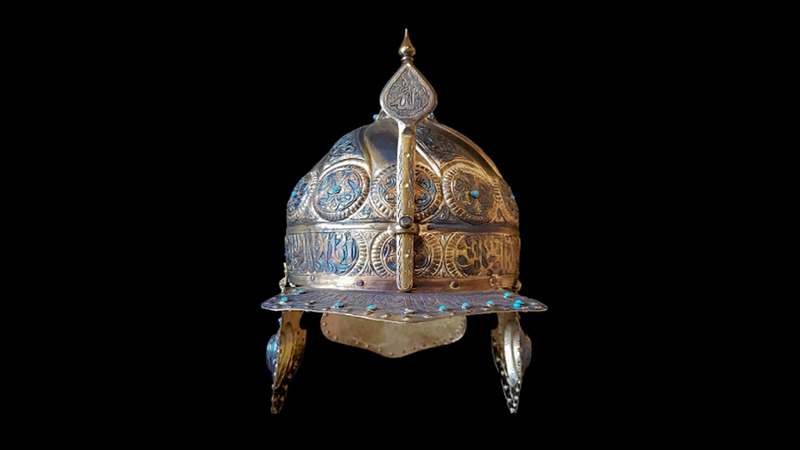
The picture above belongs to a 16th-century helmet. I understand that it was used by the Turkish dynasties, from the sun visor and the delicacy in the application of the tombak technique (gilt copper metalwork). Every time I visit the Istanbul Harbiye Military Museum, I cannot stop myself examining the medieval Turkish helmets for minutes. They reflect the culture, understanding, and technology of their time very well.
These helmets were produced to protect the head of the khan, who thinks, analyzes, decides, as the army commander, trying to prevail by using the military power on the battlefield in a superior way to the enemy.
Before I used to be a professional soldier, an army officer, and I held various positions in the Army. Currently, I work at cybersecurity services in SabanciDx. That’s why I have the knowledge and experience that can go much further than citing books on war and strategy concepts.
My main point in writing this article is to give an answer to the question: “Can Military Strategies Help in the Disruptive World of Business?”. This question expresses the subject I intend to tackle very well. I believe that the principles of military strategy taught to us in War Schools can also work in the business world. Of course, this is not just my opinion.
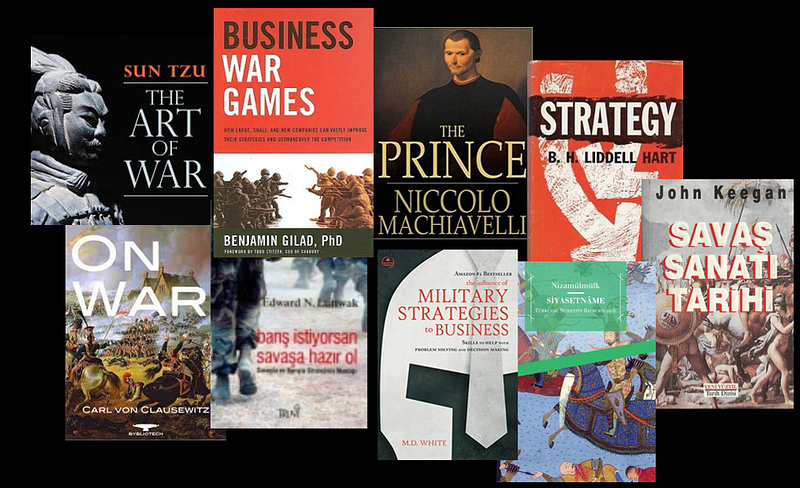
I suppose that most of you have read “The Art of War” by Chinese General Sun-Tzu, written in BC 500s. It is a great book that has gained a lot of fame also in the business world. In his book, “It is best to win without fighting.” saying, Sun-Tzu elevates the “indirect approach.” The principles of Sun Tzu, have been guiding the business world for a long time. And there are more military geniuses who have a great impact on the business world with their practices on the battlefield and their writings.
Let me give one more example; Prussian General Carl von Clausewitz’s “On War” is one of the books I read and benefited from. It is claimed to be one of the “best books written about marketing strategies.” Former soldiers are now filling the management positions in big companies; they bring their knowledge and experience on strategy and leadership to corporate life. Their experience is considered essential to bring different perspectives to the business world. They take part in seminars, and conferences as keynote speakers. They publish articles and books on management skills reflecting their own view. But how may war, a brute show of military power, teach lessons for the business world? Because war is not a brute force show!
So what is war? Whether you go to Google and ask “What is war?” the definition, below, appears:
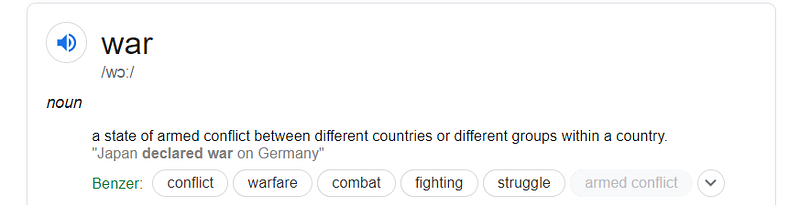
This definition seems like taken from the UN Charter. While the UN Charter was written to protect humankind from total devastation caused by a new world war. And there were intense debates over the concept of war and the definition of “what it should be.”
Now let’s look at the definition of Prussian General Carl Von Clausewitz about our question: “the continuation of politics by other means.” If the description of Clausewitz, who had written one of the most famous texts on war and military strategy after being bitten by Napoleon several times, it would have been easier to understand the world and its dynamics. For me, the best definition comes from a religious text;
“…the life of man upon earth is a warfare.”
How gorgeous! It reveals the concept of war in a simple way with most of its dimensions. So what is the strategy? Let’s ask google again;
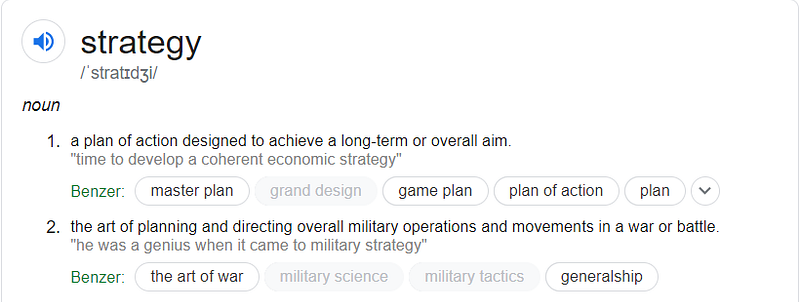
“a plan of action designed to achieve a long-term or overall aim. …” and “the art of planning and directing overall military operations and movements in a war or battle.” Art?
Yes, that’s true. The military strategy benefits from many scientific disciplines; human psychology, thermodynamics, geography, metallurgy, history, mathematics, and this goes on and on. And military strategy also has some accepted rules and tenets. But unfortunately, It is not enough to know all those sciences to apply them smartly because understanding and directing the dynamics of the factors that affect the war is not done with a dogmatic sense...
Because the successful implementation of military strategy is an art.
Let’s look at the topic from another dimension, which will help us to understand it better. According to researches, the word “strategy” comes from strategos, which means “the general’s art” in ancient Greek.
Now the time has come, to explain the importance of the statue of the goddess Athena for me given as a gift in Greece.
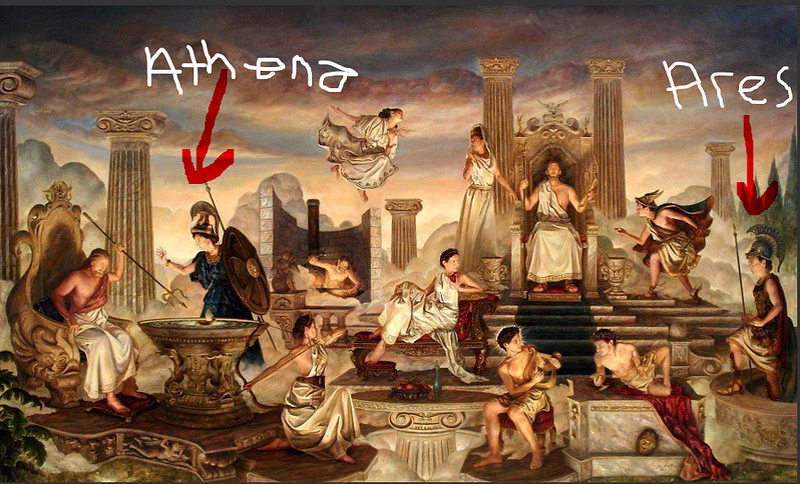
We see an interesting reference to the concept of strategy in Greek mythology. As seen in the picture, it is an ordinary day in Olympos; Poseidon is “raking” the poor Odysseus’s ship heading off towards Ithaca, Hera is nagging Zeus, Hermes is waiting for the orders from Zeus. On the far right, Ares the god of war, with the spear, staring angrily at the Athena, a beautiful lady with a huge shield next to Poseidon. Athena is also accepted as the goddess of war in mythology. Those who knew, in the epic Troja war, Ares was on Trojans’ side. However, Athena helped the Greeks under Agamemnon’s command against Trojans.
According to the narration of Homer, it was Athena who gave the Greeks the idea of entering the city of Troy with a wooden horse. I guess this is the reason why Ares, in this picture, scowled at Athena. In Greek mythology, Ares is portrayed as a bloodthirsty bully. He uses only his brute force to destroy his enemies on the battlefield. Contrary to him, Athena combines wisdom and strategy with war. She makes all kinds of deceit and games to her opponents in the war and tries to defeat them with a minimum effort in a cunning way. I also want to mention an interesting thing about Athena; she also carries the Nike (victory) fairy in one of her hands. What a meaningful symbolism, isn’t it?
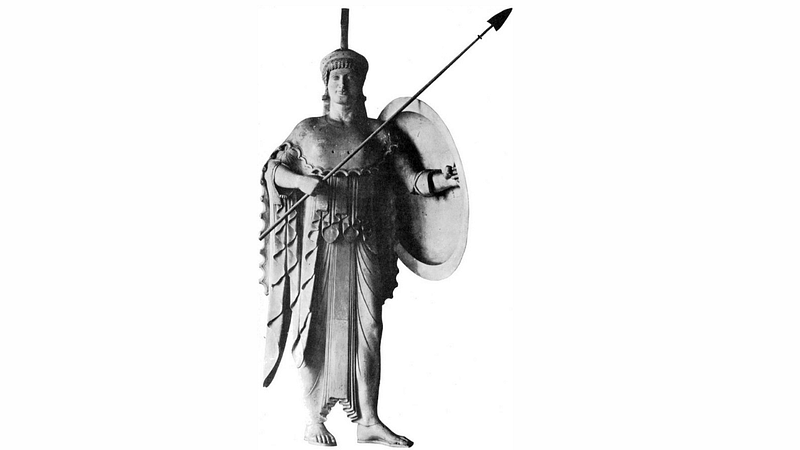
Now let’s move on to the business world. By equipping your titles, suits, computers, vehicles, you try to defeat your opponents and capture your goals. But, do you think that only the material elements that I have listed are sufficient for the victory? If it were, probably, any person with enough money to buy the best of them would be another Bil Gates, Liv Garfield, or Jack Ma. But this is not that easy, even with excellent material power.
However, repeating the exact steps of a success story does not always bring you to the same results.
Because there are thousands of internal and external factors that affect human activities, which constantly differentiate and complicate the situations faced, by colliding with each other…
There is an excellent depiction of Clausewitz for this reality: “Friction” is “the concept that differentiates actual war from war on paper,” those surprising things that happen during wartime that make “even the simplest thing difficult.”
So, it would be very beneficial for a businessperson to learn about the principles of the strategy and how to apply them in different conditions. Because, in today’s business world, all levels of executives, who wear the war helmets, even symbolically, have to fight a hard life struggle in chaotic market conditions.
So what are these principles, and how can we use them? Let’s, together, try to find an answer to this question in the following articles.
More…