
Politics
Military Coups Can Halt Democracies. However, It Is Not the End of Their Democratic Dream.
What happens to a frail democracy when it is decoupled from morals and coupled with a coup — the story of Myanmar.

Military Coups are based on inferior perceptions about people’s ability to decide for themselves and their incompetency to take on political responsibility. They undermine the potential of a society to run its politics democratically. It is an attempt not to allow people to exercise their most basic rights. Different military regimes worldwide try out distinct and seemingly persuasive rationales/propaganda to sway people onto their side. Some sell the notion that democracy is ill-suited to their culture and norms; others say the military is required to maintain unity amongst the heterogeneous population. We need to understand that any set of ideas, when taken to extremity, would start to sound fair and just if one is not comprehensively aware of what they are dealing with. In situations like one in Myanmar, fear and insecurity are created particularly to justify acts of the military and, therefore, their value and necessity.
Myanmar has a long past with the military. In 1962, the democratic government was unseated by the then army chief, Ne Win. The Junta ruled it for around half a century before coming into a partnership deal with Aung San Suu Kyi and her democratic party (National League for Democracy) in 2011. The attempt at democratization lasted for over a decade before it was halted again on this 1st of February by the military to take back full control. They are alleging that the elections held in November 2020 were rigged, which is not the case. They were clearly won by the National League for Democracy (NLD) party in a runaway victory, except that there is less clarity on how the minority voting went, including Rohingayas’; however, it is not what the military is even remotely concerned with. Voting fraud is cited as an excuse by the military to impose a yearlong emergency on the state. Their election-fraud claim was turned down by the election commission ascribing to it not being supported by any substantive proof. Military also demanded delaying the seating of new parliament, rejection of which by the NLD led them to stage a coup that was already in the pipeline for long.
To quell the wave of authoritarianism, we must do much more than just establish political rights; it is the political and social culture that needs to change. It’s worth looking at an excerpt from an interview with Maureen Aung- Thwin, where she explains the situation in Myanmar before the Coup. She says, “I think that the military, which has ruled since 1962 when they took over, made up mostly of very hard-nosed, conservative, Burman men, I might add — then that’s another thing about cultural challenges of the Burman males who feel like they’re entitled to rule — they are grabbing at anything they can within this so-called “democratic” space that they help create now, but they still control it, even though they lost the elections. It doesn’t mean they don’t control the money, the power, the cronies, the economic monopolies.” [1]
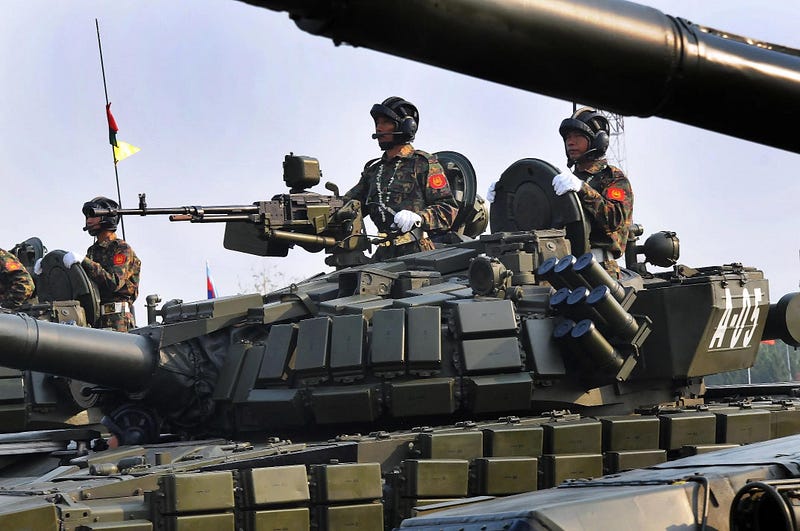
In their little adventure with democracy, all the fail-safe constitutional provisions were in place that would guarantee the political dominance and continuity of military for any contingency and otherwise. Some of those provisions are:
a. Reserved seats in the parliament that would assure the military a veto over any constitutional amendment.
b. Aung San Suu Kyi was prohibited from acquiring the presidency despite her popularity
c. The military has showered upon itself the authority to overthrow the parliament to preserve national stability. ( Constitution 2008)
NLD maintained a nonaggressive and mostly pacific attitude with the military throughout their political partnership. So much so that Suu Kyi was called out for taking a subdued approach in the case of stateless Rohingyas. It is only in the recent past they started to take specific steps that indicated NLD’s intent to remain committed to democracy, including garnering support from other smaller parties to increase their seats in the parliament. That exposed to the military their future fragilities and NLD’s growing popularity.
It seems to me like a huge risk taken by the military this time given the popular support for Aung San Suu Kyi. Unlike in the past, the presence of social media, democratic literacy, and penetration of information are certainly going to make matters more favorable for the protestors than for the military. This wave of democratization favored further by the influx of information is what the army fears most about. They have less to worry about the international export sanctions imposed on them than what’s happening on the domestic front.
The two countries that would gain the most from the coup's status quo are Thailand and China, especially China. As the pressure would rise from the western democracies to reverse the coup, China would remain the only option with Myanmar to open its economy to.
Words of Arundhati Roy sound very apt here. Roy explains, “Today corporate globalization needs an international confederation of loyal, corrupt, preferably authoritarian governments in poorer countries to push through unpopular reforms and quell the mutinies. It’s called ‘Creating a Good Investment Climate.’”[2]
Burmese people shall not let their precious brush with democracy end here. Moreover, it’s not just viewed as a form of government in Myanmar but also a system that matches their traditional and social values based on respect for each individual and harm to no one, invoked by the Buddhist religion. It has never been easy for the people of Myanmar and will be difficult in the future too. Nevertheless, while democracy can be pulled and set out to be reversed or halted, hope, courage, and optimism cannot be; they are the ingredients that go into the transition from authoritarianism to democracy.
I want to end with the fitting words of David Frum; he says, “Build a world that does not have room for millions of your fellow citizens, and they will burn it down rather than let you enjoy it without them,” says David Frum. [3]
[1] Democracy and the Deep State in Myanmar | Carnegie Council https://www.carnegiecouncil.org/studio/multimedia/20170425-aung-thwin-democracy-deep-state-myanmar
[2] Roy, A. (2015). Field notes on democracy: Listening to grasshoppers
[3] FRUM, D. A. V. I. D. (2021). TRUMPOCALYPSE: Restoring American democracy. S.l.: HARPERCOLLINS.