
Miles Davis: The Cool Genius

New here? I recommend you learn about the Cool Continuum first. You can also buy the book to access 60+ artist profiles and the practical guide.
In the expansive world of music, certain artists stand out, not just for their talent, but for their relentless drive to redefine their field. Miles Davis, an extraordinary figure in jazz, was such an artist. His approach, far from being tethered to conventional norms, consistently pushed beyond familiar boundaries, exploring fresh ways to express the language of music.
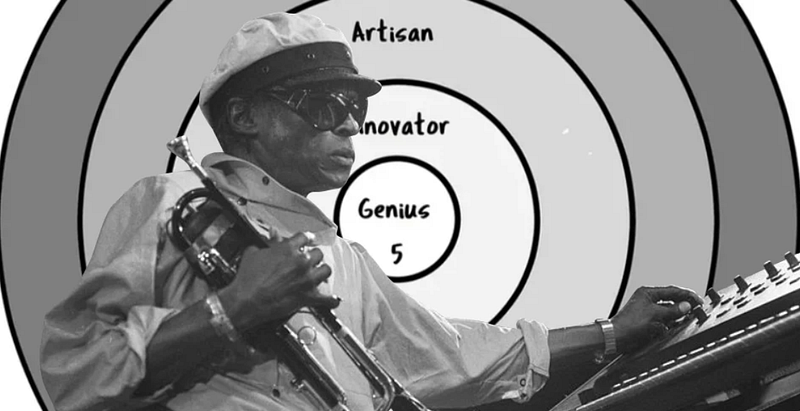
The Cool Continuum, a classification model that rates musicians based on their musical prowess, is an appropriate context for discussing Davis’s stature. Within this framework, Davis surpasses the Level 4 Innovator status, ascending to the top floor— the Level 5 Genius. To confine Davis to the role of Innovator would be to ignore the magnitude of his contribution and his place in the music landscape. Davis was not just an agent of change; he was a force that dramatically reshaped the contours of jazz.
Indeed, Davis was undeniably an innovator. He embraced change and navigated effortlessly through cool jazz, bebop, modal jazz, and jazz fusion. His distinguished body of work includes defining albums like “Kind of Blue” and “Bitches Brew”. However, describing him solely as an innovator would be insufficient and overlook the full breadth and depth of his accomplishments.
The Genius designation isn’t given solely for innovation, but also rewards extraordinary creativity, unmatched technical proficiency, and a distinctive, almost ineffable, additional quality. Davis wasn’t just a marquee star lighting up the sky; he was the North Star, guiding a generation of musicians.
His improvisational abilities, an intoxicating blend of creativity and technique, were his ‘X’ factor. They could be compared to the finesse of an orator, weaving together tales on the fly, not merely by knowing the words, but by understanding their hidden depths, nuances, and resonances. Davis, too, knew his notes, scales, and chords. But more crucially, he understood the unspoken language of jazz, the sigh between the notes, the wink in the silence.
Further cementing his Genius status is his enduring legacy as a “kingmaker”. His bands were crucibles of talent, the breeding ground for jazz royalty. From John Coltrane to Herbie Hancock, Davis had an uncanny knack for spotting and nurturing talent. His bands weren’t just bands; they were like elite jazz finishing schools, producing musicians who would go on to carve out influential careers of their own.
In essence, Davis’ genius lay not just in what he did, but also in what he ignited in others. As he famously said to saxophonist Wayne Shorter, “Don’t play what’s there, play what’s not there.” It’s a Zen koan that only a master could teach, and only a fellow adventurer could understand.
In the end, it’s not just about a musician hitting the right notes or creating a splash. It’s about creating ripples that resonate through time, influencing others and shaping the future of the music. In this sense, Davis wasn’t just playing the music, he was playing the future, swinging his trumpet like a time-traveling sorcerer.
The legacy of Miles Davis is not simply captured in albums or accolades, but imprinted on the soul of jazz itself. Another quote from Davis: “I’ll play it first and tell you what it is later.” True to his word, he played a symphony of a lifetime, leaving us listeners to ponder its profound significance, then, now, and forever.
Cool Continuum is a collaborative effort by Jason S. Comely and ChatGPT. For more artist profiles and ideas on how you can make your mark on the art world, follow me on Medium.