
Midjourney isn’t boring; prompts are: There’s a need for a dose of nonsense.
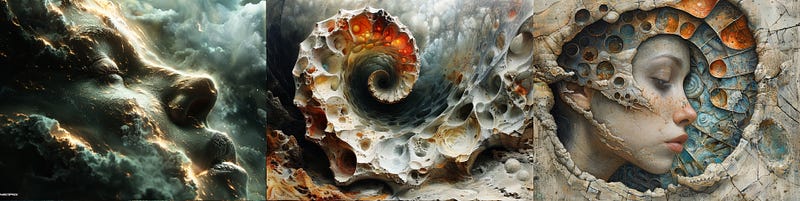
Like always in my articles, I will take a step back first. Or a leap, in this case. But please bear with me and read it through to understand the most interesting part of this article. Oh, and the possibility for money-making, too, if that is what you want.
When I first attempted to use Midjourney quite a long time ago, I had no slightest clue about prompting, just a basic knowledge that it uses “a natural language” for image generation. And since I am an avid follower of the “scientific poking” style (push the button, see what it does), I never bothered much with manuals or how other people do it. I got what I wanted, more or less (maybe with too many fingers at that time), but it worked for me. Only then did I look up how others were doing it. And it was surprising — my prompts were very different from pretty much everyone else's.
Most prompts I saw then and still see now are rather flourishing, “natural language"-driven instructions, like: “ a glamorous woman in the futuristic street. She is programming a wrist computer. She has some mixed origins with the Asian type. She wears some long, wide, thick, black latex trousers. She wears a baggy outfit made of black latex. She is looking at us with a little smile. She is standing in an attractive pose.” This, most commonly, would be followed by technical instructions using words like:” in the style of” and “focusing on” or concentrating on” and so on.
Now, being an engineer and understanding the idea of a token, I immediately concluded that this “natural language” is a waste of perfectly good tokens. Especially knowing that generative AI, Midjourney included, will take just so many tokens (5 keyword tokens in case of Midjourney) into consideration and will start skipping others.
The above-mentioned prompt, in my case, would have been optimised just for keywords and none of the language niceties, like this: “smiling glamorous women, wrist computer, mixed race, latex outfit, attractive pose, looking at the viewer,” followed maybe by actual style and technicalities without any fluff words like “concentrating”, “focusing”, and similar. I would use weight parameters if necessary to emphasise one or another element, but not language per se.
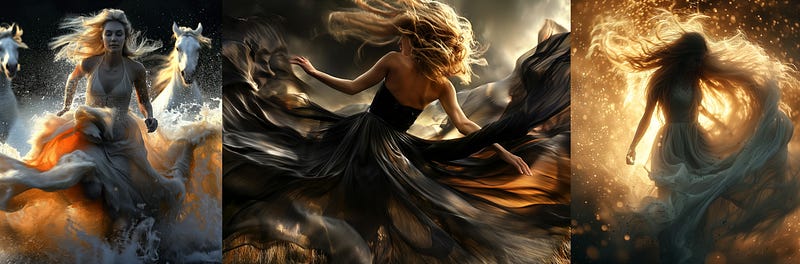
And my simple prompts work just as well, if not better, than fluffy ones. It saves time typing, too. But here is the important thing — in scientific terms, it is reductionism: minimising variables to figure out how it works and learn perfect control. Reductionism can be taken to extremes, too, with exciting results. And I indeed did just that, but it will come a bit later in this article.
The fact is, the most interesting results I ever got from Mdjourney were based on just a string of keywords: woman, beautiful, action, expressive, and so on. Not natural language in linguistically appropriate sentences, but in the meaning of the most appropriate keywords.
And I found that vocabulary is more important than the morphology of the sentence. Finding an exact word, most likely describing your vision, is a key. Beautiful could be replaced with adorable, elegant, and alluring, resulting in subtly different outcomes.
Understanding this simple rule is one of the key elements in creating unique images in Midjourney. Think about it like this: the most common words describing some phenomena will be represented by a very large number of images from which Midjourney learned. And the average of those images will be, well, average. The more unique and specific this word is, the less average the outcome will be. Meaning it will stand out from millions of other images created by Midjourney.
So, taking my reductionist approach and a simple understanding of the two facts above, we can start creating something interesting.
We will start by picking up some interesting, unusual words. I used Gemini Advanced, but any other chatbot will do. Here is my prompt:
“Provide 100 sophisticated words describing the most abstract, deepest, and most complex thoughts and concepts.”
Here is the result:
Words Evoking Abstraction and the Intangible
- Metaphysical
- Ethereal
- Ephemeral
- Esoteric
- Intangible
- Transcendental
- Notional
- Conceptual
- Theoretical
- Philosophical
Words Suggesting Depth and Complexity
- Profound
- Labyrinthine
- Intricate
- Convoluted
- Unfathomable
- Inscrutable
- Enigmatic
- Arcane
- Abstruse
- Impenetrable
Words Implying Thought Processes
- Introspective
- Contemplative
- Meditative
- Speculative
- Discursive
- Ideational
- Cognitive
- Cerebral
- Rational
- Analytical
Words Related to Knowledge and Understanding
- Epistemological
- Phenomenological
- Existential
- Essential
- Gnostic
- Ontological
- Hermeneutic
- Paradigm
- Erudite
- Perspicacious
Words Connoting Mystery and the Unknown
- Occult
- Mystic
- Cryptic
- Obscure
- Eldritch
- Ineffable
- Numinous
- Incommensurable
- Sublime
- Paradoxical
Words Centered on Origins and Purpose
- Cosmological
- Teleological
- Primeval
- Archetypal
- Quintessential
- Immutable
- Eternal
- Primordial
- Transcendent
- Immanent
Words Describing Emotional and Psychological States
- Angst
- Cathartic
- Poignant
- Evocative
- Melancholic
- Introverted
- Brooding
- Ruminative
- Wistful
- Pensive
Words Hinting at Change or Revelation
- Transformative
- Epiphany
- Metamorphosis
- Transcendence
- Paradigm shift
- Apotheosis
- Evolving
- Revolutionary
- Emergent
- Flux
Additional Descriptive Words
- Weighty
- Heady
- Momentous
- Timeless
- Infinite
- Expansive
- Elemental
- Universal
- Cosmic
- Spiritual
- Otherworldly
- Preternatural
- Liminal
- Chimerical
- Inchoate
- Nebulous
- Noetic
- Dialectical
- Metacognitive
- Protean
Some of these words are definitely unusual and different from those used in typical prompts. They are also more likely to generate unusual or at least different results in Midjourney.
But let us take our reductionism to the maximum, skip everything else, and use just our special words. Here is the image prompt: Transcendent, Sublime, Epiphany, Metamorphosis:
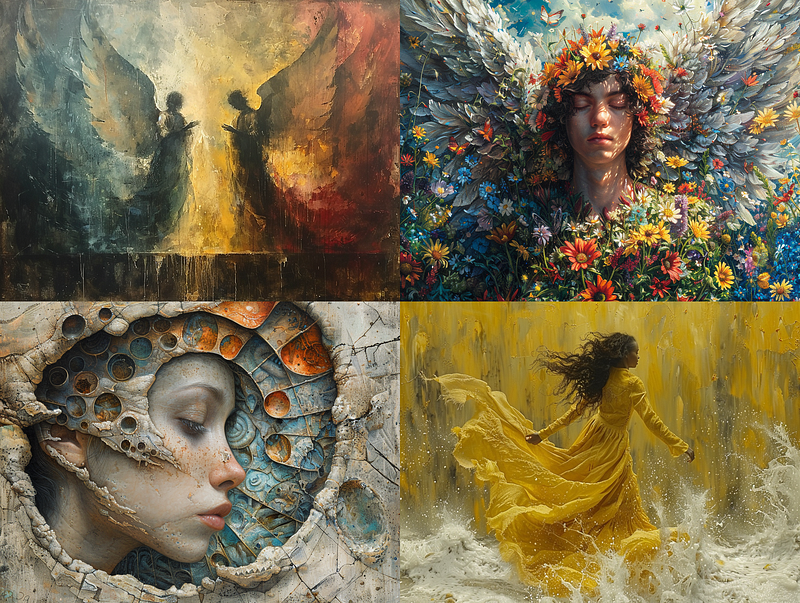
It's not too bad; some of the images are quite interesting. More importantly, some images are very difficult to prompt in any other way.
Another example, based on the string that really makes no sense - hypnotic daisy discombobulation:
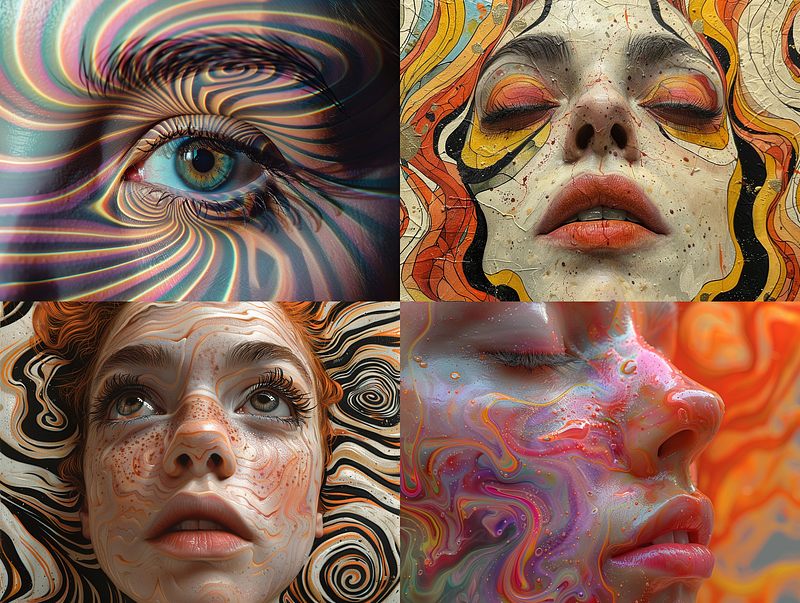
OK, no daisies, but some of those styles are interesting and difficult to prompt with a “natural language”.
Let’s go further and try another completely nonsensical string: chimerical, inchoate, noetic.
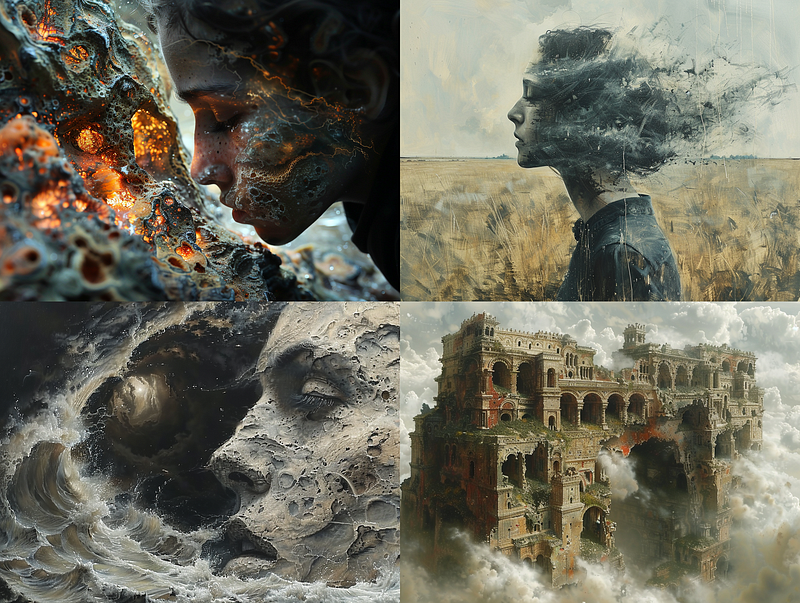
It is quite fun; some of it could be used for reference and style. But let us push it even further in nonsensical reductionism, just one word: epistomatic.
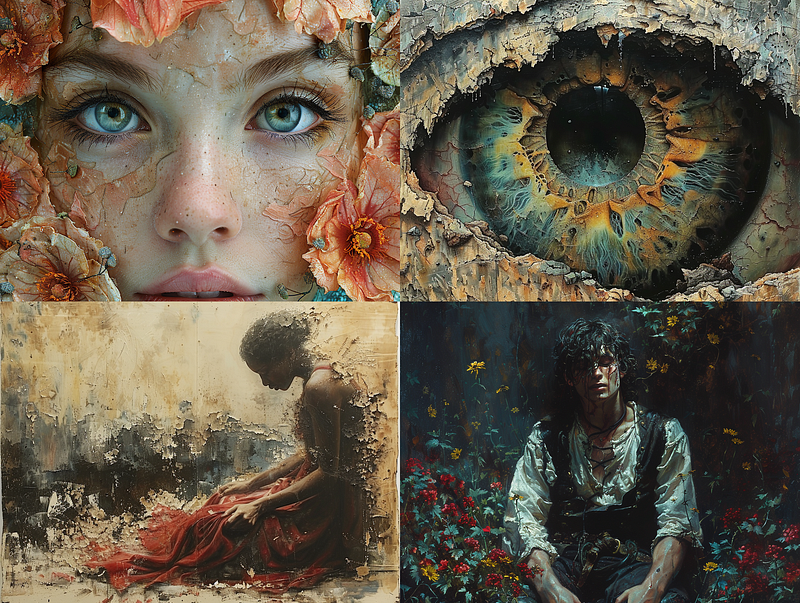
Now it has become truly fascinating — what one word can do. Oh, do not skimp on the “stylize” parameter in this stage; use quite high values to have some fun.
Here is another string: surreptitious anthropomorphic amalgamation. The result is creepy but interesting; again, it would take some time to prompt in the usual way.
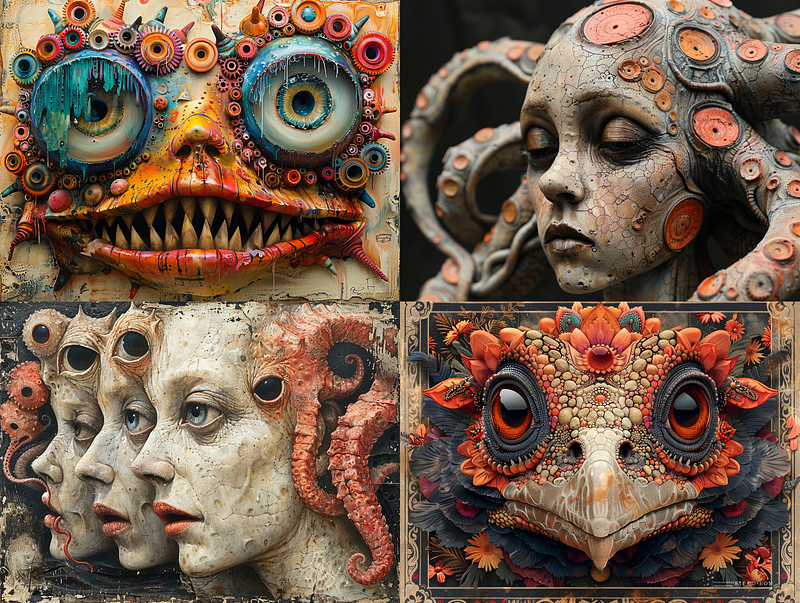
Last experimental single-word prompt: discombobulation:
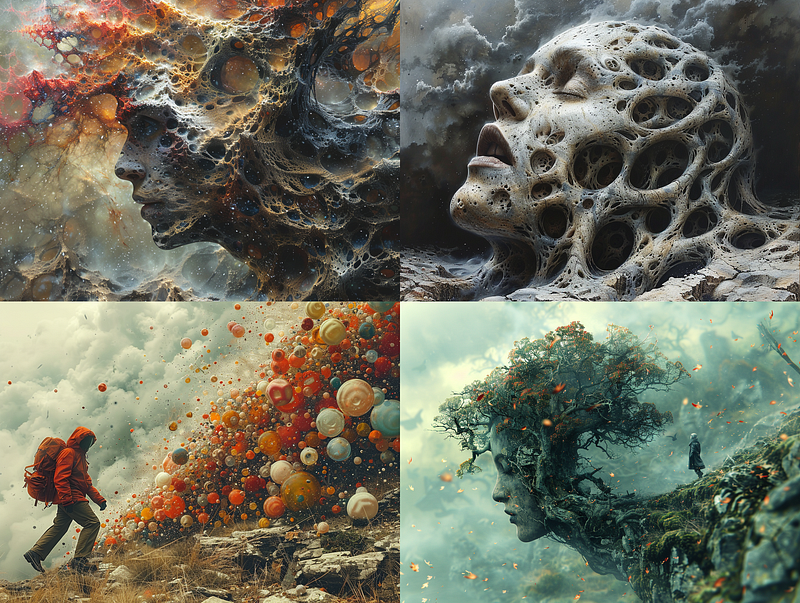
Again, we got some quite interesting stuff with just one single word.
I must confess: I find it absolutely amusing to play with nonsensical prompts and words. There are many revelations to be made in this game. For example, the word “eldrich” would produce images of decidedly tentacular nature.
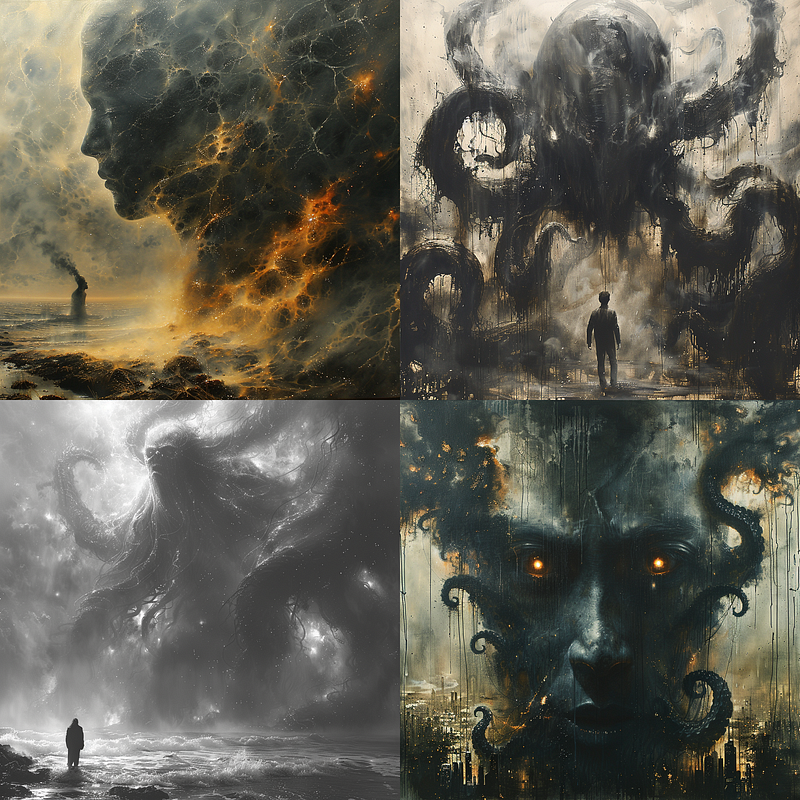
To be honest, none of those images are that groundbreaking, but some of them are quite different from “average” Midjourney images. They have something that could act as inspiration to prompt further and work out the image you can be proud of.
So here is the ”earning money” part of the article: nonsensical prompts with sophisticated words could lead to the creation of unique images and styles that stand out from millions of other images generated with AI.
It is possible to create unique, sellable reference styles using a nonsensical, reductionist approach. It is possible to create outstanding graphics for digital products. It is possible to create very different artsy images for the image stock sites.
An intelligent and curious mind (which you obviously have if you read to this point) would have inevitably deduced by this time that it is possible to do something quite more remarkable with nonsensical reductionist prompting: reverse engineer keyword trends in images. But this is a stuff for another article.
I hope this article was helpful and interesting. If so, please clap as much as you can, highlight and comment, and indeed, follow me for more reeds, even if some of them are "nonsensical."
Aivaras Grauzinis


