
Microsoft Azure Orbital
How Microsoft is investing in a rapidly expanding satellite industry
Anywhere between 12,000–50,000 satellites may be launched in the next ten years. The cost to launch has greatly decreased thanks to rideshare services like SpaceX while the cost to operationalize these satellites has not — to keep up with the satellite boom, things will need to change on the ground as well. Once in orbit, a satellite’s journey has only just begun. It connects back to a physical ground station where signals are uplinked, data is downlinked, and overall monitoring is performed. These facilities are critical to the longevity of a satellite but requiring manpower, a secure physical infrastructure, and expensive equipment. However, the industry predicts that you can save up to 80% on the cost of ground station operations by paying only for the actual antenna time used and not maintaining your own costly physical infrastructure.
To address this, Microsoft created an Azure Orbital within their Azure Space team in 2020. Azure Orbital is a Ground Station As-a-Service which provides communication and management of satellites and space craft. Azure Orbital allows users to connect to their satellites, downlink their data, and leverage data processing and scaling for their operations with Azure cloud, one of the leading cloud computing services in the world. Customers use these services on a pay-as-you-go basis without needing to build their own satellite ground stations — just like how today you can build and host an app with a cloud service provider cloud and not need to build your own physical datacenter to support it.
Microsoft has datacenters located around the world, including their new Modular Data Centers. Satellites from Low Earth Orbit and above connect to these datacenters with Azure Orbital ground stations over a secure connection. Then suddenly, you can tap into expanded Azure machine learning and cost saving capabilities for better data manipulation and reporting. They can also connect to a partner’s on premise ground station and can work with partners to customize for any unique missions.
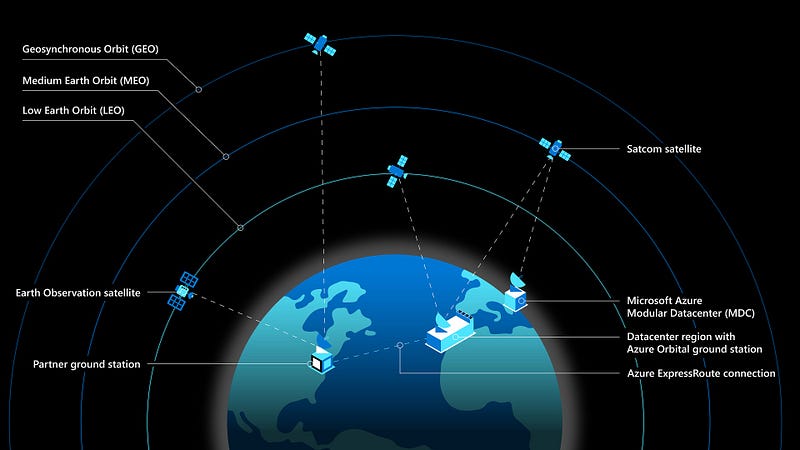
Space organizations struggle with the ability to manage massive amounts of data effectively — which luckily, is a problem solved by cloud technology a long time ago. Azure has capabilities to processes data with data analytics, machine learning, and Artificial Intelligence. Other than managing huge amounts of data, organizations also struggle with remote location connections, which can be solved with Microsoft’s global spread of secure datacenters and family of partners.
Right now Azure Orbital is focused on Earth observation and global communications scenarios. SpaceX Starlink is one of their first customers and they’ve also established partnerships with satellite companies such as SES, KSAT, Kubos. Even the ISS uses satellites to transmit human communications today — so how does this apply more directly to space exploration and astronautics?
Future communication and navigation of astronauts on the Moon is dependent on lunar satellites and a connection back to Earth. In the long-term, lunar settlements will require the same communication and navigation as we have on Earth — we will want to phone home to our families, communicate mission procedures with CapComs, or work with subject matter experts on Earth. We’ll also need to make sure we can accurately navigate the Moon (even on the dark side of the moon) — and so perhaps a future GPS for lunar settlements is on the horizon. We will need to deploy a constellation of lunar satellites communicating with lunar bases and with Earth. Azure Orbital can enable these connections back to various parts of Earth using their Azure Orbital datacenters or Azure Modular Datacenters.

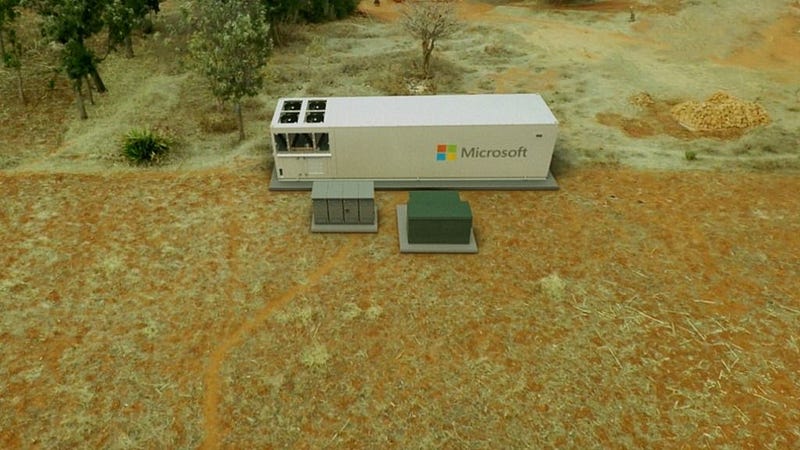
An Azure Modular Datacenter is a small yet powerful datacenter the size of a shipping container, designed to be put in austere environments around Earth. Years from now, as lunar settlements become realized, they will have great technical needs for telecommunications and managing scientific data. NASA controls its interplanetary satellite missions through satellite dishes placed around Earth in the Deep Space Network (DSN), but is pushing the limit on how well it can handle the massive amount of traffic. In 2012 USC doctoral student Ouliang Chang proposed lunar supercomputers. Conveniently placed near the poles to maintain air conditioned temperatures, these lunar datacenters could communicate with Earth, space stations, and spaceships while taking the load off overworked Earth-based infrastructures and bringing technical capabilities and network connectivity further into space.
Think about how much faster our lunar settlements will advance if the technology they need is right at their fingertips.
Microsoft is not new to the space industry and continues to develop partnerships and solutions that make them a leader in the big tech-space paradigm. Microsoft is already engaged on other space-related initiatives such as:
The U.S Defense and Innovation Unit to create more actionable space data and build agile cloud processing capabilities in support of the U.S. Air Force’s Commercially Augmented Space Inter Networked Operations project.
Lockheed Martin with HoloLens 2 to leverage virtual reality for assembly of the Orion spacecraft that will be used to support NASA’s Artemis program to carry humans to the Moon and beyond.
Seequent to levarege satellite data and Azure computational power to address water quality and quantity around the world.
The satellite industry is amidst a time where they must face technical disruption for future innovation. Azure Orbital is pioneering this with their Earth observation, global communications, and Ground Station as a Service capabilities. As we look towards the future of space exploration and astronautics, the Ground Station as a Service concept and Modular Data Centers may open up the possibility for lunar and Low Earth Orbit settlements to become cheaper and more accessible.
Follow me at https://sfalcucci.medium.com/ for more space and STEM content and to hear about my upcoming experiences in the space and technology industry. Thanks to your support, I have recently been noted as a top writer in Space on Medium!