
Wiggling On Windermere
An Alzheimers diagnosis doesn’t mean the adventure is over
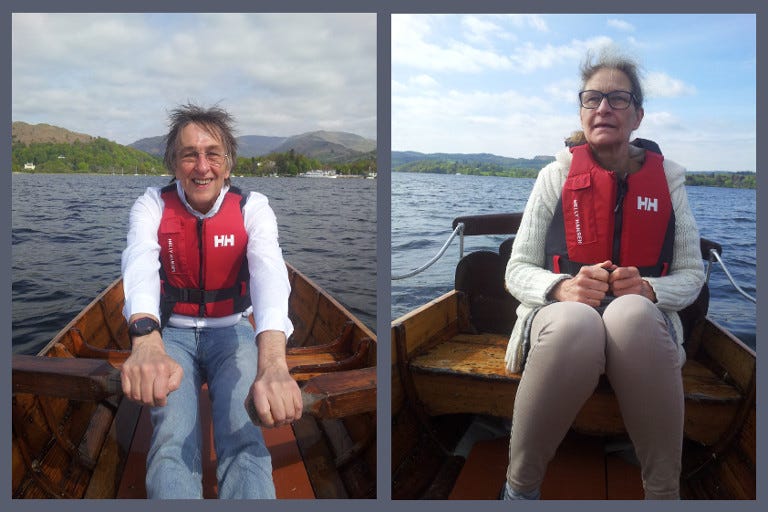
The girl got us arranged in the boat, Lena first, then me, and I tested the oars for weight and width. Hmm, not much room to get us out of here, with other boats berthed close up on either side.
– Don’t worry. I’ll give you a shove.
I’m not exactly an expert. It’s been 50 years since I last took a boat out at home on the Medway. But I’d be OK. With all those sessions on the rowing machine in the gym recently, I knew I was in shape. And besides, it was a magnificent morning for it, the sun already high, the waters of Lake Windermere just gently rippling and glinting, and a hearty English breakfast to work off.
Lena’s not a big fan of big water, but perched opposite, she was glinting too, excited, trusting me — and her life-jacket.
– Look, HH. It’s a Helly Hansen.
– Is that Swedish?
– I think so. They’re really good.
But of course they are. Like everything Lena finds that’s Swedish.
Oars raised, we inched past the last of the beached boats. We were all set. So I settled myself, took a deep breath, dipped in the oars, perfectly synchronised, pulled … and crashed back into the boats behind.
Odd! So I had to push the oars then, not pull. That’s not how I remembered it, not at all how it felt in the gym. Uncomfortable too. My knees seemed to be in the way. Ah, the foot-rest was in the wrong place, probably. I lifted it out of its slot and shifted it as far forward as it could go. It didn’t seem to help much. I was missing my knees now, but my thighs felt like they were going to cramp every time I pushed forward. Lack of practice, no doubt; I’d get used to it soon.
So, out on the open water, which way? Ahead it was just a few hundred yards to the opposite bank, then trees and the hillside behind. To the left, a challenge: the lake stretching away beyond, a grey sail balancing on our horizon. Left then.
But which oar was that? There’d been no turning on the rowing machine.
Wiggling’s not a word you usually associate with rowing, but it worked for me. I soon had the horizon in my sights and I was ready to go. Lift, breathe, back, push, exhale, pause, repeat … I was striking a rhythm, and we edged forward, vaguely parallel to the shoreline.
While I struggled, Lena was taking it all in.
– Look how beautiful it is. That house up there.
– I can’t. It’s behind me.
But I did look anyway, pausing and turning to follow her arm. Yes, it was beautiful. And what did rowing matter anyway? Here we were, alone together in a tiny boat on a massive expanse of water. Vulnerable, inexperienced, drifting — and exhilarated.
A microcosm of our life and the paradox of dementia. Such terrifying consequences, yet still so much scope for pleasure. Alzheimers has taken so much away … yet before Alzheimers, we probably wouldn’t have taken a day-break, wouldn’t have rented the boat, wouldn’t even have been fit enough to take it out for an hour.
Lena dipped a hand in.
– It’s not cold. Just like under the tap.
We were no longer alone. A steam-boat chugged up behind, separating us from the shore. A little cluster of passengers lined the deck, envying us. Someone shouted something, too far away to make out, and pointed. Lena waved back.
But now, 25 minutes out, it was time to think about turning back. A breeze had come up from behind, and I’d be rowing into it.
I’d mastered straight-line navigation now, but not turning. I dragged one oar in the water, pushed with the other. No, wrong way. So what about pulling? By mistake, I pulled with both oars … and the boat suddenly skipped away through the water.
That’s when the penny dropped. I’d been going forward, backwards. Or vice versa. Back at the beach half an hour ago I should have turned the boat once I was clear. Facing backward instead of forward. Pulling instead of pushing, just like in the gym.
I took a couple more strokes, and we were flying.
Of course it all made sense. The pointy end at the front to cut a path through the water. Elementary physics. When will I ever learn to think through a problem and not miss the bleedin’ obvious?
Reinvigorated, I got us back to the little harbour in around 10 minutes, scudding across the lake. There was time enough to take another little circular trip to the opposite bank.
Not that facing backwards is entirely without its problems. Particularly when your cox has dementia.
– Where’s the buoy? Are we heading for it?
– The boy? What boy?
– No the buoy. The little red thing in the water. That’s where the rocks are.
– I can’t see anything like that.
But I knew it was there. I glanced over my shoulder, and we were fine.
– There. That one — look.
– Oh that one. Why didn’t you say?
– Can you make sure I don’t start heading for it?
– Heading for what?
So now it was time to go in, into a tiny space, backwards, blind and coxless.
Fail.
The girl on the beach called instructions.
– Try over there — the other side of the pier. There’s more space.
More space, but not much more. First backwards … no good, another fail. So then, after all the practice earlier, what about forwards? Still no good. My positioning was fine, but I didn’t have the momentum to get us landed and there was no room to waggle my oars. Waggle — a true professional! Would we have to spend the rest of our lives in a boat?
Help arrived. The girl came to the end of the pier, grabbed the end of an oar, and between us we finally jolted and jostled our way back onto the pebbles.
– Sorry ’bout that. I guess I need more practice.
– Not to worry. You’re not the worst. And the wind makes it awkward.
Kind! The wind had dropped again.
– I really enjoyed that … once I figured out which way I was supposed to be rowing.
– Yes I know. We were watching. You gave us a really good laugh.
We had a good laugh about it too, Lena and I, as we sat a few minutes later, tucking into a blueberry scone floating in a rich rum sauce and topped with lashings of cream.
Over the lake, the clouds were coming over. We’d chosen the right moment. An hour later and we’d have missed the sun.
May 2015
Originally published at carecombine.org on October 22, 2018. Join us on The Care Combine website for more of our dementia adventures — and a plan to reimagine the way we handle dementia care.


