
Microcap Investing… Hero or Zero?
What are Microcap Stocks?
These are companies with Market Capitalizations between $300 million and $2 billion dollars.
Unfortunately, they are considered riskier because more of them tend to go bankrupt.
That is completely understandable though. Most Microcaps are still testing out the waters and might not be profitable yet.
Does that mean you should avoid the space altogether?
DEFINITELY NOT.
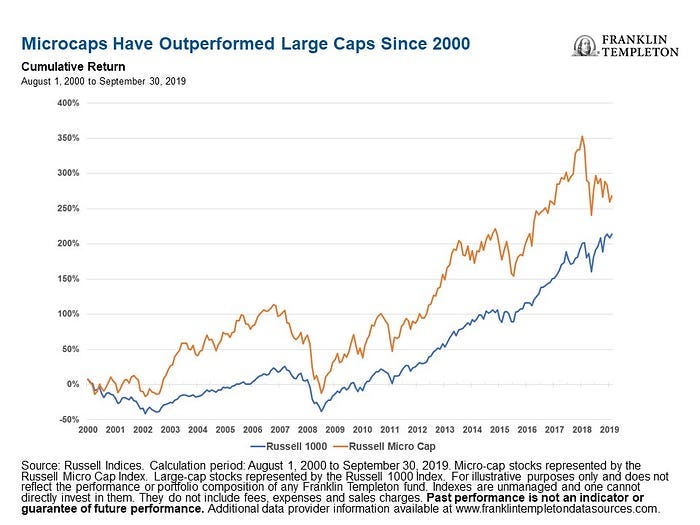
With this article, I wanted to go over three reasons I find the Microcap space intriguing and then go over what a retail investor can do to mitigate their risk in the space.
What interests me about the space
- Limited Institutional Investing: Big institutions want to invest significant percentages of their capital into their highest conviction ideas… But unfortunately for them, a significant percentage would equate to billions of dollars. That would result in them taking complete ownership of the microcap company they invested in and quite a bit of paperwork, which is not appealing for these institutions. As a retail investor, I take solace in knowing that I’m not as prone to the significant stock run-ups and sell-offs that these large corporations are known to cause.
- Potential for Outsized Returns: The massive technology companies you see nowadays were once small microcap firms that kept compounding till they reached trillion dollar market capitalizations. If you had invested $1 in Apple at a $1 Billion valuation, you would have $2,200 now. Let that sink in. Also, Warren Buffett loved the space when he opened his initial partnership in the 1950s, so much so that was he was able to compound capital between 30%–40% annually. You won’t see that in the large capitalization space.
- Simplicity of the business models: Because the companies are smaller, there is less going on when compared to a larger firm. This difference is starkly shown in their annual reports. Unlike most of the larger cap annual reports I have read, the microcap annual reports are very easy to read. They highlight exactly how the unit economics work, growth opportunities available, and the capital allocation strategies employed. The more you understand the business, the more you will be aware of what the potential pitfalls are. You will be able to decipher the difference between a temporary hiccup vs a permanent change in the business model.
Ways you can mitigate the risk
- Invest in Profitable Companies: There might be multiple unprofitable microcaps out there, but that doesn’t mean there are no profitable ones. Find the ones generating profits currently with the potential for growth and start your search there.
- Invest in Need-Based Companies: During a positive macroeconomic environment, it is easy to say a variety of companies are doing well… however, that can easily change when difficult times pop up — Revenues may drop and costs may increase. That is why I’m constantly on the lookout for companies that are able to continue to grow and prosper even in these tough times; they should have products and services that are price inelastic, which is the ability to raise prices without decreasing the demand. Take paying for gas vs going to the movies. Which would you give up first?
- Manage the Portfolio Often: You might do both the above pointers exceptionally, but at the end of the day, there is a lot of uncertainty in this space. Things can go from good to bad overnight. So make sure to assess your portfolio often and be willing to sell if need be.
That is all I have to say about Microcaps today folks.
Hope you found this helpful. Thank you for reading!
Till next time.