avatarDrama Llama

Free AI web copilot to create summaries, insights and extended knowledge, download it at here

2356

Abstract

ion of Musik / Electronic Television, and continued to work with various media over the years even experimenting with magnets to distort recordings. (Morgan, 2007, online) John Hanhardt writes:</p><blockquote id="d5c9"><p>Paik’s investigations into video and television and his key role in transforming the electronic moving image into an artist’s medium are part of the history of the media arts. As we look back at the twentieth century, the concept of the moving image, as it has been employed to express representational and abstract imagery through recorded and virtual technologies, constitutes a powerful discourse maintained across different media.</p></blockquote><blockquote id="7b93"><p>Hanhardt, 2008, online</p></blockquote><p id="ba38">Now in the twenty-first century with laser technology, digital and electronic media are fusing with video and cinema bringing about new modes of representation and forms of expression. The electronic world is ever-changing and the introduction of ‘4K ultra-high definition’ television, signals a revolution of our visual culture. Today artists use media to explore many different themes including the division between the performer in real and virtual time and spaces.</p><figure id="1f09"><img src="https://cdn-images-1.readmedium.com/v2/resize:fit:800/1*vsIvxIil2DnWfvj3J0pn8g.jpeg"><figcaption><i>photo by Paula Court</i></figcaption></figure><p id="0077"><i>Recognition</i>, a performance work by Fiona Templeton dealt with the uncertainty of transmission between place and time using both live and video performance. With themes of mortality, fiction, absence, and reality it “was a dialogue between life and death.” (Templeton, 2001, 103) The piece not only exposed the issues of pre-recording but also the dilemma of real-life drama with its collaborator. Templeton explains:</p><blockquote id="0ceb"><p>Recognition was a performance work I created with my late collaborator Michael Ratomski in 1992–96. What began as a live duet had to change as Michael became increasingly ill with AIDS; we did not want to limit his ability to act according to a set level of necessary health, so the work incorporated the stages of his illness.</p></blockquote><blockquote id="0677"><p>Templeton in Kaye, 2007, 1</p></blockquote><p id="e5a2">For Templeton, video augmented the division between the recorded and th

Options

e live and reiterated the absence of Michael. In the piece she physically manipulated the monitor “as if it were Michael’s body, repeating and re-emphasising his words.” (Kaye, 2007, 9) By using this technique the performance emphasised and multiplied the mediation between loss, forgetting, and elimination.</p><figure id="d1af"><img src="https://cdn-images-1.readmedium.com/v2/resize:fit:800/0*CYsov3CkI2bDztZ3"><figcaption>Photo by <a href="https://unsplash.com/@jarl_schmidt?utm_source=medium&amp;utm_medium=referral">Jarl Schmidt</a> on <a href="https://unsplash.com?utm_source=medium&amp;utm_medium=referral">Unsplash</a></figcaption></figure><p id="aae9">The projections arbitrated the video and ‘Fiona’ (played by Templeton) endorsed Michael’s declaration, which in turn multiplied the desire to make Michael present. In this way, the mediums became merged in their conveyance of signs and rather than be exclusive, congregated and overlapped. Paolo Rosa describes:</p><blockquote id="dc89"><p>We find much more convincing a position which posits the autonomy of the various media that concur creation, media that come together to find points of convergence and areas of overlapping, but without neglecting their differences. In fact, it is precisely these non-homogeneous processes that create the pre-conditions for open participatory narration.</p></blockquote><blockquote id="2cb2"><p>Rosa in Kaye, 2007,152</p></blockquote><p id="6888">Performance Art has explored the idea of both the moral and ethical through the relationship of life to art since the Ancient Greeks. The western theatrical supposition in essence began with Aristotle. Whether the belief that art must accomplish a moral rationale or that its function is an exposure of reality, it has dealt with life issues through many varying mediums from the live performance through to the recorded.</p><blockquote id="26b6"><p>When reality is staged it enters into the distancing of the documentary, of one choice of edit of the real over another, it is put into quotes. Michael’s quotes are represented by the tv monitor. Mine are the props, the costume. Am I acting myself, or Fiona? — Fiona Templeton</p></blockquote><p id="243e">Article written by <a href="https://linktr.ee/dramallamaperformingarts">Drama Llama</a> | Educator | Writer | Academic | Consultant</p></article></body>

Education and performance

Michael, AIDS and Video Art

A dialogue between life and death

Photo by Anna Jiménez Calaf on Unsplash

Recognition was a solo performance with a text by Fiona Templeton and developed in collaboration with the late Michael Ratomski, who also appeared on videotape. Michael originally also performed in the work; he died before it was finished.

https://www.fionatempleton.cloud/recognitions

From the 1960’s movements within video, performance and installation brought about the emergence of ‘Video Art’. This genre sought to explore the relationship between the ‘virtual’ and ‘real’ time of its performance as well as the space that performance occurred in. This in turn shaped the future of multi-media practices within art and the interplay of the live, recorded, music, sculpture, and performance and how the meeting of these can be reversed and interchanged according to their transmission. (Kaye, 2007, 100)

One of the forerunners in this new genre and highly influential in Northern American video art was Nam June Paik, a multimedia artist known for including electronic elements in his work. Thought to have coined the phrase ‘electronic superhighway’, Paik became involved in ‘Fluxus’ the Neo-Dada art movement brought about by the composer John Cage and his use of the everyday sound in his music.

Photo by Sven Scheuermeier on Unsplash

In 1963 Paik participated in the first exhibition at ‘Galerie Parnass in Wuppertal, including television monitors, Exposition of Musik / Electronic Television, and continued to work with various media over the years even experimenting with magnets to distort recordings. (Morgan, 2007, online) John Hanhardt writes:

Paik’s investigations into video and television and his key role in transforming the electronic moving image into an artist’s medium are part of the history of the media arts. As we look back at the twentieth century, the concept of the moving image, as it has been employed to express representational and abstract imagery through recorded and virtual technologies, constitutes a powerful discourse maintained across different media.

Hanhardt, 2008, online

Now in the twenty-first century with laser technology, digital and electronic media are fusing with video and cinema bringing about new modes of representation and forms of expression. The electronic world is ever-changing and the introduction of ‘4K ultra-high definition’ television, signals a revolution of our visual culture. Today artists use media to explore many different themes including the division between the performer in real and virtual time and spaces.
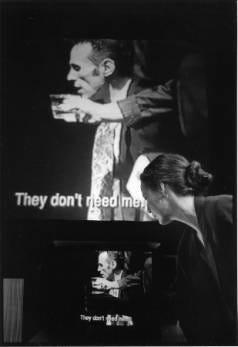
photo by Paula Court

Recognition, a performance work by Fiona Templeton dealt with the uncertainty of transmission between place and time using both live and video performance. With themes of mortality, fiction, absence, and reality it “was a dialogue between life and death.” (Templeton, 2001, 103) The piece not only exposed the issues of pre-recording but also the dilemma of real-life drama with its collaborator. Templeton explains:

Recognition was a performance work I created with my late collaborator Michael Ratomski in 1992–96. What began as a live duet had to change as Michael became increasingly ill with AIDS; we did not want to limit his ability to act according to a set level of necessary health, so the work incorporated the stages of his illness.

Templeton in Kaye, 2007, 1

For Templeton, video augmented the division between the recorded and the live and reiterated the absence of Michael. In the piece she physically manipulated the monitor “as if it were Michael’s body, repeating and re-emphasising his words.” (Kaye, 2007, 9) By using this technique the performance emphasised and multiplied the mediation between loss, forgetting, and elimination.

Photo by Jarl Schmidt on Unsplash

The projections arbitrated the video and ‘Fiona’ (played by Templeton) endorsed Michael’s declaration, which in turn multiplied the desire to make Michael present. In this way, the mediums became merged in their conveyance of signs and rather than be exclusive, congregated and overlapped. Paolo Rosa describes:

We find much more convincing a position which posits the autonomy of the various media that concur creation, media that come together to find points of convergence and areas of overlapping, but without neglecting their differences. In fact, it is precisely these non-homogeneous processes that create the pre-conditions for open participatory narration.

Rosa in Kaye, 2007,152

Performance Art has explored the idea of both the moral and ethical through the relationship of life to art since the Ancient Greeks. The western theatrical supposition in essence began with Aristotle. Whether the belief that art must accomplish a moral rationale or that its function is an exposure of reality, it has dealt with life issues through many varying mediums from the live performance through to the recorded.

When reality is staged it enters into the distancing of the documentary, of one choice of edit of the real over another, it is put into quotes. Michael’s quotes are represented by the tv monitor. Mine are the props, the costume. Am I acting myself, or Fiona? — Fiona Templeton

Article written by Drama Llama | Educator | Writer | Academic | Consultant

Life
Education
Technology
Performance
Art
Recommended from ReadMedium