
Metaverse Realm Will Be the Biggest Disruption in Human History but Are We Ready For It
A question that always comes when a breakthrough transformation comes into our lives
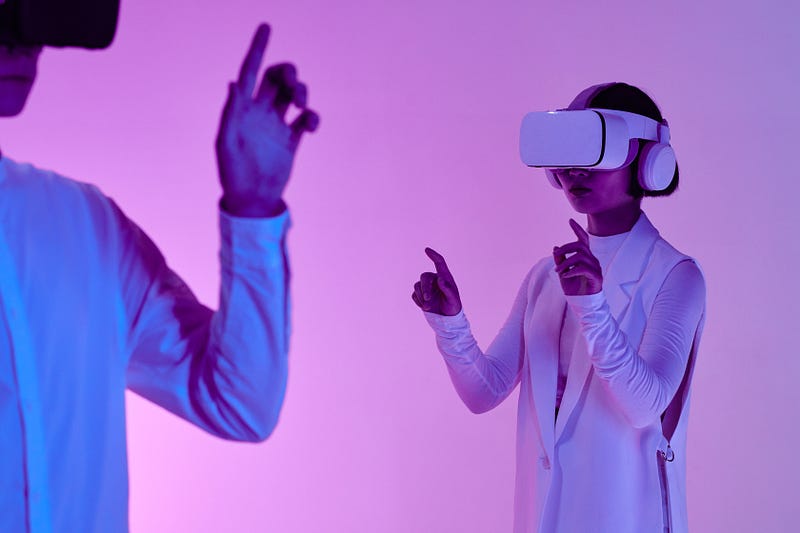
Metaverse might be the most significant technological disruption for humans in this century. No, I’m not talking about the Meta (Facebook) only.
I’m talking about the alternate digital reality or a collective virtual shared space where people might work, play, socialize and lead a life in the virtual realm created by converging our physical reality into the virtually enhanced state, with or without the connection to the physical self.
There have already been too many synonyms for Metaverse, like the mirror world, the AR Cloud, the Magicverse, the Spatial Internet, or Live Maps.
However we call it, the main objective is to mold our virtual worlds, augmented reality, and the Internet into an everyday living experience. According to ‘Reports and Data,’ the global metaverse market is expected to reach around USD 872.35 Billion in 2028, registering a staggering revenue CAGR of 44.1% in this forecasted period.
Metaverse tide has taken the world during the pandemic period.
During the lockdown days and covid-feared era (still), we have seen the tremendous usage of technology increase tenfold in our daily life. As we embraced digital presence more than ever before, the realm took off into unfolding other parts of our lives as well.
And that certainly kicked off the transition of Metaverse. From the gaming world to the NFT collectible platforms to the fashion industry, everywhere we will see the incorporation of a digital embodiment of our physical presence.
VR Products
Companies like Google, Microsoft, Apple, Horizon, Live Maps. Niantic, Magic Leap, Valve, etc., are building products for virtual interaction (like VR projects, apps, augmented reality tools, mixed reality glasses, AR simulations, video games, etc.).
Collaborations
Collaborations between organizations for releasing mixed reality products are increasing. Like the one that recently happened between Facebook (Meta) and Ray-ban, launching ‘Ray-Ban Stories’: first-generation sunglasses with video, image capturing capability, and live feed options on Facebook a couple of months ago.
Fashion
Gucci, Christie, Burberry, Louis Vuitton — big fashion brands have already stepped into the NFT field or invested in a future NFT project. ‘League of Legends designed skins’ by Louis Vuitton, or avatar accessories on Roblox by Nike and Ralph Lauren are a few examples leading the space. Digital fashion shows will be one of the big things that the fashion world will incorporate, like Hanifa.
Digital real estate
People started securing space in the virtual realm by buying virtual lands in Decentraland, Upland, Earth 2, the Sandbox, etc.
Metaverse Properties is the first virtual real estate company to provide premier metaverse experiences across platforms. Their supported platforms include Decentraland, Upland, the Sandbox, Somnium Space, CRYPTOVOXELS, etc. In some of those digitized arenas, you can interact with other people, purchase property, showcase your collectibles (art, dress, property, etc.) to the world.
According to Fortune, this industry might be a multi-trillion dollar industry in the coming days. And, this is just the virtual real estate I’m mentioning here. The physical real estate will also slowly incorporate virtual reality in their game-planning to cope (and not be left behind).
So, perhaps, a digitally authenticated virtual land NFT might be accustomed to your physical property in the future to make it more worthwhile, certified, and sellable.
Gaming
Of course, gaming has already been at the forefront of augmented reality, where Fortnite, Minecraft, and Animal Crossing are already popular with digital reality interactions.
Numerous immersive experience games are coming, adapting to augmented reality and the metaverse world. A big chunk of game developers is creating integrated games and interactive tools for the already made metaverses. The stakes are going up with Meta (with ‘Horizon World’ )and Microsoft in the game.

The global gaming industry already crossed 300 billion USD value in 2021, and Metaverse will grab a big chunk of the slice in the increasing value of this lot with the new integrations.
Music
You want to be at a concert, Metaverse will have the option to be present at the show in your digital self.
For example, John Legend recently conducted a concert (Bigger Love virtual concert) with the help of Wave XR’s technology to broadcast a virtual John Legend. Exciting, right?
Can you recall Netflix’s Black Mirror, season 5, Miley Cyrus’s episode, especially the concert part?
Close, eh!
By the way, Kings of Leon launched their music album, ‘When You See Yourself,’ as the first NFT traded music album of the world.
NFTs markets
If you go to OpenSea, you will see people are trading thousands of non-fungible assets every day. Numerous other platforms also opened up to create space for NFT minting and trading. For example, I have sold around 25+ NFT items in DESO (recently added into COINBASE trading).
Nike’s latest
Nike has purchased RTFKT Studios (a startup specializing in footwear lines that combine NFTs with physical shoes). By redefining and aligning the sync of the material and digital world (combining augmented realm to make it a mixed domain feel), they are innovating the space of fashion and sneakers sectors. Earlier in 2021, RTFKT Studios sold around USD 3.1 million virtual sneakers. Their exciting drops and new product lines will surely excite individuals in 2022.
The trend we see these days, many aspects of our lives will be coming under the Metaverse in quick succession, whether it is movies, office or work, or educational institutions.
“I do think that a significant portion of the population of developed countries, and eventually all countries, will have AR experiences every day, almost like eating three meals a day. It will become that much a part of you.” — Tim Cook.
Investors in Wall Street are excited, too (i.e., Morgan Stanley). Governments will also align their digital & IT framework, aligning metaverse strategy to cope with the changes. For example, a recent announcement from the South Korean government expresses the goal to create a national metaverse alliance for building a unified national VR and AR platform. The developments happening with ‘DeFi’ frameworks or Web 3.0 technologies are also helping the crypto market to align with the metaverse realm, slowly but surely.
But, it might not all be that positive that is being advertised.
LinkedIn Poll to know people’s reactions.
Last week, I ran a LinkedIn poll to know how people might embrace the Metaverse world. The number of responses was minimal, but the reactions showcased the caution and the tension.
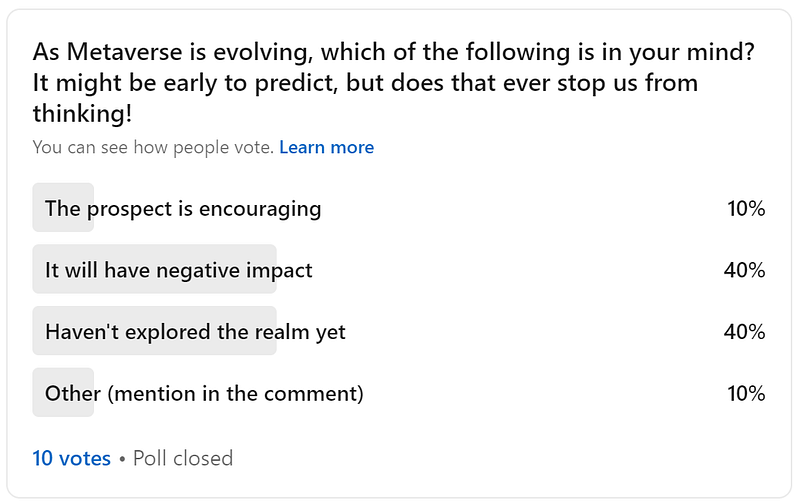
Most respondents mentioned that they are hesitant to be early adopters, as the prospect is frightening or intriguing. In addition, many respondents have not explored the concept yet.
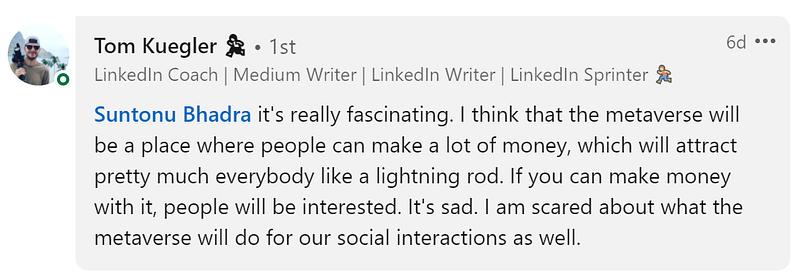
Tom Kuegler also mentioned that the prospect might be fascinating, but the toll on social interactions is still a concern for the days to come.
The concerns on Metaverse Realm
Technology fascinates me, so I always explore new technology news and updates. So, when the Metaverse realm was gradually coming live into many sectors, I started researching. I browsed through NFT marketplaces, explored Decentraland and Upland (even purchased a virtual land with free money).
I was excited at first but gradually became more concerned about the possible negative aspects.
I believe it will be impossible to handle Metaverse in the long run properly. Another aspect I am concerned about is that our social interactions in physical space will take a considerable toll.
A computer scientist named Louis Rosenberg (who developed the first functional augmented reality system) forecasted that integrating digital reality into our lives can ‘alter our sense of reality.’ It might also negatively impact our interpretations of direct daily experiences.
🔉 She also mentioned that corporations would gain more power and filter out more things into our feeds.
🔉 We will face serious identity theft issues, as much of our information will be available to the public domain and on the augmented reality feed, visible to others.
🔉 We will lose the physical space where we can still share and exchange knowledge in person. Instead, the digital interactions and live-feed information will fully replace the experience.
Can you recall Cambridge Analytica and Facebook incident? Unfortunately, similar incidents will be happening again and again, but with less resistance, as we will adapt to digital reality more than ever before.
We might forget what we truly need rather than what is fed to us.

End Notes
The technologies for the metaverse interactions are still in the infancy stage. Hence, future predictions about this new realm are still based on the current state of technology or the imaginary projection of technology.
Sometimes, it feels like the earliest stage of the dot-com boom, in the form of the Metaverse craziness. The investments in this predictive future are increasing. It will trigger lots of experimentation, projects, acquisitions, ups, and downs worldwide in the coming days.
A phrase first termed almost 30 years ago by science fiction writer Neal Stephenson currently transforming our reality. As time goes on, with the innovations, experimentations, and disruptions, the actual shape of the Metaverse will unfold. Ready Player One might become real in the coming days the way we are moving ahead.
Will it take us to a better reality?
I am not sure; nobody is. But, one thing for sure, your digital self is getting a much bigger space, and perhaps an authentic identity, that you might not be able to distinguish from your physical one in the coming days.