
Metacognition: The First Skill You’ll Need To ‘Rewire’ Your Brain
Learn The ‘First Step To Change’ with Dr. Joe Dispenza

How often do you think about your ex and immediately feel anxious or annoyed?
Or it’s Sunday night, and you’re already thinking about work on Monday morning and all the emails waiting for you in your inbox.
In an instant, you’ve gone from minding your own business to being high-key stressed, all from a single thought.
This experience is called a thought-feeling loop.
The reason we experience feelings of anxiety and stress in the present moment — even though the specific event we’re thinking about (the ex from our past or our job in the predictable future) isn’t actually occurring— is because our bodies react to whatever our brains are thinking about.
Your body can’t distinguish between what’s happening in real life and what’s being vividly imagined by your conscious mind.
If I’ve already lost you, I understand, and it’s okay. I know these concepts can be challenging to grasp at times, and some people aren’t in the right place to internalize this information. If that’s you, you can stop reading now and continue on with your day (I promise I won’t take it personally).
But if you’re here for it, and you want to continue, then buckle up.
Because if you can complete this article in its entirety and implement the ideas & exercises I’m about to discuss, I genuinely believe you will see significant improvements in your ability to notice the thought-feeling loops in your life and learn practical ways to develop a higher level of metacognition.
And I would argue that those two skills can significantly help you create a more fulfilling and purpose-driven life.
Dr. Joe Dispenza
So everything I know about thought-feeling loops, I learned from studying the research of Dr. Joe Dispenza.
Dr. Dispenza is legit. He holds a Bachelor of Science degree and is a Doctor of Chiropractic. He is also a researcher, lecturer, New York Times best-selling author and has post-graduate training in the following fields:
- Neuroscience and neuroplasticity
- Quantitative electroencephalogram (QEEG) measurements
- Epigenetics
- Mind-body medicine
- Brain/heart coherence
In short, his mission in life is to demystify the mystical, so people have all the tools within their reach to make measurable changes in their lives.
In this article, I want to give you a crash course on a few of Dr. Dispenza’s discoveries by doing the following:
- Summarize the science that goes into our thoughts and how they impact our emotions, and ultimately our life.
- Define metacognition and why meditation is an effective way to develop that skill in your daily life.
- Provide a simple meditation exercise that you can implement quickly and tips to help you develop a greater sense of metacognition and self-awareness.
A Quick Recap on The Brain
Before we dive deeper into thought-feeling loops and metacognition, we need to refresh ourselves on the brain and how it functions.
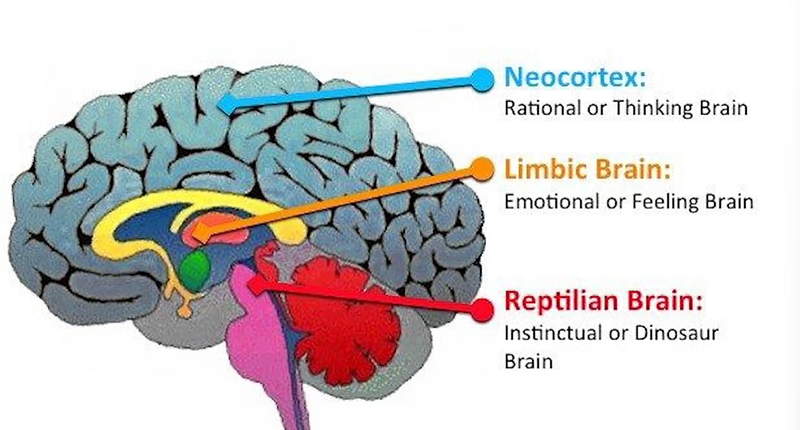
The Three Brains
Think of our brains as three smaller brains put into one. Each one has a specific function, and together they help us Think, Do, and Be.
- The neocortex is our rational/thinking brain. It is the seat of our conscious mind. It is responsible for our ability to invent, focus/concentrate, learn, pay attention, be intentional, speculate, restrain emotional reactions, and contemplate new possibilities.
- The limbic brain is our emotional/feeling brain. It’s responsible for sending chemicals throughout our bodies based on the information it receives from the neocortex. It also seats our autonomic system (aka your automatic nervous system), which is the part of the brain that subconsciously regulates blood sugar levels, hormone levels, temperature, breathing, and heart rate.
- The reptilian brain (the cerebellum) is our instinctual/dinosaur brain. It controls the subconscious mind and is activated when we perform the same actions repeatedly until they become a skill/habit.
In short, the neocortex thinks the limbic brain does, and after enough time, the cerebellum stores the habits you’ve formed and becomes.
Neural Networks
“Nerve cells that fire together… wire together” — Hebb’s Law
Neural networks are bundles of neurons in our brain that have been fired and wired together and are related to specific thoughts, memories, or behaviors.
They’re responsible for storing information like our shopping list, the texts we need to reply to, the meeting we have to attend, the bills we have to pay, the shows we want to watch, and all the other people and conditions in our lives.
Everything known in your outer world has a neural network associated with it. The more attention you place on those specific areas of your life, the more energy your brain sends to those corresponding neurons.
So the stronger those neural networks become, the more those specific thoughts and habits are stored in your cerebellum (subconscious mind), and the more those thoughts, feelings, behaviors, and habits eventually create a particular state of being.
Can Our Thoughts Make Us Sick?
Let’s go back to our thought-feeling loop example from the introduction, but this time, let’s include the terminology we just learned.
When your neocortex remembers a negative experience from your past (like the breakup between you and your ex), your limbic brain immediately recalls the emotions associated with that event (anger, fear, resentment). Then it sends neurochemical signals to the autonomic system, which produces the same hormones from that experience into your body, in the present moment.
Remember, your body can’t distinguish between what’s happening in real life and what’s being vividly imagined by our conscious mind. So the more those emotions are produced, the more they become hardwired in your subconscious mind.
Said another way, the more you think about your ex or, the more you think about all the reasons you don’t like your job, the more the related stress hormones are sent throughout your body, which are experienced in the present moment.
Science also proves that after enough time, stress-related hormones like cortisol and adrenaline can negatively affect our genes and be directly linked to causing diseases like heart attacks and strokes.
Meaning if we’re not careful, after enough repetition, these stress-inducing thoughts will make us sick!
But what if I told you this realization is actually a good thing?
Why? Because if that statement is true, then the opposite must also be true.
Suppose we were to focus our conscious thoughts on the more positive things in our lives that produced elevated emotions like love, gratitude, and joy. It’s equally proven that those thoughts can positively affect our genes and can ultimately make us healthier over time with enough repetition.
So knowing this information, we need to commit ourselves to remember this the next time we experience an intense negative thought-feeling loop. Having negative thought-feeling loops isn’t bad; allowing them to continue when you know they’re there is.
Meditation & Metacognition
The definition of meditation in Tibetan is “to become familiar with.”
But for the sake of this article, we will assume it also means “ to become familiar with *yourself*.”
Metacognition is the skill of becoming more aware of how you think, act, and feel.
So it’s safe to say that implementing a practice of meditation (where the only goal is to become more familiar with yourself) is one of the most effective ways to develop a higher level of metacognition (the conscious awareness of your thoughts, actions, and feelings).
Meditation Exercise
Meditation trains the body like you would train an animal, to pay attention to your conscious mind again.
- The first step to meditation is to sit our bodies down and close our eyes to disconnect from everything known in our outer world — The less sensory information that comes into the brain, the more our inner world becomes more noticeable than the outer world.
- The second step is to simply focus all your attention on the present moment. — The present moment is the point in time where there are no thoughts, no other people, nothing from your outer world, and nothing from your past or in your future. (Dr. Joe Dispenza describes the feeling of the present moment as one of oneness, wholeness, and absolute).
- The final step begins when you’re sitting in the present moment, and you inevitably hear a thought about something from the outer world. — When this happens, calmly focus on pulling your attention back to the present moment and try to find that feeling of oneness and wholeness again.
When you notice your attention beginning to veer toward the people, places, or experiences in your life, and instead, you redirect your attention back to the present moment; you’re intentionally choosing where to focus your attention, and you are consciously telling the body that you, the mind, are back in control.
And every time you do that, it’s a victory. And over time, those victories add up. Before you know it, you’ll start becoming more aware of your attention outside of your meditation.
Said in another way, you’ll begin to develop a greater level of metacognition.
It’s About to Get Uncomfortable
“The moment you decide to make a different choice for your life, get ready because it’s 100% going to feel uncomfortable, it’s going to feel unfamiliar.” — Dr. Joe Dispenza
If you have not already started a meditation practice, I must warn you now: your first few sessions will most likely be uncomfortable, and that’s okay; it’s expected.
Here are some tips that might help you get started:
- Start small: Start with a meditation session for 30 seconds to 2 minutes. Something so small that it sounds like a joke to your brain, but long enough so you can still practice the three steps mentioned above. – If you’ve had trouble developing a meditation habit in the past, it might be because the task initially seemed too daunting in your mind. But if you only focus on a 30-second meditation for the first week, it should lower the fear associated with the habit, and you’ll be more motivated to give it a shot.
- Quickly identify the uncomfortable thoughts: Thoughts like: “I can’t do this.” “It’s too hard.” “I’ll never change.” “This doesn’t feel right.” — When you hear those thoughts in your mind, remind yourself that’s your body reaching out to your conscious mind trying to get its most familiar stress hormones and emotions sent to the body again.
- When you hear the uncomfortable thoughts, remember: “Just because you have a thought doesn’t mean I have to listen to it.” — You can constantly challenge these thoughts with sound logic and reminders/mantras that inspire you to push through the fear.
- Don’t be afraid to customize the habit: If you have an idea for your meditation that sounds interesting, add it. If you need to be at a specific location, at a specific time, with specific things in your environment, then so be it. If you need to do it sitting on a chair or on the ground, more power to you. If you only have for once a week, then once a week it is.
- Embrace the meditation marathon: If you accept developing a meditation practice that works for you, you also need to accept that this will be a lifelong journey that you’re always working to improve. Just like exercise or mastering a skill at a high level, you never truly end the self-improvement pursuit. Practicing meditation is no different.
Metacognition is the First Step to Change
“Now, the next step is to take that knowledge, that philosophy, and to begin to apply it, to personalize it, to demonstrate it, to initiate that knowledge in some way.” — Dr. Joe Dispenza
So there you have it; a quick lesson on the brain and neural networks, a reminder on the power of our thoughts and how we always have control of them, the definition of metacognition, and why meditation is the most effective daily practice for developing this skill, and a simple meditation exercise with tips to help get you started.
But I get it.
Just because you know this information doesn’t mean your life will immediately become rainbows and sunshine. To this day, I still struggle with maintaining a consistent meditation habit, and I too, find myself occasionally experiencing negative and destructive thought-feeling loops.
But ever since I decided to intentionally develop my metacognition, I’ve learned to consciously focus my attention on the positive moments from my past that trigger feelings of joy, gratitude, or love more than the negative moments that trigger feelings of stress, anxiety, anger, suffering, or guilt.
The more I focused on those elevated positive emotions, the more natural positive energy I felt on a daily basis. So much that I now use that excess energy as fuel to focus on my future and intentionally imagine what it would feel like to experience those same elevated emotions there. (In another article, I’ll explain why that action is crucial for intentionally creating your destiny.)
I hope you go through that same conscious thought process during your new meditation practice and metacognition journey, and eventually, you also begin to see significant improvements in your ability to notice your thought-feeling loops and learn to develop more positive elevated emotions daily.
Which, after enough time, always leads to a more fulfilling and purpose-driven life.
Additional Resources of Dr. Joe Dispenza
- “Rewired” by Dr. Joe Dispenza on Gaia.com
- Interview of Dr. Joe Dispenza with Tom Bilyeu
- “Breaking the Habit of Being Yourself” by Dr. Joe Dispenza


