
Metabolism Required for an Information Mothership
The Information Mothership: ‘Maps’ and ‘Indexes’
Two polar approaches to handling information can be considered: “Map-like” and “Index-like” qualities. The map-like approach involves rearranging information spatially or temporally for intuitive understanding. The index-like approach involves categorizing information by attaching various concepts to it and seeking indices based on the content.
Both are important aspects of information, and neither method can fully govern all information on its own.
For example, imagine you see the name of a restaurant in a phone book. However, the name and phone number (concepts) don’t clearly indicate how far the restaurant is from your current location or how much effort it will take to get there (though you could roughly guess if the name contains a location or from the area code).
Conversely, imagine you see a mark on a map indicating that a restaurant is there. But the map doesn’t clearly indicate when the restaurant opens.
In the above example, a series of actions like “making a reservation at the restaurant and getting there” is accomplished by combining both types of information.
In simpler cases, the purpose is achieved by handling just one type of information, but the world of information surrounding humans is not so simple that it can be fully understood by one or the other.
Therefore, if an application or tool specializes in one aspect, it shouldn’t be used to handle all information. Methods often heard like “write all information into this notebook” will eventually falter somewhere.
So, recognizing that information has these two aspects, it’s crucial to think about how to combine tools useful for each aspect to govern the whole. When those tools extend over multiple platforms, a “mothership of tools for handling information” is needed.
The physical body has a “home” or “place,” naturally securing stability and a sense of belonging. However, the mind and consciousness are formless, diffuse in multiple directions, and are potentially hard to converge. If this diffusion progresses extremely, there’s a risk of losing the focal point or home of the mind.
In such situations, a “mothership of tools for handling information” becomes a valuable existence. Amidst the scattered array of diverse tools, information, and thoughts, it serves the role of providing a singular “mental base.” By returning to this “mothership,” one can readjust themselves and refocus when faced with chaos or excessive diffusion.
Thus, when numerous tools exist, each specialized for a particular aspect, a “mothership” to harmonize, oversee, and manage them is necessary. With this “mothership” in place, one can return there to reevaluate the situation and plan the next course of action when any issues or confusion arise, or if some of the tools fail.
Problems with Using Obsidian as an Information Mothership
Obsidian allows for the possibility of becoming a mothership for both facets mentioned earlier, through the use of its plugin ‘DataView’ and its built-in feature ‘Canvas’. However, I find it difficult to rely solely on Obsidian due to specific issues in these key features.
DataView is highly efficient, but to use it freely, you need to learn a specialized language. While this is very effective for people familiar with programming, for general users, the best they can do is to secure a template and customize it to be useful for them.
Canvas does not add backlinks to the notes you place. I still don’t understand why this is the case.
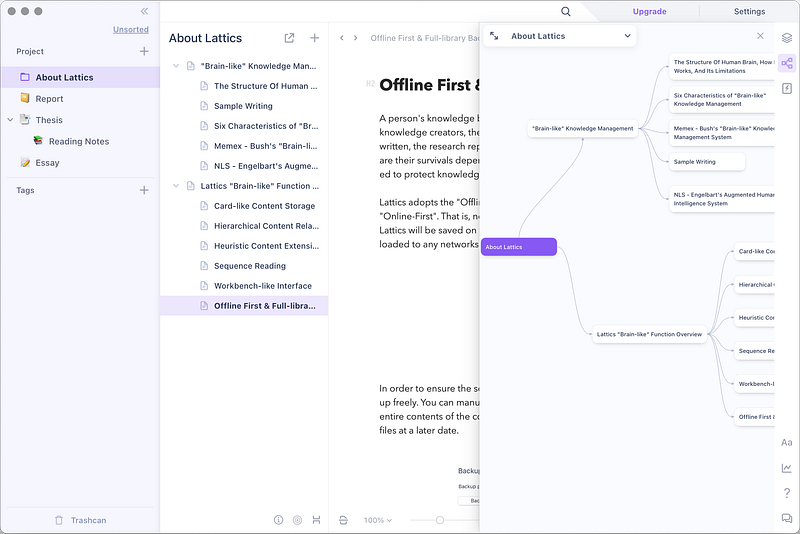
Although not directly related to the above, another issue is the handling of attached files. Due to the app’s structure, attached files exist as ‘independent references’ from the note. This poses several inconveniences:
Even if a note matures into an effective chunk of information with various attachments and links, it cannot be exported as a package for reuse in other apps. It’s only effective within Obsidian.
If an attached file has the same level of significance as the note itself, deleting the parent note leaves the file remaining within the Vault. This becomes a problem as these orphaned files are not explicitly revealed unless found in something like a ‘Graph View’. Essentially, ‘unnoticed but currently unnecessary information’ continues to take up storage space, which is unavoidable due to the structure.
Although the above issues can be solved by the ‘Consistent Attachments and Links’ plugin, it does not offer 100% reliability.
For these reasons, I could not make Obsidian my informational mothership. To draw an analogy to the human body, it’s like having a highly efficient ‘ingestion’ and ‘digestion’ system but having issues with ‘excretion’.
Random Thoughts on the Potential of Heptabase as an Information Hub
Heptabase features a Whiteboard function as its “mapping” aspect. This feature is simple, multifaceted, and incredibly deep — too deep to cover in detail here.
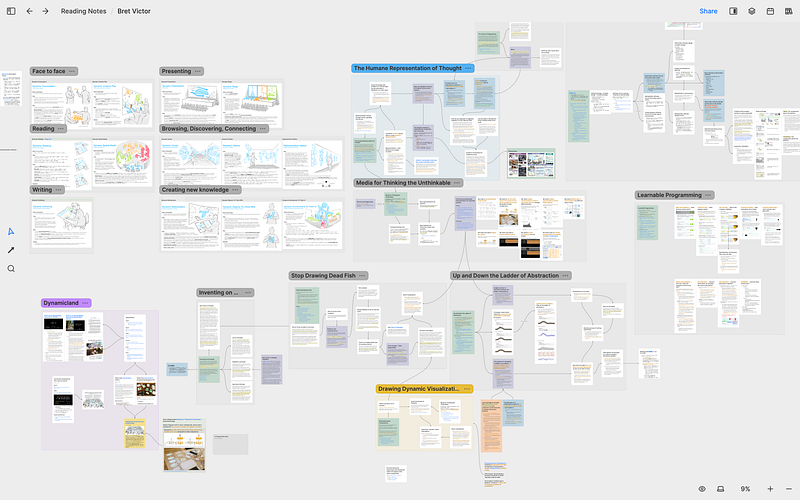
One unique characteristic of the Whiteboard is the multi-layered nature of its elements. These are supplementary pieces of information situated around the main units of information called “Cards.” These supplements function like Post-its that surround the Card; they are not the primary information, are not managed by tags, and serve as low-status ancillary data. (Card conversion is possible at any time.)
This allows for the flexibility to demote information previously considered valuable or to promote minor elements as major ones, essentially providing real-time selection and rejection capabilities.
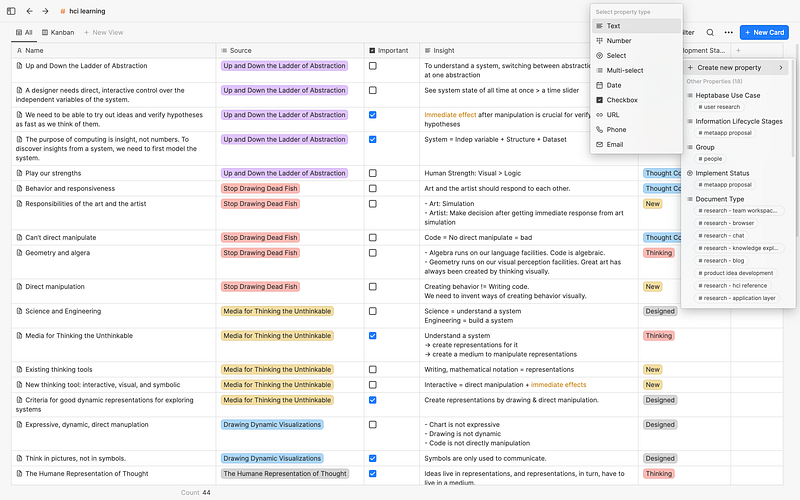
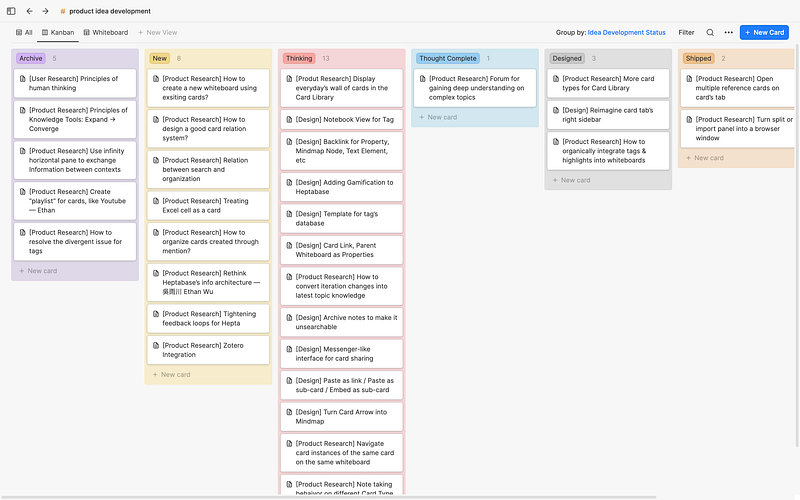
Furthermore, its Tag feature as a form of “indexing” has a deep structure that sets it apart from other common information management apps. This feature allows for tabular-style viewing and more dynamic handling within Kanban boards.
Only Card elements that are tagged are managed in this area. That is, some information is managed both on the Whiteboard and here simultaneously, while some Card information is only referenced under tag attributes and does not exist on the Whiteboard. (Elements on the Whiteboard can’t be tagged, so they are not handled here.)
At this stage, it’s not possible to select multiple cards within the Tag area, which gives the impression that this area is primarily designed for classification and viewing. However, as the operability of cards in this area improves, the selection and rejection of card information from this perspective will likely become more practical.
Whiteboard and Tag in Heptabase
In the official manual, these two areas are described as “sibling-like entities.” The unit of information in Heptabase, known as a “Card,” is managed by either or both of these areas.
As of now, if asked whether these two have fully established seamless interoperability within Heptabase, my understanding would be “not yet.” However, this would likely be accomplished at the end goal that this structure aims for.
In fact, there is a separate area called “Journal,” but its relevance to the Tag area is currently minimal, so it can’t yet be considered a comprehensive area for all information. The “Card Library” contains all cards from both the Tag and Whiteboard areas, making it a sort of initial comprehensive location for sorting and selecting information.
Information accumulates daily, and within that accumulation, it is categorized and deleted, evolving into a form that better suits one’s lifestyle. Just as our physical bodies become closer to an ideal state through exercise, so too does information become refined into an ideal mental alias.
There are likely such flows in Obsidian as well — flows that can only be achieved in Obsidian. Similarly, there are such flows in Heptabase. These flows should maximize their potential when matched with the user’s exercise methods and philosophy.
What I Wanted to Say Here
For something to serve as an information mothership, it is crucial for the processes of ‘intake’ and ‘excretion’ to be smooth, much like in a human body.
Why ‘Excretion’ Is Important
Because a mothership and a warehouse are two different things.
A warehouse is characterized by a fixed location and its primary functional purpose is the gathering and categorizing of items. There is no need to constantly reside in a warehouse, nor should one. In contrast, for a mothership (where one is onboard), what’s important is its ability to ‘move toward a goal.’ To progress, just like the metabolic pathways of our own thought processes, the mothership requires an energy metabolism to enable its forward motion.