
Message in Time
Part One: Weaving A Way Through
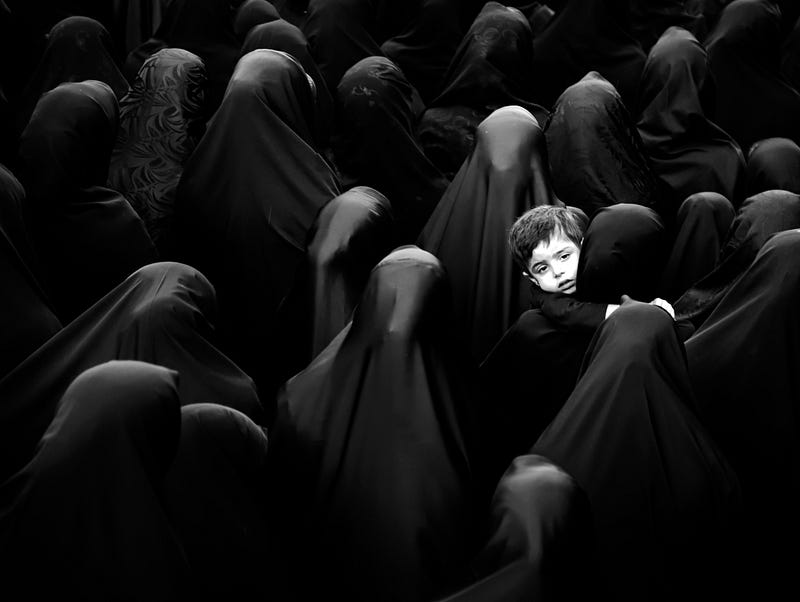
“I rang your cousin in Pakistan and asked them to sacrifice a goat for you to get well. They will distribute it to the poor, after prayers in the mosque”.
It was a moment before I realised that it was me who’d groaned loudly at this news. My mother glared at me as she stood at the foot of my hospital bed. Obviously they had expected me to say something appreciative… one ‘shukreeah’ at least. But my father understood I was in a lot of pain after the operation. He was actually, a remarkably sensitive, empathetic man. I knew he was hoping his prayers (and those of the people back home in his village, who ate the goat) would reach heaven. That the Divine would be persuaded to speed up my healing. (This daughter’s foolishness in being vegetarian, was not going to get in the way of doing what’s right.) Eventually she would get better and become normal again!
I suppose we all have some sort of contradictions that have been knitted into the very warf and weft of our consciousness. My parent’s contradictions mostly revolved around the need to survive in the openly hostile, racist climate of the UK in the 1970’s. My father worked damn hard, doing double shifts of 16 hours in the factory, getting up before dawn and cycling through wind, snow , ice and slush to do that physically demanding work during those harsh winters in the North of England. He would hand over his wage packet — I think in 1970, it was around £5.00 a week to his wife, as was the custom of his father, and his grandfather too. (Put that in your pipe and smoke it, white feminists.)
Thanks to my mother’s wise housekeeping, by around 1972, my parents eventually saved enough to get a mortgage on a business property. With advice from others in the Asian community, they had applied for a licence to sell alcohol, even though it says in the Koran, selling alcohol is as bad as drinking it. But they reasoned, (along with all the other Muslim business owners) that the whites would buy it from somewhere anyway, so they might as well buy it from their local corner shop.
I took a deep breath as the throbbing pain around the stitches calmed down. I opened my eyes again, to the crane and bamboo curtains and my nephew’s sing song reciting of the Koran. I kind of wished I was back in the hospital actually. I had felt safer, freer, there. Now, I wanted to get away, back to my life in Leeds, but I would need to keep very still for at least a few more days. It was sweet, in a way, waking up just now, to my nephew’s voice as he was reciting… well… I have to admit, there was some ridiculous, immature, childish part of me that liked the breathless rhythmic intonation of those oh so-familiar sounds. For this had been one of the things that had distinguished me from the other children at my nearly all-white school in the 1970’s.
I’d been the one brown face in a sea of pink. Being called ‘Paki’, ‘nigger’, ‘wog’, was nothing unusual. Naturally, this ensured that I never felt I belonged. Because to be accepted as English or British, you obviously had to be white. By the end of my first year in the secondary school, I’d stopped talking to most of the other children around me. Defiantly, I had embraced my difference …. I would become browner! So when I got home, I made a point of facing the sun and baring my arms in the little stream of sunshine that reached our back yard — though of course, a yard in Middlestone is hardly akin to sitting under the Saharan or North Indian sun!
In those days, I loved learning the sounds that my mother taught me, each dancing curve and angular stroke of Arabic letters, looked to my eyes, beautiful. I had adored the fact that my mother could teach me the sounds of these letters, then string them together into sentences, which we chanted like a magic spell. It was something that my classmates’ mothers’ could not do. So what, if their mothers helped them with their homework? So what, that I had to read and then translate into Punjabi, the mail that came to our house, as my parents could not read English? Me, learning to read the Koran was the magic carpet that would transport me into another world, a world of significance and meaning that the white children had no entry into, just as they made sure to let me know I did not belong in theirs.
Little by little, I had rejected not only the name-calling children (always white boys) but most of the white girls too, for their silent compliance, for never sticking up for me. I turned my back on the lot of them and chose the freedom and solace of solitude, missing school dinners so I could sit alone at lunch time, reading. Taking from my school satchel, an apple, a packet of crisps and a bar of chocolate, I would enter another world, hungrily devouring one book after another, week after week on the third floor of the Humanities block. Sometimes another refusenik or curious kid might join me for a few minutes, but it was Janice who became my best friend and we often spent our whole lunch time together.
It was funny in a way, because we were opposites in so many ways. She was very tall, with a kind of Celtic look, her very pale skin, making her dark brown hair look even darker. Unlike me, she was a practicing Christian and also unlike me, she was not at all athletic. But we both shared a love of reading. So she often joined me on the third floor of the humanities block, near the wall of books that separated the classroom from the open plan study area. Janice’s parents were so wealthy that she had a study of her own. I didn’t care about that, but it was one of the things that had made her a pariah of sorts with the other girls.
I tried to turn in bed but a shooting pain went up the middle of my body, where the stitches were, bringing me out of my reverie.
“Oh Auntie, are you alright? “ Again, Haroon bounded up from his cross-legged position near my bed. The painkillers were not working so… but I was feeling all woozy.
“ It’s ok… I tried to shift and … pulled on.. the… the stitches”.
Just then the door opened and my mother came in. I gripped the quilt tightly.
“Haroon, thu itha kee kartha vah?”
“Let him stay, Umeegi, I am awake now”, I said, my voice quiet. It hurt to speak, even just to take a deep breath.
“Kosh chaitha?”
“Just a glass of water and some tissues”, I answered, avoiding her eyes.
I closed my eyes again, and in turning sharply away from her, was rewarded by another stab of pain along the length of my belly where the stitches snaked five or six centimetres long. I gritted my teeth. My tears rolled across my cheeks and wet the pillow.
Here was this child of nine, being taught to recite the Koran, being taught to read without understanding, without his intellect being challenged, without any attempt to synthesize moral, spiritual and social considerations. Bereft of all meaning, how could his reasoning capacity, his ‘aql’, develop? Was this not the source of decadence and corruption, the crypt in which ignorance and hypocrisy flourished in Pakistani Muslim communities, wherever they transplanted themselves? Rote learning was the game and the aim? Why, to tame! Ask not for the reason why, just obey or else, get lost and die! Where the heck was our William Tell?
How ironic, that I, the outsider at my almost all-white school, had so soon become the outsider from the bosom of my Muslim family too. It was all because I was Hungry for Meaning. Aged twelve, I knew I had so much to learn. I used to lie awake at night, staring into the grey fogginess of the Northern English sky. Travellers had stars to guide them, but what had I? I’d burn with questions that had arisen during the day. The conflicting visions of reality and values, between home and school were chopping my inner world into senseless contradictions. My questions were huge bridges of Possibility and chasms of Probability, flurries of Maybe’s and Somehow’s as I spun in tornadoes of confusion. I wondered why my two older sisters didn’t feel what I felt. Why did I have to become the pariah, asking questions my parents didn’t have answers to? Finally, I had protested to my mother.
“Reading the Koran in Arabic, is wasting my time! If Allah sent the Koran as a guide for Muslims to live by, I need to understand it. I should learn Arabic properly, understand the meaning of words, not just make sounds strung together. Or at least, let me read the Koran in English.”
“Stupid girl, we don’t read to understand, we read to place Allah’s words in our heart”!
Later that week, my father joined in with her efforts. Together, they tried bribes.
“We’ll get you a new suit, Ruhannah, beautifully embroidered with those little round mirrors, you like, once you have finished all the Koran.”
They tried threats.
“If you don’t read the Koran, you will burn in Hell forever”.
“At least finish the fifteenth chapter which you are on’, wailed my mother at one time.
“Then, when you come to your senses, you won’t have to go back to the beginning, but can carry on from the sixteenth chapter…”
“But I have come to my senses,’ I replied defiantly. “From my reading in the library, I know the word ‘Islam’, means submission to Allah’s Will. But how can I submit my will, when I don’t know anything about what Allah’s Will is?”
Another time that week, when my older sister had meekly read the daily dosage of Koranic pages, (with her mind as usual on something else), I had again refused, saying, ‘You want to turn me into a parrot, but if Allah had wanted me to be a parrot, he would not have made me human”.
My father was home that evening, and he swore at me.
“Look down when you talk to me!” he commanded, but I carried on looking him in the eye. So I was rewarded with some thumps and slaps for being so impertinent. But neither my father nor my mother had been able to repudiate the logic of my thinking and so aged twelve, I had taken the stand to make my life, be a life based on reason, not the hearsay of tradition.
And it was at that point that I’d become intractable, uncompromising. With my mind cut loose from the authority of the adults around me, I had begun roaming libraries like a refugee from illogic and ignorance, searching for answers from authors, dead or alive.
However, nothing I said or did ever made a dent in my parent’s habitual ways of thinking and doing things. Not even when my much-respected grandfather visited from Pakistan and actually agreed with me! He agreed that the Pakistani custom of teaching children to recite the Koran, teaching them just the sounds of the alphabet without any teaching of the meaning, was indeed not right. His momentous realization happened shortly before he died in August 1991. Haroon was about seven years old then. And now, two years on, here was my mother, continuing to teach the same old thing, the same old way, to her grandson. She made no reference to the battles with me, when I was twelve years old, and how despite all the ways I was pressured conform, I had stayed true to my own senses. I had never resumed reading the Koran in Arabic again.
Twenty-two years later, my bravery and intelligence, was still denied. My grandfather’s deathbed insights, ignored. Blind tradition was to be, blindly applied. What could I do now?