
Merui Seshu
This life held little promise for women and slaves
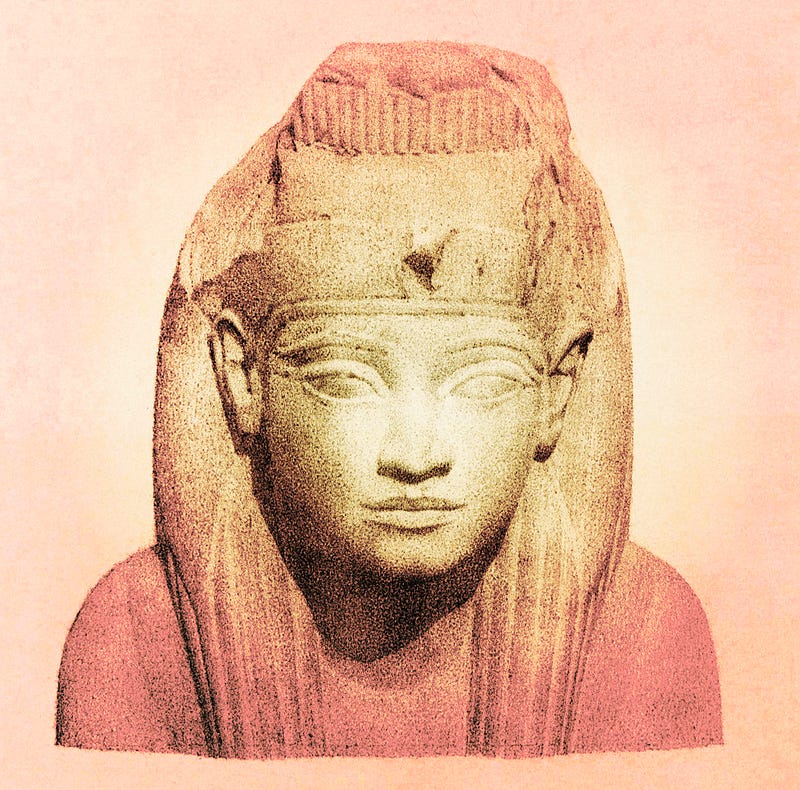
Mut Sesha-T rolled clay between warm fingers until it felt like living flesh. Quickly, she shaped a woman’s body. On its legs, she inscribed blessings and instructions: To love, to teach, to write, to impart wisdom and kindness. Adorning it with beautiful clothing, she painted it to look like her. When her daughter, Masika Maat, awoke, she would know her and be unafraid. Into tiny hands she placed a tablet and a stylus. Over the crook of its arm, she hung a basket of tiny bread loaves and fruit. Keep her safe, Mut Sesha-T whispered, where I cannot. She exhaled, willing her own life’s breath into the delicate lump of clay, as tears streamed down her face at last.
Mut Sesha-T was known to Pharoah, though she was but a slave. Her shabti figures were exceedingly lifelike — said to be so good they might fool the gods of the underworld into believing they could command a king to work their fields in the afterlife. She wove powerful magic into each, and adorned them with all the tools of their respective trades, so that they would be equipped to bring great honor to their owners. He, himself, had a thousand of Mut Sesha-T’s shabti. But such powerful magic was reserved for kings and nobles, forbidden to slaves.
To use the magic for her own daughter was forbidden — punishable by death. It was good that he had all the shabti he would need in the underworld. Mut Sesha-T must set an example, lest powerful magic like hers be turned against a king.
Mut Sesha-T knew and accepted what was to come. As she wrapped the shabti in her child’s arms, she laid another figure atop the burial clothes. It was equally lovely, but there was no time to weave the coffin spell — no time, and no need. Mut Sesha-T prepared herself for the judgment of Osiris. Her heart felt lighter than a single, downy feather.
When Pharoah’s men came, they snatched the second shabti from the coffin and smashed it on the stone floor, grinding it savagely underfoot. Mut Sesha-T stared at the shards and barely felt the blow that ended her.
Merui Seshu, beloved scribe…arise.
I awoke, stretching languorously in the morning sun. “I hear you! No need to shout!” Had I merely dreamed the voice? Where was I? On the floor, apparently. A child lay on a palm-covered bier, beside me, smiling in dreams of her own.
Masika Maat. I heard her name on the warm wind that blew through the open window from the sea. I watched her scrunch her face and bat away some demon that plagued her. I smoothed her hair. She sighed and smiled. Opened sleepy eyes. “Mama!” she cried.
I scooped the child into my arms, feeling the rightness of her there, and understood my purpose: To write her a new story, a better story than the one Isis herself had imagined for her.
This month’s prompt:
This “flantasy” (flash-fiction fantasy) story was inspired by the shabti figures (funerary figures, meant to be servants in the afterlife) of ancient Egypt.


