
Men Have About the Same Average Number of Sex Partners as Women
And more about other aspects of the myth of male promiscuity

Over the past couple of months, I’ve written about various aspects of the popular assertion that men are somehow biologically programmed to be much more promiscuous than women. It’s a long-standing cultural belief often used to justify certain male behaviors or to point to certain social dynamics as being inevitable.
Unfortunately for the pop evolutionary psychology bros and wanna-be “alpha males” who often tout this, there’s no real substantive evidence of this dynamic in nature. Promiscuity can have reproductive benefits, but in many species, including all primates, the same holds true for females as well. In addition, there’s also a lot of evidence of choosiness in males as a sometime reproductive strategy. It depends on the situation, and most researchers who have studied human mating agree that there is no universal set of strategies that always applies. Human mating is adaptive to a wide variety of circumstances as well as cultural conditions.
I’ve already deconstructed several aspects of this myth, but here is a brief recap, as well as a deeper look into the actual average number of sex partners for both men and women in the present day.
First was an in-depth look at the famous fruit fly study from the 1940s — one that has long been considered scientific proof that males are just naturally randy and promiscuous and that females are choosy and sexually reticent, as Darwin first hypothesized.
The Bateman Principle, as it came to be known, is full of unsound methodology, and faulty science that is completely obvious to any student of genetics, and yet, it is still considered important and relevant in some circles today because it tells a story that some people really want to believe in. Many research teams have unsuccessfully tried to recreate Bateman’s experiments and have pretty much all reached similar conclusions about its failings.
“Here was a classic paper that has been read by legions of graduate students, any one of whom is competent enough to see this error,” Gowaty said. “Bateman’s results were believed so wholeheartedly that the paper characterized what is and isn’t worth investigating in the biology of female behavior.”
“Our worldviews constrain our imaginations,” Gowaty said. “For some people, Bateman’s result was so comforting that it wasn’t worth challenging. I think people just accepted it.” Source
Next came a look at the pop evolutionary psychology assertion that men are biologically designed to be promiscuous because “a man could impregnate 100 women in 100 days.” Perhaps if you were Genghis Khan with a vast harem of fertile young women that you didn’t have to meet or entice into sex with you, this could happen, but that wasn’t a common thing at any time in history.
Despite the average man likely having enough sperm to perhaps pull this off, it has no evolutionary relevance because real-world circumstances, including other factors other than available sperm, also have to be taken into account. Just because Genghis Khan could do this, doesn’t mean it’s relevant to most men and certainly not to our Paleolithic ancestors, as sometimes asserted.
Something is evolutionarily adaptive if it leads to fitness, meaning the chance of offspring living long enough to produce their own offspring. Even if a Paleolithic man could have met and wooed 100 fertile, ovulating, not pregnant/nursing, or otherwise unavailable women in 100 days, there is no way that the vast majority of those offspring could live long enough to reproduce. In short, as one commenter noted, “That’s a lot of child support.” For humans, having a few offspring whose well-being you invest heavily in is a much better strategy for passing on your genes than a large number that you don’t invest in at all.
In addition, until about 12 thousand years ago, the world population had not yet reached 1 million. At that time, most humans lived in small bands of 20 to 50 people, and although they did interact with neighboring bands fairly regularly, in part to trade members for the purposes of genetic diversity, it seems unlikely that most Paleolithic men would have met much more than 100 women in their lifetime, to say nothing of all the other problems with this theory which I’ve gone into more depth in the story dedicated to it.
But ancient history and theoretical suppositions aside, the real way we can determine that men are not naturally randy and promiscuous (at least not more so than women) is by looking at current mating habits. It turns out that on average, men and women have around the same number of sexual partners over their lifetime and there’s also a huge amount of variety.
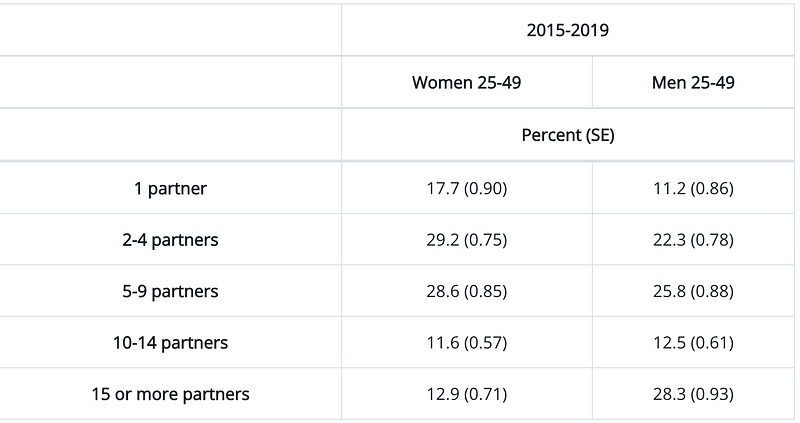
The 2014 study on CDC data mentioned above in the section on age is very telling. In general, there’s a lot of variety in the number of sexual partners people have as adults. Having just one partner in your lifetime is generally as common as having 10 or more lifetime partners. (source)
Among heterosexuals, the numbers skew slightly towards men having more partners, but overall really aren’t that significantly different, particularly when you take into account how much more women have to consider their safety, whether or not they will get pregnant, and other social considerations that men today don’t have to face, such as being considered a slut. The only place where there is a large difference is at the very highest end of the spectrum. Only 12.9% of women have had 15 or more partners vs. 28.3% of men ages 25–49, but in every other category, it’s pretty similar.
Additionally, recent research from all around the world indicates that women are the ones who get bored with monogamy long before men do. Women may like the closeness and comfort of monogamy, but it is well documented that it does tend to tank their libido.
“Moving In With Your Boyfriend Can Kill Your Sex Drive” was how Newsweek distilled a 2017 study of more than 11,500 British adults aged 16 to 74. It found that for “women only, lack of interest in sex was higher among those in a relationship of over one year in duration,” and that “women living with a partner were more likely to lack interest in sex than those in other relationship categories.”
The psychiatrist and sexual-health practitioner Elisabeth Gordon told me that in her clinical experience, as in the data, women disproportionately present with lower sexual desire than their male partners of a year or more, and in the longer term as well. “The complaint has historically been attributed to a lower baseline libido for women, but that explanation conveniently ignores that women regularly start relationships equally as excited for sex.” Women in long-term, committed heterosexual partnerships might think they’ve “gone off” sex — but it’s more that they’ve gone off the same sex with the same person over and over.
So who is actually more biologically “programmed” to be promiscuous?
As I noted above, in both animals and humans, sexual promiscuity can offer an evolutionary advantage — for both males and females. “A female who mates with several different males will have more genetically diverse offspring, boosting the chances that at least some of them will thrive.” Source
In fact, female primates couldn’t be further from reluctant breeders or seekers of “intimacy” with a single “best” mate, or dead set on doing it with “the alpha.” Indeed, Small suggests that it is difficult for us humans to wrap our minds around “just how little importance nonhuman female primates attach to knowing a male before they mate with him.” Au contraire, our primate sisters are sexual adventuresses, driven by the thrill of the unknown and unfamiliar.
Martin, Wednesday. Untrue (pp. 164–165). Little, Brown and Company. Kindle Edition.
The Darwinian notion that only males are naturally randy and promiscuous — and that females are biologically designed to be choosy and sexually reticent is really just a projection of Victorian mores. Bateman’s supposed confirmation of Darwin’s theory isn’t scientifically sound, no matter how much it was embraced, and a look at the actual number of average partners shows no great gender disparity. All of the purported evidence falls flat and doesn’t prove what it claims to prove. This is really just another cultural myth — one that our Paleolithic ancestors would no doubt find strange and absurd.
© Copyright Elle Beau 2023


