
Memories of Murder (살인의 추억): Milestone in Korean Cinema
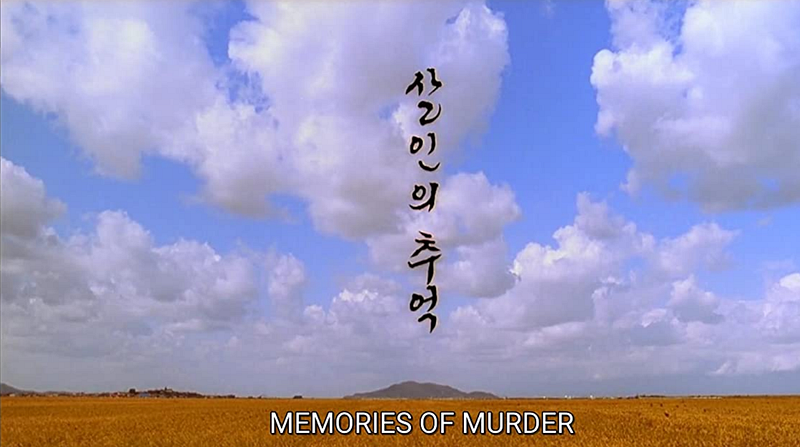
After watching this masterpiece countless times; I have concluded that this movie is more than merely a crime thriller. It floats in the van diagram of more genres. Let’s glance at the synopsis and then see what makes it a milestone in cinema!
Synopsis
The movie is based on the serial killings and rapes of more than 10 women in Hwaseong between 1986 and 1991. These serial killings were also South Korea’s first confirmed case of ‘’Serial Killer”. The movie opens up with local detective Park Doo-man ( played by Song Kang-Ho) investigating a murder-rape case. It becomes rather clear that the investigations were poorly handled, authorities were shown to be incompetent and overwhelmed, systemic evidence collection and forensic investigation were almost non-existent. Seoul city detective, Seo Tae-yoon ( played by Kim Sang-Kyung) volunteers to join the investigation of this small-town murder. Seo is shown to be a competent, silent but strongly opinionated detective. What follows from here is a clash of these detectives, cat-and-mouse game to catch the perpetrator, incompetency, and ignorance of task force, the sexism that is shown very subtly (just like the real world where it is mostly covered with backhanded remarks), and a whirlpool of twists, emotional moments and nail-biting scenes.
Detective Park Doo-man
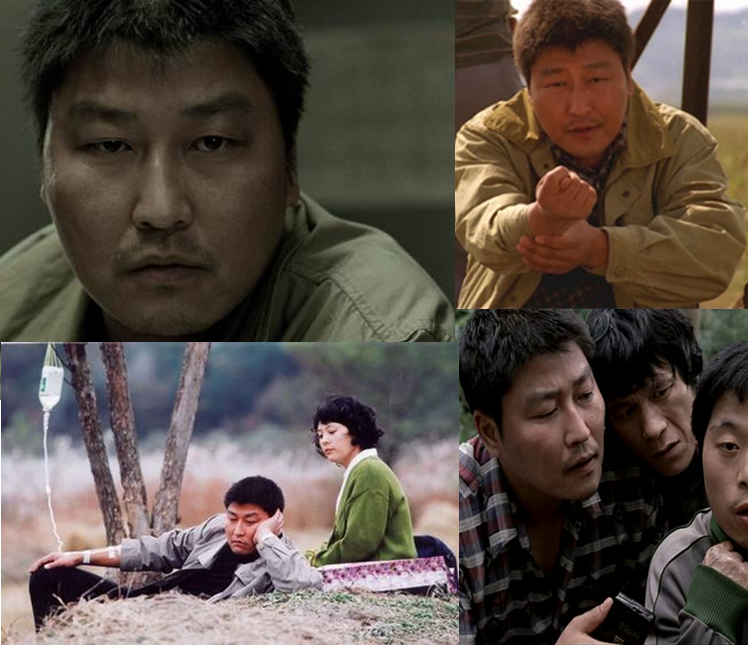
Detective Park Doo-man is shown to be quite an ‘eccentric’ detective at the beginning of the movie and one does not see him as a reliable detective(given the gravity of the situation and his actions towards it). We are made to believe this when he claims that he can tell whether a person is guilty or not by looking directly in his eyes (he claims to have shaman’s eyes). We see him forging evidence and he is rather concerned for his popularity by solving the case at any means possible than to solving the case. Park is seen advocating the beating of suspects and justifying it with the evidence that he falsified. Park’s partner is portrayed as the muscle man, who beats the suspects thinking that they would confess. He is also seen beating protesters and getting into a brawl with the public. Safe to assume that Park with his partner, were headed for the disaster. Eventually, that happens when we see them getting humiliated in the press, even humiliating themselves in front of the new superior. Park’s frustration piles up as they fail over and over again to catch the perp, while more killings and rape occur. Even after they somehow manage to identify the pattern and MO of these cases. At one point, Park pays a visit to a shaman to gain a lead!
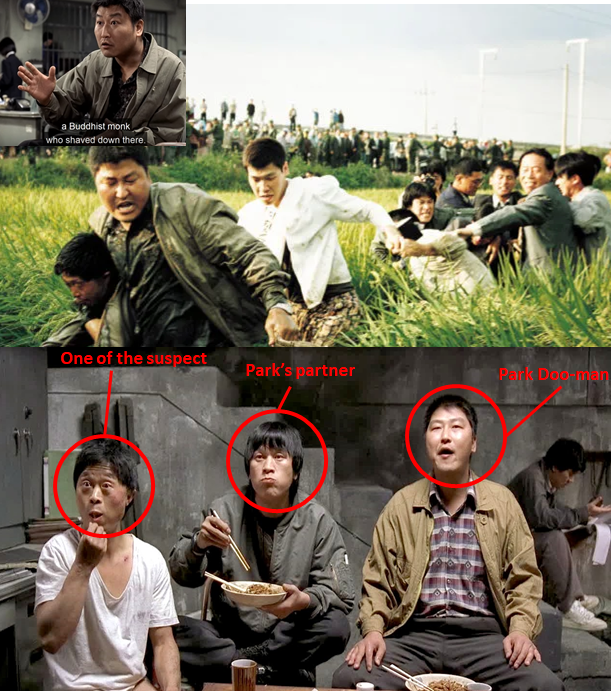
However, Park’s perspective and actions towards this whole case and everything, in general, start to change. It’s hard to pinpoint that exact moment in the movie, but we see something shifting in him. It could be guilt, shame, or an actual sense of duty that dawned upon him. We see him following up the evidence, conjecturing theories based on it, and not acting on whims. We shall later look at how the movie shows more of human nature, the failure of the system, and watch the movie was about since the movie never revealed the actual killer!!!
Detective Seo Tae-yoon
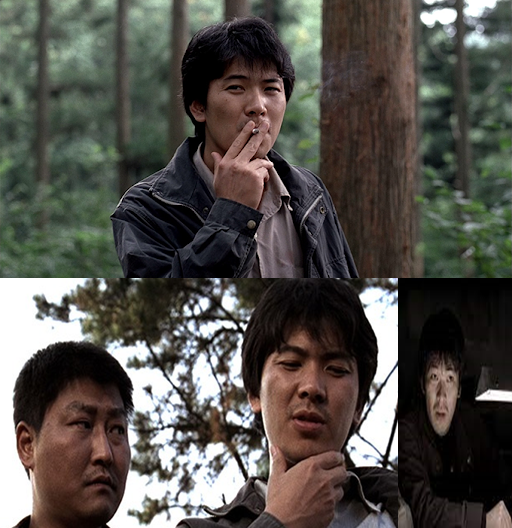
Detective Seo can be seen as the polar opposite of Detective Park as soon as he appears in the movie. A big-city detective, playing always by the rules, talking only when asked to or necessary; keeps himself away from the shenanigans and rolls on his own (no pun intended !!!). He starts going through documents and evidence quietly in a corner while his colleagues are busy beating suspects for confession. The newly appointed superior sees the rationale in him and starts steering the investigation the way Seo wants. Naturally, this doesn’t fit well with Park; followed by friction and exchange of fits between these two. Instead of doing everything by the book, Seo fails over and over again and he ramps up his efforts. He finds himself at the dead-end of every path he takes. This takes a toll on him so much, from the frustration and anger that the calm and confident Seo is now shaky and unreasonable. To a point where Park has to control his rage and fits.
Character arc
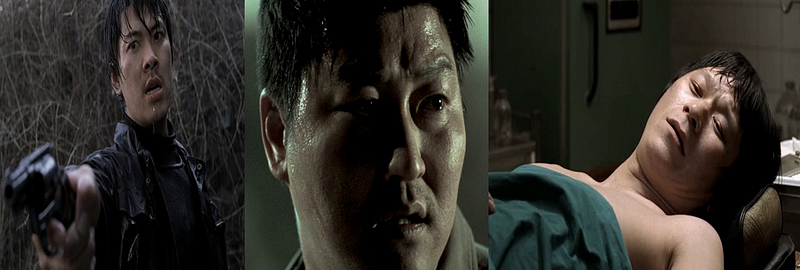
This movie can certainly be seen as the study of human nature. Look at Park, a guy who trusted shaman to catch the perp lets go a suspect when it seems highly probable that he is the one! Why? Because a scientific report proved he can’t be the killer. Also, he admits by the end of the movie that now he is unable to tell if a person is guilty or not just by looking in his/her eyes. He starts questioning himself and his psychic ability. On the other hand, Seo completely flips under the same conditions and starts morphing into Park. He starts getting violent to a point of even coming close to killing and not believing in evidence anymore. He seemed to be engulfed by rage and frustration and doesn’t care about logic and evidence. Park’s partner who is always seen beating suspects and protesters with his proud military boots had to get amputated after a public fight. It is almost like each of these characters morphs into what they hated the most in another human. Park could not stand the big city gun because he uses his head more than his legs. Seo was pitiful and belittling Park for not being able to be a “real” detective! Whereas Park’s partner was a representation of the 80’s Korean dictator regime, ends up losing a leg (and his pride and job with it). For me, it was not just a story about them trying to catch a killer but more of a study of how we behave in chaos and mayhem, how we are ready to put horse blinders to get what we want, and, as Bong joon-ho said: “ he wanted to represent the Korean society in 80's”.
From suspects to victims
This idea or concept didn’t hit me for a long long time, only after I watched the movies so many times that I started noticing the nuances. Since Bong joon-ho says all his movies are mere a social satire, he likely wanted to show the brutality of the task force in 80’s South Korea. It is interesting to see how all suspects end up more or less as the victims.
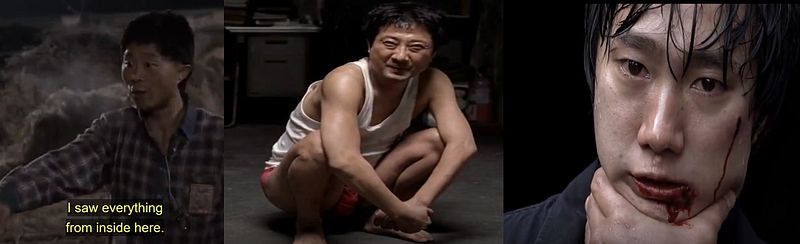
Talking about the first suspect, he happened to see the murderer so he ends killing himself at the end. Just like the other victims who had to die after seeing his face? The second suspect was beaten and tortured while made to wear the red undergarment. This was symbolic of all the victims, they were wearing red clothes and their undergarments were on their faces when found dead. The third suspect, who was targeted based on his request for a particular song on rainy nights to a radio station; and this is when the murder took place. This third suspect is beaten to a pulp by Seo on a rainy day and was almost killed as well!
Sexism
I noticed this in the opening scenes of the movie when a female inspector and Park are gluing suspect pictures on a logbook. The female inspector is shown to put these passport size photographs in an aligned and arranged way, a way of showing sincerity to work. Whereas Park almost doesn’t even look at what he is doing, the irresponsible behavior. Repeatedly, all of her male colleagues are seen to throw her ideas and suggestions out of the window. And over and over again, we see that she was the most articulate and rational one. Instead of listening to what she has to say, she is ordered to get more coffee! This sexism and masculinity are very well observed and explained by Guillermo del Toro.
I know you are watching this!!!
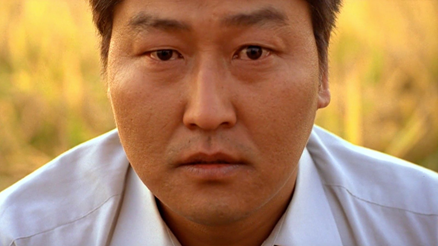
Look at the final scene of the movie, where Park looks directly into the screen. Knowing that the killer was not caught, it was certainly a genius stroke from Bong. Bong joo-ho wanted the killer to deliver the message that he sees him, he was hopeful that the real killer might watch the movie and see the Shaman’s eye directly staring at him, judging him and ready to deliver the judgment. And guess what who watched this movie!
The real killer
Lee choon-jae was convicted for the Hwaseong serial murders in 2019! He was identified after DNA from one of the victim’s undergarments was matched with his. Further investigation led to more DNA matches of other victims and he was identified and announced as the culprit.
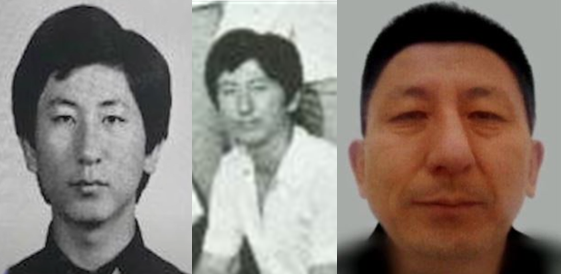
When Lee was identified as the killer, he was already serving his life sentence in Busan for the murder and rape of his sister-in-law. According to the Korean Police, Lee committed these crimes as frustration of his monotonous life after his discharge from military service. What is more interesting is that, until Lee confessed, Yun Sung-yeo, was wrongfully imprisoned for 20 years for these serial killings. Lee always thought that he would get caught in a matter of time. He admitted to being not too careful about hiding things as well. This is why I think the movie is much more than a crime thriller! The fact that Bong joon-ho wanted to make it a movie representing Korea in the ’80s, in what kind of conditions people live, someone who is not a mastermind went on to continue committing these heinous crimes; the failure and limitations of authorities. A movie that is certainly one of Bong Joon-ho’s best and a milestone in Korean cinema!