
Memes Are Not the Only Things That Influence Our Culture
Several aspects help shape culture including a leak of a Supreme Court draft opinion

While I took some courses associated with sociology and psychology in college, I did not major in those subjects. I research a lot and read a lot and share my observations and interesting knowledge that’s now in my braincase. Life experience can fill in the blanks too.
Understanding the behavior and influences behind cultures can be as complicated and deep as you want it to be.
Let’s start with what a meme is in case you don’t know what one is
For those who don’t have an understanding of what a meme is, here you go, without the philosophical or academic interpretations.
Memes are like shorthand communication. They imitate things or people and tend to evolve especially on social media. There are so many memes out there in the internet world, that you might not even understand all of them. Some are funnier to your friends than they might be to you. Some are even hateful. Some mock, and some are so sarcastic to the point that you know you shouldn’t laugh, but you do. Some even have a message worth chewing on.
In the same way emoji have been used to convey complex ideas of mood or emotion, a meme can impart a complex idea, state of mind, or shared understanding far quicker than typing out and reading a written explanation of an idea. (Source.)
Below is a published piece on Medium by Anthony Murphy that contains a lot of examples of memes, all interesting or humorous.
In 1976, the term “meme” was introduced by British evolutionary biologist Richard Dawkins in his book entitled The Selfish Gene.
A meme can be funny even when they follow some disturbing event. It can also be beneficial or harmful. Memes are on Facebook, Twitter, Instagram, and all over the internet. If you’re into sarcasm, you’ll love them.
Memes are influential and they plant ideas and thoughts. They contribute to shaping our culture, but they aren’t the only forms of communication that do. They’re used in dark humor and they’re used to make fun of serious topics. And of course, there’s the usage in politics which is very persuasive.
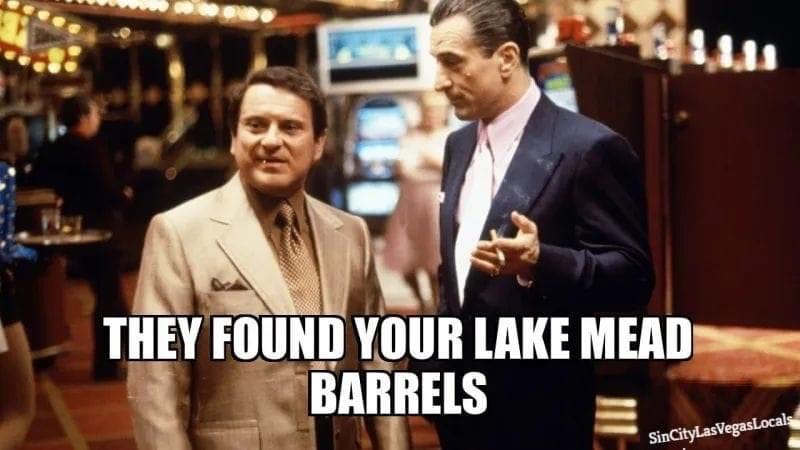
A few days ago, the news came out with barrels of human remains found in Lake Mead in Nevada. There’s already a meme circulating about that. See below. The humor in the meme just might supersede the surprise of the actual contents of the barrels.
What else influences our culture?
Let’s look at some definitions of culture first. According to Merriam-Webster, culture (noun) is defined in part as the customary beliefs, social forms, and material traits of a racial, religious, or social group. Sometimes “culture” may be confused with “society.”
I like the way Wikipedia breaks it down: an umbrella term which encompasses the social behavior, institutions, and norms found in human societies, as well as the knowledge, beliefs, arts, laws, customs, capabilities, and habits of the individuals in these groups. Culture is often originated from or attributed to a specific region or location.
There are so many elements that shape and influence culture:
- A belief system (choice of faith which would include marital customs) or other religious observances like Easter and Christmas.
One example of culture being influenced by religion is the civil rights movement which dramatically impacted American culture. The movement was born out of African American churches in the South, and this religious origin was critically important to MLK and other leaders. (Source.)
- Family traditions like the Tooth Fairy, Easter Bunny, Thanksgiving meal, and a visit from Santa Claus have permeated western cultures. These have been passed down from one generation to the next.
- Moral values (e.g., be honest, don’t cheat in school, don’t harshly judge others, and treat other people like you want to be treated). These values influence culture and adults conform to these values especially when is the norm for the culture they belong to.
- Languages spoken. According to Telelanguage, a survey from the U.S. Census Bureau discovered over 350 different languages are spoken in the United States.
Babbel Magazine reports that the top six languages in the United States are English, Spanish, Chinese (“Cantonese, Mandarin, and other varieties”), Tagalong (Filipino), Vietnamese, and French and French Creole (including Cajun).
The United States has been viewed as a large melting pot. As such, being educated about cultural diversity is important. There are also various religious beliefs, traditions, and even customs based on the origin of some people. All these elements influence our culture.
- Learned behavior.
- Laws influence culture, but culture also influences laws.
Attitudes influence culture
An attitude displayed or depicted on a meme that gets shared is an influence. If you go to work in a bad mood, that mood affects those around you.
In organizational culture, you want to be exposed to people who lift you up instead of bringing you down. Then, you take that attitude home with you, to the grocery store, your church if you attend, and your attitude goes on like a cloud following you everywhere. Imagine the good if that attitude isn’t bad.
Can I have that to-go, please?
A big part of our culture wants as much as conveniently as possible. How fast can you get that hamburger made at the window? How soon can you pick up your online order for the dress you want? How quickly can you get your tailored suit?
It’s the behavior of now, now, now. I think that our culture has been affected by that behavior — it’s a yo-yo of fast here, fast there. Behavior and culture affect each other.
Associations between cultures vs. risks to health
Anthropoligists and epidemiologists have identified many associations between culture, customs, and risks to health. Those who, for religious reasons, abstain from tea, coffee, alcohol, and tobacco have smaller risks of getting cancer of the gastrointestinal or respiratory tract than others of similar social, economic, and residential background. (Source.)
If you reflect on religious beliefs and their practicing customs:
Both religion and culture surround social behavior and affect our value system. Religion assists us in our pursuit of happiness. As children, many are pushed into one belief system or the other, with child having no choice. Most of us claim our religion to be the only true religion, but truth may not be the factor when we adopted it. (Source.)
There have also been study comparisons between migrants and the populations they move into versus where they had originally lived.
How does the recent Supreme Court draft opinion leak influence culture?
At best, it’s been a mess. People are outraged, particularly women of different cultures in our society. It’s a perfect example of how one action can influence behavior.
There’s talk about how this incident will affect the reputation of the integrity and reputation of the Supreme Court. It’s not the first leak that’s happened in history but the subject involved with this leak carries a lot of weight among a lot of people, particularly women.
What are the political consequences?
‘The USA is heading for a new peak in the culture wars!’ The judgment, it says, ‘could divide America.’ (Source.)
Everything we say and do can serve as an influence on culture. We are also influenced by culture from the cradle. We observe people around us as we mature, we take in what we see and hear and decide what’s right for us. We decide what cultural norms we agree with.
We’re like a sponge taking in everything from the environment we’re raised in. We even decide what behaviors are appropriate or acceptable for us. As we mature, we gain an understanding of the influences on culture and vice versa that make it less complicated. We grow into another complicated stage — what we want and need to do to influence behaviors in society to change.
Thank you for reading.
© Cathy Coombs — 2022
Write, self-publish, and self-market your work. Connect via Twitter or LinkedIn. My Website.


