
Meme Stocks: Is Conventional Investing Dead?
GameStop, Dogecoin, AMC. Today, stocks and cryptocurrencies can go impressively viral as we have seen in the last few months. This is how a new type of investor emerges: the meme investor — and now also the richest man in the world is among them.
“Use Signal”: these two words, tweeted by Elon Musk, were enough to cause the price of the listed company Signal Advance to explode a few weeks ago. The company’s shares rose in price by a staggering 1,100 percent within a few hours. With his tweet, the Tesla billionaire had actually only called for the use of the messenger Signal, which of course has nothing to do with the medical technology company Signal Advance. But that’s how it works: As soon as Elon Musk tweets something to his 46 million followers, prices can shoot to the moon. Mr. Musk is probably the most important stock market influencer in the world right now. Musk's tweets have recently boosted the stock of e-commerce service Etsy, among others, and of course, fueled the hype around GameStop. Lately, the second richest man in the world likes to tweet about the cryptocurrency Dogecoin, whose value has multiplied in recent weeks.
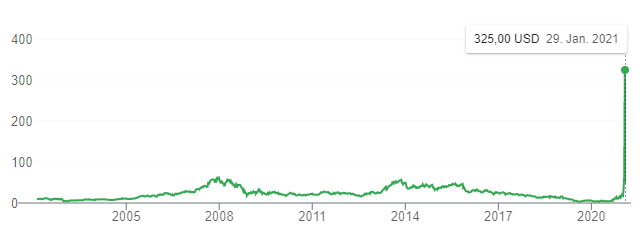
In the summer of 2020, a user of the Reddit community WallstreetBets — a curiously chaotic association of self-proclaimed “reckless investment idiots” with over 2 million members — announced his forecast: GME (stock symbol for Gamestop) is down, but short-sellers have overdone it with their bets against the company. He would hold an investment of 50,000 dollars until January 2021. While many initially paid little attention to the user, at the beginning of this year a real hype about the development of the GME share spread in the community. The result: in order to put further pressure on the short-sellers, thousands also began to buy shares in the company, a chain reaction was the consequence. The development of the share price is therefore currently only due to the fact that short sellers are obliged to buy shares, which are much more expensive than they had bet. — How a Reddit shuts Down Hedge Fonds — GME Update, Maximilian Perkmann, Medium, 2021
The Billionaire Next Door
The fact that the Tesla CEO has such a great influence on the financial markets has a lot to do with his reach, but not only. Elon Musk is seen as a likable nerd, a hip billionaire from next door. He’s someone who occasionally tweets about the video game Cyberpunk 2077, then again about the rocket launches of his space company Space X, who announces in a mood that he wants to take Tesla off the stock market, and who also likes to smoke a joint from time to time. Elon Musk has a reputation as a rebel who likes to take on the financial industry and who hates short-sellers, i.e. speculators who bet on falling prices. After all, short-sellers had also bet against Tesla — and lost. All this is being well received, especially by millennials, who are increasingly stirring up the stock markets with the help of trading apps.
Besides, Elon Musk skillfully plays with the meme culture in tweets. He shares funny pictures and videos and speaks the language of the Internet. This fits into a time when not only memes can go viral, but also stocks.
The development is driven by trading apps such as Robinhood, Traderepublic, or eToro, which make it very easy to trade stocks or derivatives, often at very low fees or even for free, as is the case with Robinhood. Trading stocks is thus made as easy as playing Tetris. And that has consequences: In the U.S., Robinhooder are already said to be responsible for 20 percent of trading in stocks and bonds. Corona in particular, or more precisely boredom, and government financial stimuli have caused the number of young investors to grow. The hype surrounding GameStop was only the high point of this development for the time being.
What Matters Is a Good Story
This new type of investor ticks differently than professional investors. For these young investors, conventional key figures for valuing a company do not really. It’s not revenue, profit, or the price-earnings ratio that is buying-criteria here, but rather a good story — which is why there’s already talk of so-called “story stocks”. The story “Reddit community vs. evil hedge funds” was one such story that carried many along. And Elon Musk, in turn, is someone who speaks exactly the language and has the reach to spread such stories.
It’s not yet clear how big the disruption will be that this new stock market world will bring. Popular stock market whisperers like Elon Musk are likely to help the share price of a company to reach unexpected heights.
Right now, however, owners of Bitcoin should be especially happy: Tesla has announced that it will soon be possible to pay for the company’s cars with Bitcoin. Also, Elon Musk’s company has invested $1.5 billion in digital currency. The Bitcoin price shot up after the announcement.
Is Value Investing Dead?
Value investing is an investment strategy that involves picking stocks that appear to be trading for less than their intrinsic or book value. Value investors actively ferret out stocks they think the stock market is underestimating. They believe the market overreacts to good and bad news, resulting in stock price movements that do not correspond to a company’s long-term fundamentals. The overreaction offers an opportunity to profit by buying stocks at discounted prices — on sale. — investopedia.com
Value investing, shaped by Warren Buffett, has been a guarantor of above-average stock returns for decades. Now though, it seems like the meme stocks would surpass the traditional framework.
Recent research by Eugene Fama and Kenneth French, two of the major proponents of factor-based investing, have found that the returns to value investing have fallen sharply in the second half of the 1963–2019 period.
Basically, it appears value investing was a great idea before it was popular, but now as its perhaps more mainstream and more completely documented, returns have reduced. Maybe the literature on the effectiveness of value investing is its own worst enemy. Perhaps value investing is now a crowded trade, reducing its effectiveness. — forbes.com
The Irrational Market
Mr. Market is a fictional character invented by Warren Buffett’s mentor Benjamin Graham to illustrate the sometimes irrational movements of the stock markets. Mr. Market has an extremely emotional and moody personality, is often irrational and short-term oriented, and therefore causes stock prices to fluctuate wildly.
Currently, Mr. Market seems to have one of his very optimistic phases.
There are various attempts to explain the current excesses on the stock market. One — ironically — has to do with the coronavirus. The price collapse and subsequent rapid recovery in the spring of 2020 have attracted many new investors who, thanks to the lockdown, have now had time to get to deal with the subject of the stock market. Investors from this new generation have very clear favorite stocks that keep sending them skyward. Unknown, “boring” and “dusty” value stocks fall behind.
Price-earnings ratios, financial statements, balance sheets, and valuation models are cryptic words for this generation of investors. After all, there are top investment tips on Twitter, Instagram, and Reddit!