
‘Melancholy’ — 3 things about this word that’ll inspire you.
And three reflections.
I still remember encountering this word for the first time when reading a book as a child.

“Ah!” said Mr. Tumnus in a rather melancholy voice, “if only I had worked harder at geography when I was a little Faun, I should no doubt know all about those strange countries. It is too late now.”
It was the part human, part goat who was speaking in The Lion, the Witch and the Wardrobe.
I didn’t even know how it was pronounced.
Since then I’ve learnt a thing or two about this word.
Three things I’ll share here.
1. It comes from Greek, meaning ‘black bile’
In Greek, Melaina chole (µέλαινα χολή) means black bile.

Bile is a liquid secreted by the liver which is yellow-greenish in colour. It is stored in the gallbladder, and in various literary traditions it connotes bitterness and sadness.
But originally, in Greek thought, bile was what caused sadness.
Hippocrates, a foremost physician in Ancient Greece, thought that a depressed mood with corresponding physical symptoms was caused by bile entering into the bloodstream.
Melancholy stood for ‘black bile’.
2. Melancholia was associated with artistic endeavours in the Renaissance (around 15th century)
In the Renaissance, melancholy took on a different meaning.
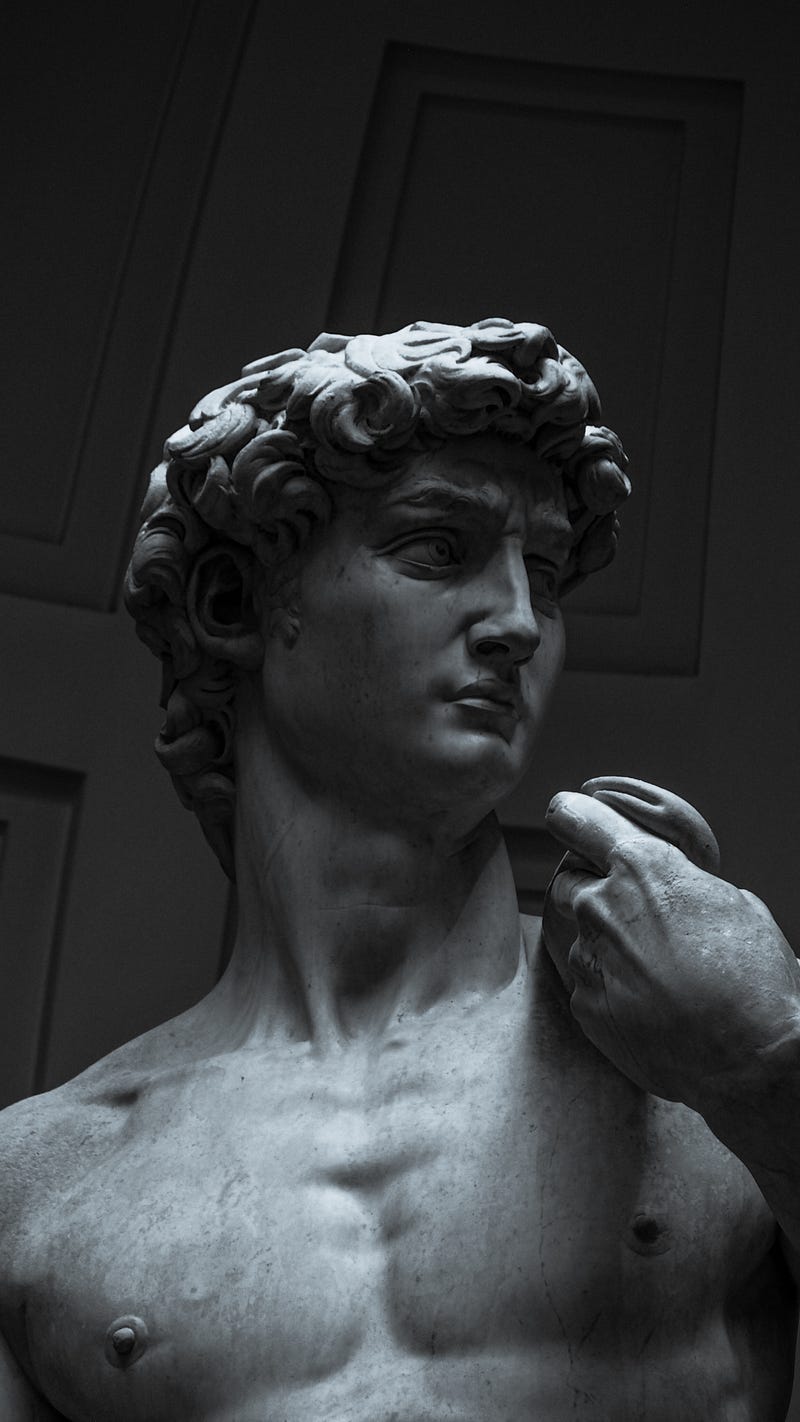
It became entwined with artistic genius, a source of inspiration for philosophy, poetry, and the arts. But there was also great risks associated with melancholia.
In Shakespeare’s As You Like It, the main characters referred melancholia to an unshakable sorrow (see source here from Shakespeare Folger).
Robert Burton, English writer, wrote a book called The Anatomy of Melancholy (1621). He tried to gather in all the complex ideas and experiences associated with the word. (Also referenced in the above link.)
This is further evidence of how the word fed into the popular imagination back then.
Milton
John Milton, that great poet which many considered second to only Shakespeare, wrote a poem called Il Penseroso (‘The Thinker’).
“Hail divinest Melancholy, Whose saintly visage is too bright To hit the sense of human sight; And therefore to our weaker view, O’er-laid with black, staid Wisdom’s hue; Black, but such as in esteem”
Earlier in the poem, he said Joy is vain and deluding, fickle and uncertain.
But here he praises melancholy as something divine, originally white and pristine, but only due to our human weakness becomes black. But even when it’s black, it’s still beautiful.
Towards the end of the poem he ‘prays’ to Melancholy:
“Till old experience do attain
To somthing like prophetic strain.
These pleasures Melancholy give,
And I with thee will choose to live.”
He states his desire to a life of contemplation, if Melancholy would give him inspiration and experience beyond himself.
Durer
Albert Durer had a painting called Melancholia I:
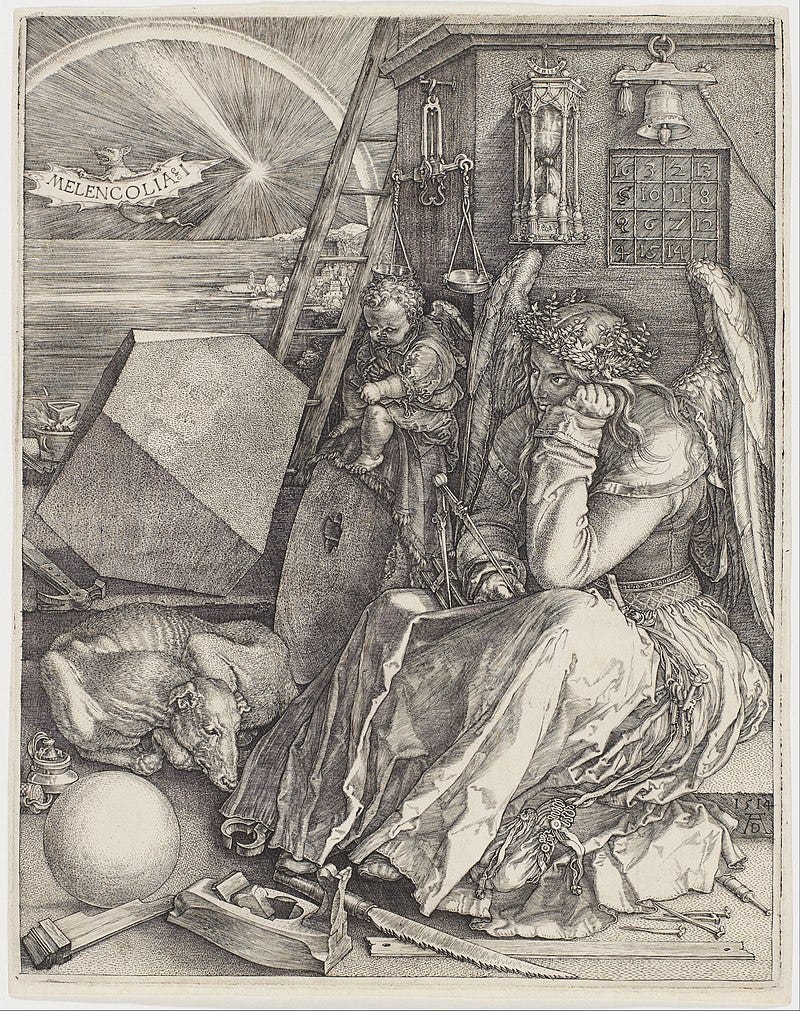
We see Melancholia, possibly a representation of a Muse (source of artistic inspiration), holding her head in her hand.
She is surrounded by objects including a saw, a sphere, a dog, and a polyhedron, and other building tools.
I can identify three groups here:
- Building materials — artistry is associated with hard labour, similar to how melancholy or artistic inspiration can be obtained
- A dog — isn’t fidelity also associated with labour? “The labour of love” — love and faithfulness require effort.
- Geometric shapes — again, the pursuit of truth via geometry requires hard work and toil. Mathematicians forget to eat their bread, and their white hair grows out, even as they try to prove theorems about the universe.
These are, it’s worth mentioning, only my take on this.
An article suggests that the winged creature is actually androgynous i.e. male and female at the same time. The creature is muscular, and perhaps because of this Melancholy remains heavy on earth, unable to rise to the heavenly realms of truth.
3. Melancholy became synonymous with depression (20th century)
In the last century, melancholy just became known as depression.

It fits many of the descriptions people in Ancient Greece or the Renaissance gave. So this isn’t just a random assignment of a word, coming out of nowhere.
Wikipedia actually sums up the symptoms well:
Hippocrates, in his Aphorisms, characterized all “fears and despondencies, if they last a long time” as being symptomatic of melancholia.
Other symptoms mentioned by Hippocrates include: poor appetite, abulia, sleeplessness, irritability, agitation.
Reflections
Some thoughts.
1. Fruitful labour often comes with sadness
Indeed, fruitful labour is often bound up with great toil.
Kurt Godel was a momentous Mathematician who proved the incompleteness theorem, which states that a mathematical system cannot prove its consistency. However, he suffered bouts of paranoia and hypochondria throughout his life.
American Mathematician Steven Krantz said in his book A Primer of Mathematical Writing that:
“Being a mathematician is a bit like being a manic depressive: you spend your life alternating between giddy elation and black despair.”
In the account of the Garden of Eden, after the first humans rebelled, work became cursed:
“By the sweat of your brow you shall eat bread.”
Professional and intellectual pursuit can promise great rewards, but it’s often mingled with frustration and difficulty, at times at great cost to our health and well-being.
2. Dwelling on a mystical ‘sadness’ isn’t healthy
There is something nice about nostalgia.

I believe the word ‘bittersweet’ is connected with this.
A memory is bitter, like a spell of unrequited love towards a person you could never attain to. It is sweet, because there were also moments of great promise and hope of success.
But there’s an element of making the past seem better than it could be. We can be discontent with the present and idealise the past.
There’s an appearance of wisdom and depth in this feeling which we don’t understand, but it’s also dangerous. There’s a reason why melancholy is called black bile after all.
Better look to something else and move forward than to dwell in quicksand.
3. There is something divine in melancholy
This is from a Christian perspective, which is my confession after all.

Just as the first Adam rebelled in the garden, the “second Adam”, a title given to the God-man Jesus Christ, was the one who would not repeat Adam’s mistake and redeem mankind.
The book of Psalms was considered to be his prayer book. The main character who spoke the Psalms, the ‘kingly figure’, is considered to ultimately refer to him.
Lines like:
“Why, my soul, are you downcast? Why so disturbed within me? Put your hope in God, for I will yet praise him, my Savior and my God”
and
“I cried out to God for help; I cried out to God to hear me.
When I was in distress, I sought the Lord; at night I stretched out untiring hands, and I would not be comforted.”
and
“My God, my God, why have you forsaken me? Why are you so far from saving me, so far from the words of my groaning?”
This last quote — the first sentence was the exact words which he spoke on the cross as he gave his breath away and died.
But his glory consists in this — that he not only rose again, but that he did die. We think of glory as victory. But his God-ness was bound up in suffering too.
It shows that we’re not alone in our depression, but he has shown himself to both understand it (deeply and personally) and also do something about it (through the resurrection).
This provides a source of fascination but also great comfort.


.jpg)