
Mekong Delta tour
Three days on boats and buses
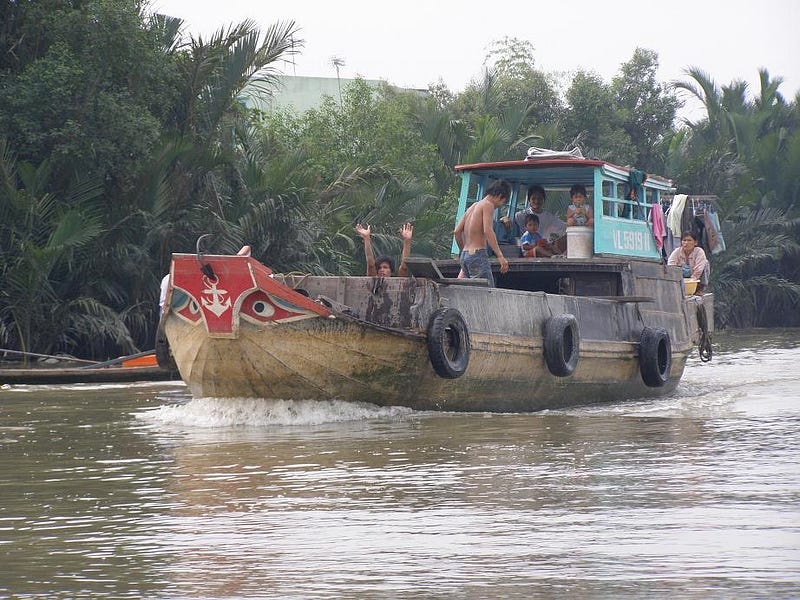
I was traveling in Vietnam with my friends Dennis and Mark, who were living in Thailand at the time. They needed to leave the country every ninety days as part of their visa requirements to live there.
We had only arrived the day before in Ho Chi Minh City (Saigon), and Mark was not feeling well, so he decided to stay at our hotel while Dennis and I went on our three-day/two night tour of the Mekong Delta.
For the remainder of the trip we were mostly independent, but this time and for the Halong Bay mini-tours, we arranged for others to shepherd us around. It was a good way to see places off the solo-tourist trail.
Sunday
Dennis and I were picked up at 7:15. The first segment of our journey was on a twenty-one-passenger motor boat for two and a half hours on the Mekong. We arrived in My Tho (pronounced “may taw”), a city of 1.5 million inhabitants, about seventy miles from HCMC.
From My Tho we went on yet another boat across the river to Unicorn Island. Once there, our first stop was at a cafe where we were served tea sweetened with locally produced honey. While we slurped our tea, the staff came around with samples of a variety of products made with the honey. I was particularly taken by the ginger and the pressed dried bananas.
As we walked along the path from the cafe, there was one shop after the next selling T-shirts and other objects. I asked Hung, our guide, if “Unicorn Island” means “Island of Shops.”
That wasn’t all. There was yet another cafe in store for us. As we ate several different varieties of fruit, we were treated (?) to the sounds of a local musical group playing their instruments at an ear-piercingly high pitch. And, to make it ever better, they were accompanied by the voices of several singers.
Hung told us that they are amateurs but they “seem like professionals.” Then he asked us, “You know why they seem like professionals? They play same music every day.”
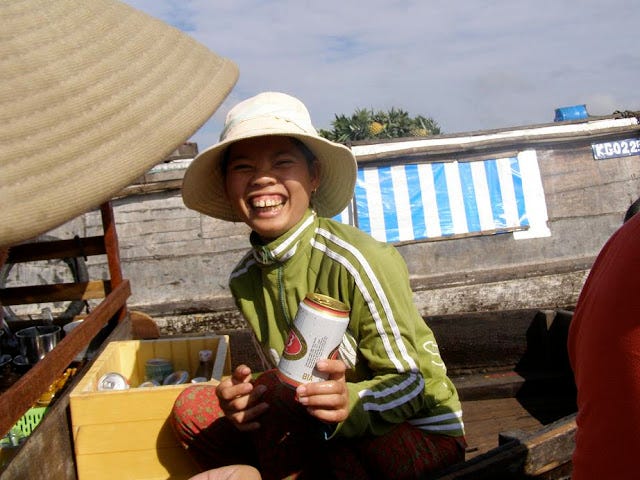
We left there via a series of small rowboats that accommodated only four passengers each. These rowboats took us through narrow channels that led back to the river, where our boat was waiting for us.
Next up: lunch! This was nearby, in the village of Than Thach, where there was only one restaurant from which to choose. It was a leisurely meal, with time to spare, which was made so in order for people to be able to rent bikes or walk around. But a sudden heavy rainstorm meant that we all just stayed put. There were five hammocks available at the restaurant, and we reclined in those until it was time to go.
Our boat took us back to My Tho, where we got onto a bus for a 2.5-hour trip along roads that were continually lined with businesses. There would have been no easy way for a non-local to know when we were leaving one community and entering another.
After about forty minutes, then a fifteen-minute ferry ride, then another fifteen minutes on the road, we reached Can Tho, the capital of the Mekong Delta region, a city of two million. It was about 18:30.
Dennis and I found a really nice waterfront restaurant for dinner. We opted for this luxury rather than dine on the cheap. Oh, yeah: “expensive” was $6. per person. Great spicy tofu in lemongrass.
My Tho appears to be a clean, well-organized city with a fairly standard array of stores, outdoor markets, and bustling traffic comprised mostly of motos.
Monday
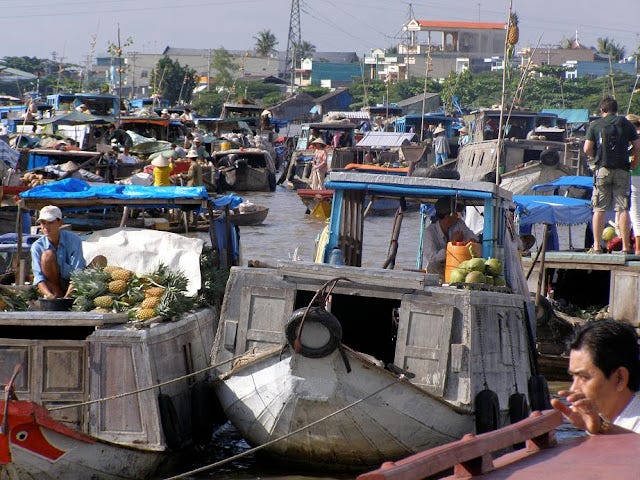
We spent most of the day in the Can Tho area. Morning took us via boat to a floating market that was downstream about half an hour. From there, we meandered through a land market and then to a rice factory.
After lunch we had a long bus ride again: this time 3.5 hours, during which the back of the bus, where I was sitting, was being subjected to an inordinate amount of bumpiness. At one point, I moved towards the center of the bus and sat in a vacant seat there. It was much smoother there. The only problem, being that close to the driver, was that his ever-present horn honking was difficult to deal with because it was that much more audible to me because I was sitting closer to him.
Life is full of trade-offs, isn’t it?
We arrived after dark, at 18:35 in Chau Doc. Upon our arrival, the logistical madness of running tours like this came into play. There is a dizzying array of variables that our guide and somebody out there arranging this has to deal with, most notably: (1) tourists on one-, two-, three-, and four-day tours and (2) participants who, upon arrival at each town, have signed up for either a mini-hotel, floating hotel, homestay, or hotel upgrade, each of which has a different drop-off point and set of instructions for next-day rendezvous.
On top of that, there are all these ferryboat, rowboat, and small motor boat operators, hotel owners, and other concessionaires who need to be paid their percentage of the fees we paid for this trip (total cost about $55).
Regardless of these many choices that the guide has to deal with, everything seems to be happening without excessive delays or problems. I don’t know how they do it, but they do.
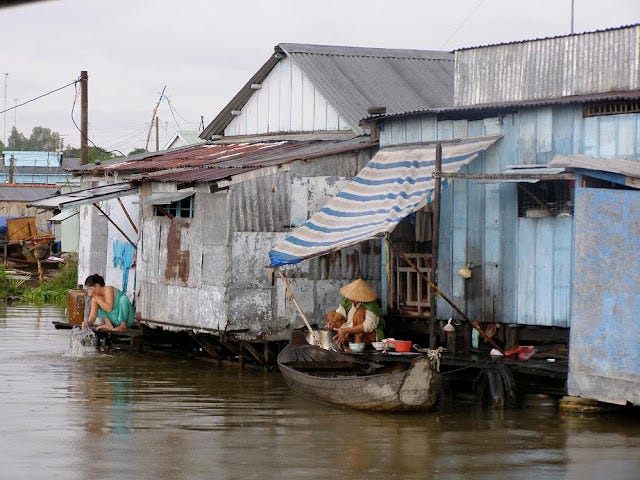
We were the last ones to be housed, as we were in the mini-hotel, the same choice as Hung, our guide.
Our hotel rooms were basic — clean, but basic. Dennis has no air-conditioner. I do, but there is no remote to turn it on. There are ceiling fans, though.
We hit the road to look for dinner. The first restaurant we came to had a big sign that said “CHAY” and the English translation: vegetarian food.
First thing we did was order two beers. We asked for Saigon. The restaurant does not serve beer, but somebody ran out to get two. He returned moments later with two beers — not Saigon, but 333. One of the beers was cold and the other was warm.
We told the guy we wanted the cold one, but not the warm one. This explanation stretched a bit beyond his English comprehension ability.
Then he showed a glimmer of understanding, as he walked over to the cooler where the soda was, and displayed that he was going to put it in there.
What was I supposed to do? Crawl in there with the beer to drink it?
We were emphatic: no, we didn’t want that beer. He crossed the road again with it. He didn’t come back with another one.
Only two doors away, we found a place, right there on the side of the road. Traffic was whizzing by only three or four feet from us.
We were enjoying our beers when two young local woman crossed the road and sat themselves at our table. They were overly friendly and spoke to us exclusively in Vietnamese.
One of the lessons I have learned while traveling is that it is never a good sign when a foreign woman initiates conversation, and I find this to be true only 100% of the time.
The woman was looking at me in a suggestive manner, moving her arms in a way that we might if we were pantomiming that we were running, and continually said the words “boom-boom.”
It was totally clear what she wanted, but I found that my best course of action was to open the guidebook to find the phrase for, “I don’t understand,” and then sit there ignoring her. But Dennis and I did understand, and it was too funny not to laugh.
We said our good-byes and walked away, heading to our hotel. En route, we saw another cluster of women sitting at a restaurant table, and whatever they called out to us included the word “boom-boom.”
Then we ran into our guide Hung and asked him, What does ‘boom-boom’ mean?
For whatever reason, even though I find that I cannot effectively reproduce the correct tones in order to say “tofu” so that a Vietnamese will understand me when I am looking for that, my pronunciation of the word “boom-boom” was impeccable, as shown by the way Hung’s eyes opened widely and he fell backwards laughing heartily at this question.
We told him where we had heard it. He replied, “Yes, they a lot of those here.” Then it was back to the hotel to bed. Alone. No “boom boom.”
Tuesday
Last night when we arrived at our hotel, Hung told us to be in the lobby at 6:30 for breakfast. “Breakfast included,” he informed us.
When I got on the bus as we were preparing to leave the hotel, he came to me and advised me that I hadn’t paid for my coffee.
You said last night that breakfast was included, I replied.
“Yes, but not drinks,” was his response. I guess we were operating under different definitions of “included.”
That’s not the only feature that was not included at the hotel. Last night, when I entered my room, it was stifling hot and, as I meantioned earlier, there was no remote for the air conditioner.
When I went to the front desk to inquire, the clerk told me, “Ai-ah conditionah fi dollah extra.” I didn’t deliberate for a moment about the extra cost: a good night’s sleep would be worth it, as it was 83ºF in my room. I gave him the 80,000 VND (that’s how they abbreviate Vietnamese dong) and returned to my room. I did, indeed, have a much more pleasant sleep than I would have with only the ceiling fan.
Also not included with the room was hot water.
During the night there had been a tumultuous thunderstorm. In the morning it was still raining, but not as heavily. The first stop was to a mountain where we would be climbing to the top so that we could see the Mekong Delta area.
I wasn’t in the mood to make a mountain trek in the rain. I was the only person, other than the driver, who stayed on the bus.
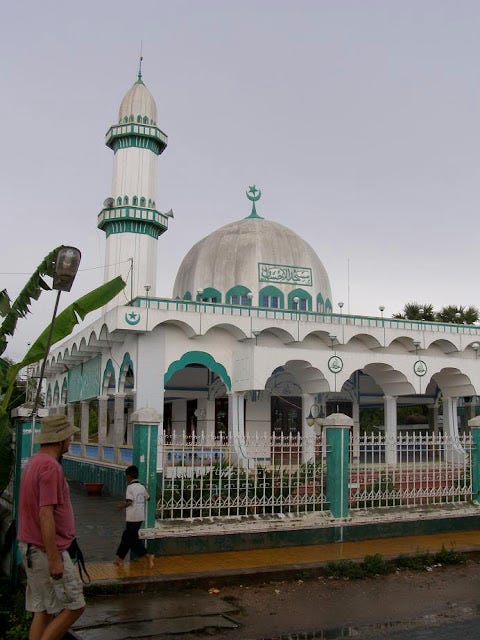
They took only about forty minutes, and then we were off to the nearby village of Cham, at which Hung afforded us yet another shopping opportunity. This village is populated by an ethnic minority of Muslims originally from Malaysia. Their primary means of earning a living is by weaving.
We took a look at the mosque, had a coffee, and wandered a bit. A small boat took us to a larger boat — “five star boat,” as Hung described it. Hung is a comedian and enjoys this sort of fooling around, just like when we are all on the bus and he informs us, “This is bus to Phnom Penh. Just want to be sure you are on right bus.”
On the road again, we had to settle in for a long continuation, as it would now take more than six hours to return to HCMC. Today’s driver was not a honker, but he did have some other irritating habits, such as speeding up and then slamming on the brakes.
Yes, this Mekong Delta trip turned out to be more road than river, more bus than boat. Fortunately, I find the roadside activity to be endlessly entertaining: the homes, schools, restaurants, shops, construction sites, cemeteries, canals, rivers, monuments, food stalls, gas stations, and billboards continue one after the other, with no break from one community to the next.
Particularly noteworthy is the juxtaposition of new and old as they are constructed side-by-side: rusted corrugated tin, scrap lumber, bamboo stakes held together with wire and rope, open-air shops and homes, roofs of dried palm fronds, and shelters of tied plastic tarps are interspersed with buildings of freshly-painted stucco, polished wood, ceramic tile, glass enclosures, gleaming stainless steel railings and letters, and crisp canvas awnings.
It seems evident that there is no concept for what we would call zoning laws. If you have been to Houston, you get the idea, as all of these businesses, government buildings, schools, and residences are placed amongst each other in a haphazard manner.
One common feature of the businesses here is that the entire width of the building is open as an entrance. It is almost as if each business frontage were a garage door that opened to expose its contents.
The most common vehicle on the road is the motorcycle, or “moto” as they are most commonly referred to. Drivers and passengers wear helmets. Hung tells us that the law making helmets compulsary is about one year old. The fine for not wearing a helmet is 100,000 VND (about $6), and that is a fee that most people do not want to pay, so they comply.
We returned to HCMC to find that Mark was in good health, recuperated, and ready to join us on the road tomorrow.
After the traveling that we have done the last few days, Dennis and I made an agreement: no matter what Mui Ne was like, we were going to stay for three nights, so that we would not have to be on the road again so soon.