avatarBrian Loo Soon Hua

Free AI web copilot to create summaries, insights and extended knowledge, download it at here

2954

Abstract

he variolated compared with the usual 30% among those who had contracted the airborne virus. Also, the variolated, while possessing immunity, could still spread the disease to the unvariolated (sounds familiar?) and cause an epidemic among them.</p><p id="c2ad">Enter Edward Jenner. An English physician and scientist from Gloucestershire, he studied reports of variolation but more crucially he came to some interesting conclusions while observing the milkmaids from the countryside around his home.</p><figure id="851d"><img src="https://cdn-images-1.readmedium.com/v2/resize:fit:800/1*EFv3zommE3-u4kd8dLLY6w.png"><figcaption>Cowpox pustules on a cow’s udder. <a href="https://en.wikipedia.org/wiki/Cowpox#/media/File:Cowpox_Engraving_(detail).png">Source</a></figcaption></figure><p id="3c48">Many of them had pustules on their hands from exposure to a virus contracted from cows called (what else?) cowpox. Despite causing painful and unsightly pustules cowpox was not dangerous. But therein lies nature’s mysteries. The cowpox virus is a close relative of the virus that causes the deadly smallpox. And if a person had had cowpox, for some reason they never contracted smallpox. Edward Jenner developed an idea.</p><h1 id="1f25">The world’s first large-scale vaccination programme</h1><p id="f015" type="7">“Jenner’s unique contribution was not that he inoculated a few persons with cowpox, but that he then proved [by subsequent challenges] that they were immune to smallpox. Moreover, he demonstrated that the protective cowpox pus could be effectively inoculated from person to person, not just directly from cattle.” — Dr. Donald R. Hopkins</p><p id="0713">What was remarkable was that Edward Jenner made his discoveries without the aid of a microscope! He formulated the theory that a person exposed to cowpox caught from cattle then developed a natural resistance to smallpox AND that this immunity could be successfully passed on to other humans by infecting them with fluid from cowpox blisters inserted through small cuts in their skin (disgusting to our modern sensibilities I know, but Jenner had to work with whatever he had at his disposal during that time).</p><figure id="b77e"><img src="https://cdn-images-1.readmedium.com/v2/resize:fit:800/1*ShPNdQICnWF-FxHqRh6i4A.jpeg"><figcaption>Edward Jenner performing his first vaccination on an eight-year-old boy named James Phipps, 1796. <a href="https://commons.wikimedia.org/wiki/File:Jenner_phipps_01_(cropped).jpg">Source</a></figcaption></figure><p id="8c32">Eventually, vaccination became an accepted medical practice, although this took several decades in England.</p><p id="32df">But not without resistance from a vocal minority. We would know them today as antivaxxers.</p><h1 id="dcb6">Enter the Antivaxxers</h1><figure id="6b04"><img src="https://cdn-images-1.readmedium.com/v2/resize:fit:800/1*KjXkL_tvdjwtccmKcjt8og.jpeg"><figcaption>Edward Jenner, Thomas Dimsdale and George R

Options

ose chasing off antivaxxers as the dead lie at their feet. Etching by I. Cruikshank, 1808. Welcome Images <a href="https://commons.wikimedia.org/wiki/File:Jenner_and_his_two_colleagues_seeing_off_three_anti-vaccinat_Wellcome_V0011075.jpg">Source</a></figcaption></figure><p id="c54d">Over 200 years ago, opposition to Jenner’s unorthodox techniques was swift. Some claimed that using materials from cows to infect humans was unsanitary and satirical cartoons popped up showing people growing tiny cow parts on their bodies after being vaccinated!</p><p id="ec42">Some Christians objected to having to infect their bodies with matter from lower creatures.</p><p id="293a">Some even thought that smallpox wasn’t passed from person to person, but then again without microscopes and other modern equipment, how were they to know about viruses? Their fear was a natural human response: being afraid of the unknown and not trusting that which they do not comprehend.</p><p id="af3d">Lastly, many people objected to vaccination because they believed it violated their personal liberty. Objections became worse as the British government mandated compulsory vaccination policies.</p><p id="0064">Sounds familiar?</p><h1 id="ccb3">Today</h1><p id="0a3d">And so, after almost 200 years of vaccinations (to be fair, many countries were slow to implement vaccine policies and vaccine production itself was severely limited in those days so it took a while), what happened to smallpox?</p><p id="6428">The last natural infection occurred back in 1978. Smallpox is now effectively extinct in human populations and exists only as stocks kept in two labs with the highest level of biosafety precautions in the world: the United States’ Centres for Disease Control and Prevention and Russia’s State Research Centre of Virology and Biotechnology VECTOR.</p><p id="a73a">That’s right, smallpox has been eradicated and relegated to samples in high-security labs.</p><p id="3199">And here’s another interesting tidbit. What’s the Latin word for cow?</p><p id="a53b"><i>Vacca</i>. And <i>vaccina</i> means “derived from a cow”.</p><p id="610f">That’s right, the world remembers and honours Edward Jenner’s work by naming this now-routine procedure after the animal that started it all in the first place.</p><h1 id="4f77">References</h1><ol><li>Albert, M., Ostheimer, K.G., Breman, J.G. <a href="http://www.nejm.org/doi/full/10.1056/NEJM200102013440511#t=article">The last smallpox epidemic in Boston and the vaccination controversy</a>. <i>N Engl J Med</i>. 2001;344.</li><li>Riedel, Stefan (January 2005). <a href="https://www.ncbi.nlm.nih.gov/pmc/articles/PMC1200696">“Edward Jenner and the history of smallpox and vaccination”</a>. <i>Proceedings (Baylor University. Medical Center)</i>. Baylor University Medical Center. <b>18</b> (1): 21–25.</li><li>Wolfe, R.M., Sharpe, L.K. Anti-vaccinationists past and present. <i>BMJ</i>. 2002d;325:430–432.</li></ol></article></body>

Meet the World’s First Antivaxxers From Way Back in 1802

Yes, antivaxxers have always been around
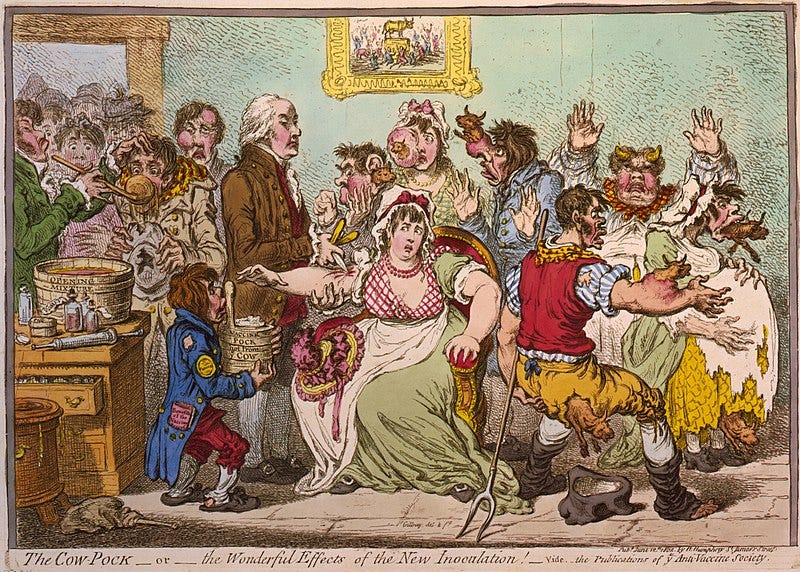
In 1802, people thought getting Edward Jenner’s vaccine against smallpox would cause them to grow cow parts! Source, Public Domain

People fear that which they do not know, or rather that which they do not understand. The pages of history have shown that misinformation, combined with a tendency to trust sensational news, contributed to what was probably the world’s first antivaccination movement. Over 200 years ago.

A history of smallpox

Smallpox was a highly contagious disease that wreaked havoc in entire nations for centuries. Caused by a virus that spread through the air, the symptoms were horrific: ugly red rashes and pustules appearing all over the body, fever, headaches and, with many survivors, blindness. The risk of death was as high as 30 percent. Most survivors were disfigured by unsightly scars called pockmarks for the rest of their lives.
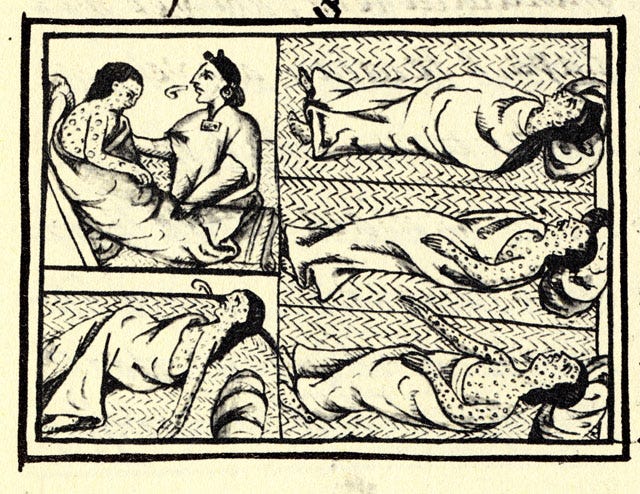
Native Mexicans suffering from smallpox, Florentine Codex, 16th Century. Source, Public Domain

While Europeans were being threatened by this epidemic, people in China, India, parts of Africa and the Middle East had been practising an ancient form of inoculation: variolation.

Basically, the smallpox virus was an airborne one, spreading through droplets in the atmosphere and entering the body through the mouth and nose caused full-blown smallpox. However, in Africa and Asia, it was discovered that smallpox spread through infecting the skin caused milder symptoms, but more importantly, the patient would develop immunity to the disease. This procedure later became known in Europe, where it was called variolation.

In the Ottoman Empire (mostly what is now Turkey) European visitors were surprised at (but nevertheless took note of) the widespread practice. Fluid from the smallpox pustule of a newly infected child was collected and rubbed into a cut in a patient’s skin. As expected, the patient developed pustules and rashes around the infection site and a fever, but usually recovered with the added plus of now having lifelong immunity to smallpox.

Edward Jenner

While variolation was effective, it wasn’t entirely risk-free. The patient could die from the procedure — the mortality rate was between 1% to 2% among the variolated compared with the usual 30% among those who had contracted the airborne virus. Also, the variolated, while possessing immunity, could still spread the disease to the unvariolated (sounds familiar?) and cause an epidemic among them.

Enter Edward Jenner. An English physician and scientist from Gloucestershire, he studied reports of variolation but more crucially he came to some interesting conclusions while observing the milkmaids from the countryside around his home.
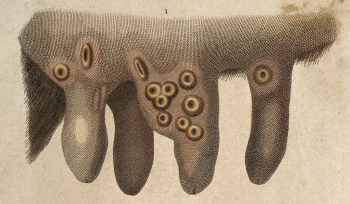
Cowpox pustules on a cow’s udder. Source

Many of them had pustules on their hands from exposure to a virus contracted from cows called (what else?) cowpox. Despite causing painful and unsightly pustules cowpox was not dangerous. But therein lies nature’s mysteries. The cowpox virus is a close relative of the virus that causes the deadly smallpox. And if a person had had cowpox, for some reason they never contracted smallpox. Edward Jenner developed an idea.

The world’s first large-scale vaccination programme

“Jenner’s unique contribution was not that he inoculated a few persons with cowpox, but that he then proved [by subsequent challenges] that they were immune to smallpox. Moreover, he demonstrated that the protective cowpox pus could be effectively inoculated from person to person, not just directly from cattle.” — Dr. Donald R. Hopkins

What was remarkable was that Edward Jenner made his discoveries without the aid of a microscope! He formulated the theory that a person exposed to cowpox caught from cattle then developed a natural resistance to smallpox AND that this immunity could be successfully passed on to other humans by infecting them with fluid from cowpox blisters inserted through small cuts in their skin (disgusting to our modern sensibilities I know, but Jenner had to work with whatever he had at his disposal during that time).
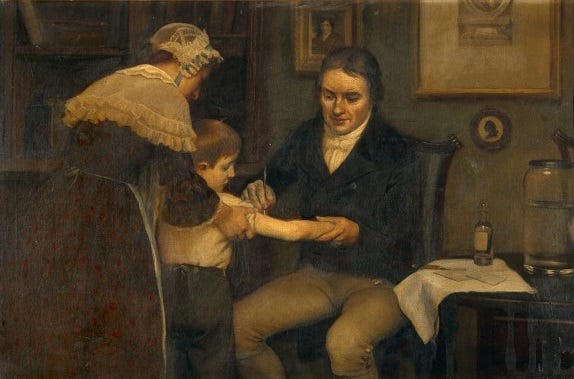
Edward Jenner performing his first vaccination on an eight-year-old boy named James Phipps, 1796. Source

Eventually, vaccination became an accepted medical practice, although this took several decades in England.

But not without resistance from a vocal minority. We would know them today as antivaxxers.

Enter the Antivaxxers
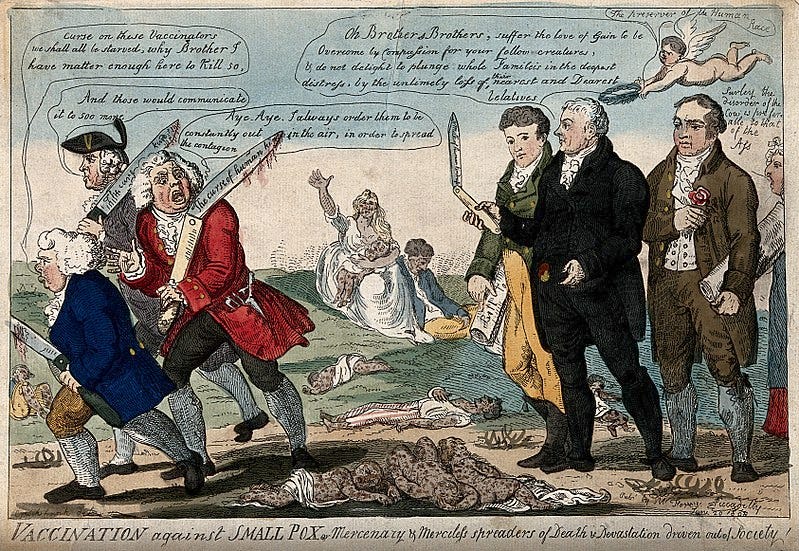
Edward Jenner, Thomas Dimsdale and George Rose chasing off antivaxxers as the dead lie at their feet. Etching by I. Cruikshank, 1808. Welcome Images Source

Over 200 years ago, opposition to Jenner’s unorthodox techniques was swift. Some claimed that using materials from cows to infect humans was unsanitary and satirical cartoons popped up showing people growing tiny cow parts on their bodies after being vaccinated!

Some Christians objected to having to infect their bodies with matter from lower creatures.

Some even thought that smallpox wasn’t passed from person to person, but then again without microscopes and other modern equipment, how were they to know about viruses? Their fear was a natural human response: being afraid of the unknown and not trusting that which they do not comprehend.

Lastly, many people objected to vaccination because they believed it violated their personal liberty. Objections became worse as the British government mandated compulsory vaccination policies.

Sounds familiar?

Today

And so, after almost 200 years of vaccinations (to be fair, many countries were slow to implement vaccine policies and vaccine production itself was severely limited in those days so it took a while), what happened to smallpox?

The last natural infection occurred back in 1978. Smallpox is now effectively extinct in human populations and exists only as stocks kept in two labs with the highest level of biosafety precautions in the world: the United States’ Centres for Disease Control and Prevention and Russia’s State Research Centre of Virology and Biotechnology VECTOR.

That’s right, smallpox has been eradicated and relegated to samples in high-security labs.

And here’s another interesting tidbit. What’s the Latin word for cow?

Vacca. And vaccina means “derived from a cow”.

That’s right, the world remembers and honours Edward Jenner’s work by naming this now-routine procedure after the animal that started it all in the first place.

References

  1. Albert, M., Ostheimer, K.G., Breman, J.G. The last smallpox epidemic in Boston and the vaccination controversy. N Engl J Med. 2001;344.
  2. Riedel, Stefan (January 2005). “Edward Jenner and the history of smallpox and vaccination”. Proceedings (Baylor University. Medical Center). Baylor University Medical Center. 18 (1): 21–25.
  3. Wolfe, R.M., Sharpe, L.K. Anti-vaccinationists past and present. BMJ. 2002d;325:430–432.
Anti Vaccination
Science
Art
Vaccination
History
Recommended from ReadMedium