avatarFaisal Khan

Free AI web copilot to create summaries, insights and extended knowledge, download it at here

1497

Abstract

  <div>
            <img class="ratio" src="http://placehold.it/16x9">
            <iframe class="" src="https://cdn.embedly.com/widgets/media.html?src=https%3A%2F%2Fwww.youtube.com%2Fembed%2Fd4xWYhdSRxU%3Ffeature%3Doembed&amp;url=http%3A%2F%2Fwww.youtube.com%2Fwatch%3Fv%3Dd4xWYhdSRxU&amp;image=https%3A%2F%2Fi.ytimg.com%2Fvi%2Fd4xWYhdSRxU%2Fhqdefault.jpg&amp;key=a19fcc184b9711e1b4764040d3dc5c07&amp;type=text%2Fhtml&amp;schema=youtube" allowfullscreen="" frameborder="0" height="480" width="854">
          </div>
        </div>
    </figure></iframe></div></div></figure><p id="cc16">The U.S President averages 10 tweets a day with about 10,000 of them sent out after his inauguration in 2017, according to JPMorgan’s analysis. While his twitter activity reached a low of 5 tweets per day going into his inauguration, but this has picked up substantially since late 2018, when the trade talks between China &amp; the U.S went off-track.</p><p id="94d0">According to Citigroup quantitative foreign-exchange strategist Sukrita Chatterji, 10% of Trump’s tweets have pertained to the U.S financial markets. Lately, with a cautious approach of the Feds on cutting the benchmark interest rate, Fed Chair Jerome Powell has been in the line of fire by President’s attacking tweets. Trump has included a direct reference to the Federal Reserve over 20 times in the past month alone.</p><figure id="5b8b"><img src="https://cdn-images-1.readmedium.com/v2/resize:fit:800/1*fcPpr-BV7

Options

GHav51fq4HnCA.png"><figcaption></figcaption></figure><p id="da13">The Volfefe index (LHS) by JPMorgan was compared to the Treasury yields in the five minutes after a Trump tweet. The rolling one-month probability of this comparison showed that each tweet was a market-moving event (chart above). Citi’s work on Forex markets regarding the impact of Trump’s tweets showed a stretch of higher volatility in the global currency markets as well.</p><p id="2b56">While quantifying the real effect of Trump’s tweets might not be definitive but it is certain from the index that his missives are a reason for spiked volatility in financial markets.</p><p id="436e">JPMorgan & Citigroup are not the only two banks attempting to calculate the impact of Trump’s twitter activity on financial markets. Analysts at Bank of America Merrill Lynch recently came out with interesting statistic — days of frequent tweeting saw negative stock returns of 9 basis points on average, while fewer tweets returned positive returns of 5 basis points on average.</p><p id="4c6a">Trying to gauge the effect of Trump’s tweets to make a quick buck on the financial markets is a risky business. I, for one, would stick to prudent risk management techniques & with a technical reading of charts defining my points of entry & exit. Have to give it to JPMorgan though for coming up with the name & the index.</p><h2 id="7432">Stay informed with the content that matters — Join my mailing list</h2></article></body>

Meet the ‘Volfefe Index’

JPMorgan has come up with the Index to measure the market reaction to Trump’s tweets

It would be fair to say that Trump is the only U.S President to have run his administration on a micro-scale like him. Using Twitter as his Press release mechanism while outlining his government’s policies & his stance on important issues, the financial markets have perhaps been the most affected by his micro-blogging missives.

JPMorgan Chase — one of the biggest banks has now created a “Volfefe Index,” based on Trump’s infamous covfefe tweet from May 2017. The bank is trying to quantify the effects of Trump’s tweets on the financial markets. Citigroup Inc.’s foreign exchange team pitched in with their reports that his tweets are “increasingly relevant” to foreign-exchange moves.

Being a forex trader myself, I have had the first-hand experience of his electronic musings & can vouch for Citigroup’s conclusions. There have been many boring, range trading days that have suddenly come alive for apparently no reason, and then the news hit the wires that the U.S President has opined on something.

The U.S President averages 10 tweets a day with about 10,000 of them sent out after his inauguration in 2017, according to JPMorgan’s analysis. While his twitter activity reached a low of 5 tweets per day going into his inauguration, but this has picked up substantially since late 2018, when the trade talks between China & the U.S went off-track.

According to Citigroup quantitative foreign-exchange strategist Sukrita Chatterji, 10% of Trump’s tweets have pertained to the U.S financial markets. Lately, with a cautious approach of the Feds on cutting the benchmark interest rate, Fed Chair Jerome Powell has been in the line of fire by President’s attacking tweets. Trump has included a direct reference to the Federal Reserve over 20 times in the past month alone.
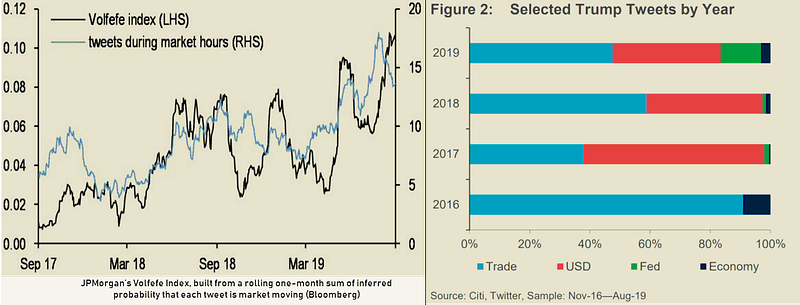
The Volfefe index (LHS) by JPMorgan was compared to the Treasury yields in the five minutes after a Trump tweet. The rolling one-month probability of this comparison showed that each tweet was a market-moving event (chart above). Citi’s work on Forex markets regarding the impact of Trump’s tweets showed a stretch of higher volatility in the global currency markets as well.

While quantifying the real effect of Trump’s tweets might not be definitive but it is certain from the index that his missives are a reason for spiked volatility in financial markets.

JPMorgan & Citigroup are not the only two banks attempting to calculate the impact of Trump’s twitter activity on financial markets. Analysts at Bank of America Merrill Lynch recently came out with interesting statistic — days of frequent tweeting saw negative stock returns of 9 basis points on average, while fewer tweets returned positive returns of 5 basis points on average.

Trying to gauge the effect of Trump’s tweets to make a quick buck on the financial markets is a risky business. I, for one, would stick to prudent risk management techniques & with a technical reading of charts defining my points of entry & exit. Have to give it to JPMorgan though for coming up with the name & the index.

Stay informed with the content that matters — Join my mailing list

Economics
Finance
Investing
Economy
Business
Recommended from ReadMedium