
Meet the Indigenous Women Who Fought for the Vote
The feminists in the (unfinished) battle for suffrage in Indian Country
This story is a project of the Indigenously newsletter. Sign up today. It’s free.
It took the better part of a century to pass a law saying American women had the right to vote. It took even longer to deliver this right to Indigenous women — which really short-changed all Native Americans. For the longest time, the word “suffrage” has been aligned with the historic passage of the 19th Amendment, a decree ratified a century ago, this week, outlawing discrimination of voters on the basis of their sex. But in reality, such shorthand, couched in twentieth-century white feminism, was exclusionary. The right to vote in Indian Country tells another side of this struggle in which Indigenous women were on the frontlines from the start.
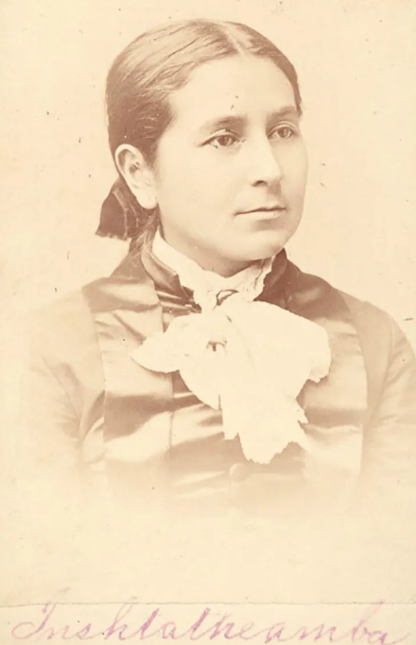
While the19th Amendment represents a cornerstone of gender equality in America, few know about the way the vote was won or the limitations it imposed on people of color. Public school curriculum often portrays this history of the suffrage movement through the important advocacy of notable white women, Elizabeth Cady Stanton and Susan B. Anthony. But there were so many more who helped make female suffrage possible; a few of them were Indigenous women: lawyers such as Marie Louise Bottineau Baldwin of the Turtle Mountain Chippewa Tribe, Yankton-Sioux writer, Gertrude Simmons Bonnin also known as Zitkala-Sa, and Omaha lecturer Susette La Flesche Tibbles.
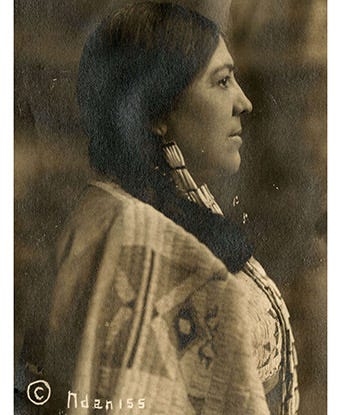
Leading up to the ratification of the 19th Amendment on Aug. 18, 1920, these Native women participated in suffrage parades, made compelling speeches, and wrote commentary that would likely have gone viral, today. But more intriguing, Indigenous women were the source of inspiration for the movement’s lead organizers, Stanton and Matilda Joslyn Gage. The women, two New Yorkers who lived on the colonized homelands of the Iroquois Confederacy, wrote how they grew motivated to make lasting voting rights change after recognizing the roles women played in the tribes. Then as now, the Confederacy’s six nations of the Onondaga, Mohawk, Seneca, Cayuga, Oneida, and Tuscarora functioned as a government based on female authority in which Haudenosaunee women maintained authority over their subsistence economy. They also had final authority over land transfers and decisions about engaging in war. And they practiced a structure of political power shared equally among all clan families and their members — a pure democracy — what also inspired the birth of the United States.
Gage and Stanton, colonial women, lived under realities that were the mirror opposite of the Haudenosaunee. Women’s Vote Centennial, the official site commemorating the 19th Amendment anniversary, notes the white gender dynamics of the era:
“The very being or legal existence of the woman is suspended during the marriage, or at least is incorporated and consolidated into that of the husband; under whose wing, protection, and cover, she performs everything.”
Another source for Gage and Stanton’s inspiration came from remarks Native American women had made at the 1888 International Council of Women, the first meeting of women’s rights advocates in the Western world. Historians noted that Native women from across Indian Country were the only suffragists in attendance who held legal right to their own possessions or property. Yet, these societal structures were the target of aggressive colonization tactics of the era steeped in Christianized ideology and racist “civilization” policies. In this regard, suffrage for Indigenous women represented a greater purpose: their sovereignty. One ethnographer noted a Native attendee’s views at the time:
“As an Indian woman I was free. I owned my home, my person, the work of my own hands, and my children could never forget me. I was better as an Indian woman than under white law.”
However, such advanced equality recognized and embraced by Indigenous women is, yet, one more example of the injustices befallen on Indian Country — a direct result of America’s lasting lust for land. The taking of tribal territory also took away gender equality for Native women. Today, we see the grave outcome of such disruption in the countless number of cold cases involving lopsided rates of deaths and disappearances of Indigenous women, girls, and transgender people. These parallel realities of historic colonization and modern-day crime rates are not a coincidence when reflecting on the Native suffrage timeline.
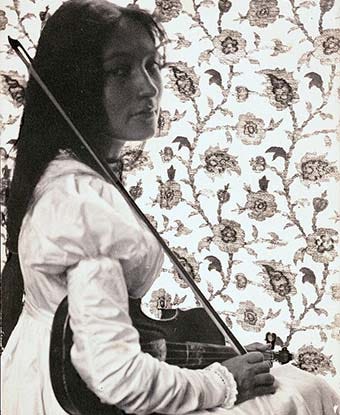
While women like Zitkala-Sa were inspiring voices in the early fight for voting rights, their visibility in suffrage activism would not fully transcend to Native American women (and men) until four decades later — an uneven path prompted by the Snyder Act of 1924. Also known as the Indian Citizenship Act, the law corrected the Fifteenth Amendment, passed in 1870, which granted all U.S. citizens the right to vote, regardless of race. But the citizenship mandate failed to include Indigenous Peoples whose very lands laid the foundation of this nation. While the Snyder Act, in theory, intended to afford full U.S. citizenship to Native Americans, it was a painful process that took far too long to carry out. Nowhere was this more obvious than in Maine.
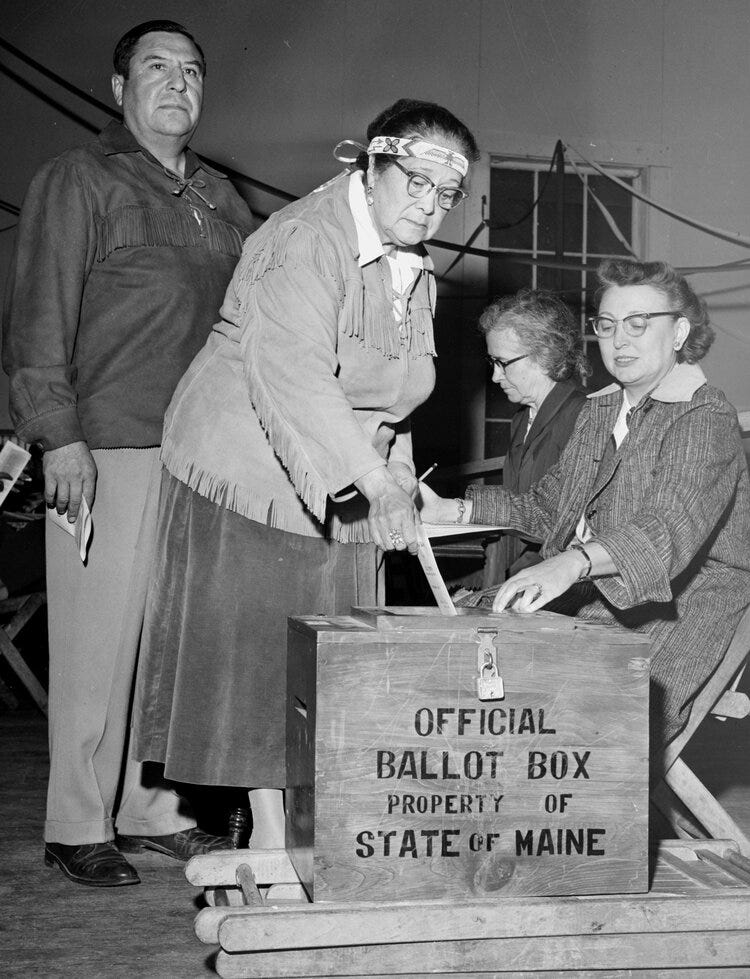
In 1955, Penobscot Nation voting rights advocate, Lucy Nicolar Poolaw, became the first Native American to cast a ballot on a reservation in Maine. The state is believed to be the last in the union to comply with the Snyder Act. As reported by Penobscot canoe maker, Henry Mitchell, in the 1930s, Natives weren’t just told they couldn’t vote; they were verbally shunned by their white neighbors.
“Just why the Indians shouldn’t vote is something I can’t understand. One of the Indians went over to Old Town once to see some official in the city hall about voting. I don’t know just what position that official had over there, but he said to the Indian, ‘We don’t want you people over here. You have your own elections over on the island, and if you want to vote, go over there.”
It would take another twelve years before Poolaw and her fellow tribal members would be eligible to vote in statewide elections in Maine. Lawmakers objected to the idea as late as 1967. Today, these political imbalances make Maine (one of the whitest states in America) one of the most challenging places in the fight for Indigenous rights.
Next month, the Penobscot Nation will argue before the First Circuit Court of Appeals, a long-standing defense of their Indigenous homelands— litigation not unlike the recent landmark victory, McGirt v. Oklahoma, which maintained original treaty-territory for the Muscogee (Creek) Nation. For the Penobscot, it’s their namesake river that is at risk of being lost, a land battle that boils down to who has rights to a sixty-mile portion flowing through the tribe’s reservation boundaries. The State contends that “the [Penobscot] River itself is not part of the Penobscot Nation’s Reservation“ and has relied on a legal firm that has long-defended polluters of the Penobscot — the paper mill companies. For the tribe’s part, this latest stand to protect the river is as old as the history of the colonization of Maine, itself. What choice do they have, but to fight?
With Maine as an example of the destructive impact that disparate voting rights can and do have for today’s tribal nations, it reinforces the hard fact that the right to vote remains an uphill battle for Native Americans. The biggest hurdle is voter suppression. While the Voting Rights Act of 1965 helped to secure and protect the Native vote, a 2013 Supreme Court decision removed one of its most powerful tools ensuring equal access to the ballot; the ruling upholds controversial voter ID laws. Among the states hardest hit — Alaska and Arizona, as well as North and South Dakota — are where significant Native American populations exist.
As noted by twentieth-century suffragettes, getting the vote wasn’t the endpoint, but rather an opening to change circumstances experienced by such communities as Indian Country. And in this unfinished struggle, Indigenous women are once more leading the way to even the political playing field, including the first two Indigenous women elected to Congress, Deb Haaland and Sharice Davids, the highest-ranking Native woman to lead state office, Lt. Gov. Peggy Flanagan of Minnesota, and so many more who are running for office in unprecedented numbers.
One hundred years after the ratification of the 19th Amendment, the prolonged political and symbolic disenfranchisement of Indian Country has its place, again, in reflecting on the passage of laws that shift power for the betterment of all Americans, not just Native Americans. In this way, the Native vote — precious, if not almost sacred — represents the most powerful tool we have in our democracy, though not yet fully realized.
Reprints and reposts: Indigenously encourages you to make free use of this article by taking these easy steps.