
Meet Ghrelin: the hunger hormone
All about the science of hunger and eating

How do you pronounce this thing anyway?
If that’s on your mind, don’t worry. You are not alone. What bothers me is that the first two letters are consonants and the connecting vowel is missing. So the way to do it is, to pronounce it as Greh-lin. H is silent as in honest.
Now coming to the point…
Why do you feel hungry?
What happens if you eat too much?
What happens when you don’t eat when hungry?
Why do you feel satisfied as soon as you complete eating?
Most of these questions can be answered on understanding Ghrelin.
But, let’s look at some literature first
I read some papers about Ghrelin, its popularity as the hunger hormone and, the current understanding of its function. If you think this part is boring, you can skip it. Else, brace yourselves.
- Ghrelin: much more than a hunger hormone: This article says that Ghrelin is a multi-faceted gut hormone. This paper does not deny the fact that Ghrelin’s major function is managing hunger. In addition to that, it is a catalyst for many metabolic reactions, the formation of bones, and early-stage development of cancer.
- Ghrelin: Structure and Function: It not just going to make you hungry, it is also responsible for your growth. That’s that value addition from this article. Ghrelin has the capability to trigger growth hormones (GH) which are responsible for body growth.
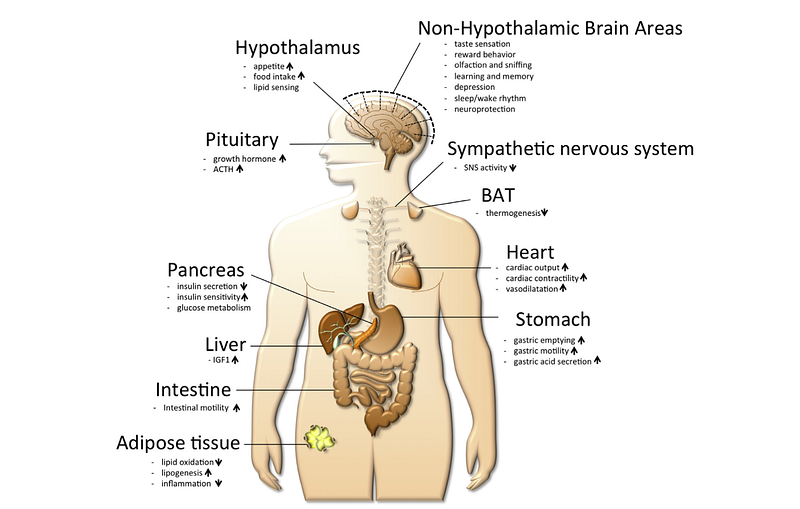
- Ghrelin: This gastrointestinal peptide hormone that was discovered in 1999. More than two decades ago I see. Below is a fantastic illustration of what Ghrelin is responsible for. This research explains that more Ghrelin was secreted in hungry rats and compared to fed rats. A similar study on humans was not conducted.
There are more papers on Ghrelin but mostly repeating the above three points and discussing physio-chemical reactions in detail.
Coming back to the main question
Why do you feel hungry?
The science behind this is simpler than you thought. As and when blood sugar levels drop in our body, there is a rise in Ghrelin.
With rising levels in Ghrelin, you will develop cravings forcing you to eat something. On eating, the blood sugar levels rise to normal and Ghrelin levels drop. As simple as that.
But, what if you keep eating?
Excess sugar kills neurons

We know that insulin maintains blood sugar levels. But if you keep eating, the bloodstream will be loaded with sugar which in turn starts feeding sugar to the brain reaching neurons.
According to Dr. Andrew Huberman, a study found a shocking revelation that excessive sugar results in the death of neurons. That’s right. Neurons die when exposed to excessive sugar. So its better to make sure what you eat. And that’s why…
Fasting is better than eating
There is probably ample evidence that fasting will improve your health. But I won’t repeat it and make you feel bored. This post is not about that anyway.
A study found that Ghrelin levels, as they increase in the body, will subside even if you do not eat. It comes back to the circadian rhythm or simply the body clock.
In this study, Ghrelin levels of two similar people were compared. The first one ate as he felt hungry and the second one did not. Results showed that there is no difference between the Ghrelin levels for both of them.
The underlying reason is that Ghrelin levels closely follow a circadian rhythm. And hence, your craving is a mere illusion. You do not always need to succumb to it. And yes, that’s the takeaway.
Eat when you have to. Not when you want to.
If you like my work, consider buying me a coffee. Been a while since I had a nice coffee.
Alternatively, you can support me by taking a membership.


