
Meet David Wernsman, Kidnapped and Beaten at 17 for Being Gay
His parents sent him to a school in the Dominican Republic run by U.S. Christians who beat and humiliated him.
The U.S. troubled-teen industry has been in the headlines a lot lately. Maia Szalavitz recently wrote for the New York Times (free link) that the industry offers trauma, not therapy, and is in desperate need of regulation and oversight. She wrote that Democrats in Congress have tried for years to pass meaningful laws to protect kids from abuse, but Republicans will not cooperate.
If you haven’t heard of the industry, it’s largely owned and operated by conservative Christians who deny mental-health science and work to “convert” LGBTQ youth into being cisgender or straight. They claim to be able to cure “delinquency,” drug addiction, alcoholism, depression, “defiance,” and even panic attacks.
“Because,” she told him, “I could never love a gay son.”
The movement’s boot camps, ranches, outdoor-adventure programs, and boarding schools have long been dogged by complaints of brutality and ineffectiveness. Despite that, the industry receives billions of public dollars to “treat” teens whose only crime was not conforming with their parents’ religious beliefs. The American Bar Association estimated that the industry received about 23 billion USD in 2021 alone. Those are your taxpayer dollars if you live in the U.S.
David Wernsman is a crystalized example of industry abuse. This is his story.
Warning: Descriptions of violence that follow many traumatize some readers. I had to stop researching and writing several times to regain my composure.
Disclaimer: I use the word “kidnapped” in this story, fully understanding that what happened to David might not fit the legal definition. But I think the word is accurate in its ordinary received meaning. You decide.
Over 10 years ago, in the prosperous Colorado city of Greeley, two muscular strangers shook 17-year-old David Wernsman awake in his own bed in the middle of the night. They barked orders without explanation, insisting he leave his parents’ home in a wealthy neighborhood and come with them. Confused and terrified, he refused. The men pinned him down and tied a belt around his waist. They used the belt to drag him outside and force him into their car.
They drove David to an airport and dragged him inside with the belt. I don’t know how they got him through security, and neither does he. He says he asked “many” people for help. With the belt, the men frog-marched him to a gate and dragged him onto an airplane in plain view of the public, airport staff, federal authorities, and airline crew.
When they landed in Miami, David finally realized his destination was the Dominican Republic, where he would not enjoy U.S. civil and human-rights protections.
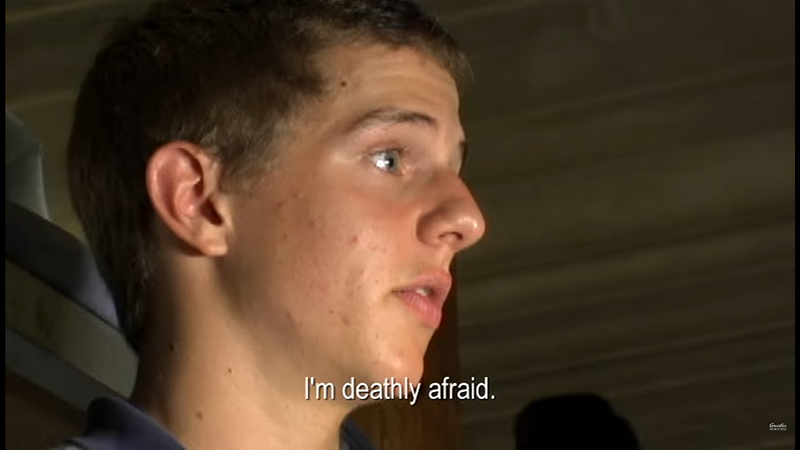
After arriving, the men dragged him into an isolated compound where 30 or 40 other kids lived in prison-like conditions. David stayed for seven months, forced into hard physical labor all day, memorizing Bible passages and suffering frequent beatings. “I was forced to bend over a chair,” he told filmmakers. “These guys would hold your belt up to give you a wedgie and then just beat the shit out of you.”
Many other youth in the program have attested to frequent beatings and worse torture.
David soon learned why his parents paid those men to kidnap him.
About a year before his flight to hell, he had come out to his parents as gay. David says his mother insisted he could not be. “Because,” she told him, “I could never love a gay son.”
Escuela Caribe claimed to “heal” rebellious, delinquent, or criminal youth. David was there to be tortured into being straight. He says the torture he endured haunts him to this day, as does the torture he watched other teens suffer.
As an aside, staff and some inmates have called beatings “swats,” but I won’t be using that euphemism. According to David and other inmates, the “swats” from wooden paddles and leather straps often resulted in raised welts, significant bleeding, and even scarring. I will use the words “beat” and “beaten” in the interest of accuracy.

Was David really a “troubled” teen?
He can’t have been beaten for months, held in solitary confinement, and forced to exercise until he bled … just because he was gay? Surely something else was going on. I wondered about that when I first heard his story.
Let’s hear from David’s friends and community members.
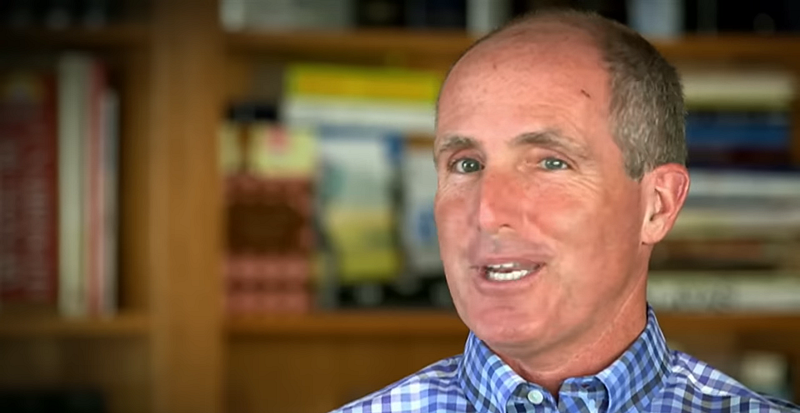
“David was a spark,” says his former drama teacher Peggy. “He was talented. He was just a good person, and somebody we all felt a connection to, and we couldn’t understand why somebody like this had been taken away from us.”
“It was so strange and surreal,” says David’s classmate Angie. “It was was like one minute he was there… and then the next thing I knew, I’m waking up and my best friend’s gone.”
“We began to become suspicious,” says Mark, an adult neighbor and family friend. “Because it just didn’t seem consistent with how David had interacted with people. He would always share what he was up to. He was very excited about what he was doing.”
Mark, Peggy, and Angie played critical roles rescuing David from Escuela Caribe after he turned 18 and staff held him against his will by telling the U.S. Consul that he had already left. They were actually hiding David in a locked, windowless cell.
Before he was kidnapped and tortured, David had good reason to be excited about his life. Far from being troubled or delinquent, he was a straight-A student who took mostly AP classes, which had earned him a 4.3 GPA. For readers outside the U.S., 4.0 is a perfect grade-point average. Students taking advanced-placement (AP) classes can earn bonus points.
David was already applying to elite universities to study music. He had the grades and accomplishments for admission. All he had to do was finish his senior year, which did not happen.
How about the other inmates at Escuela Caribe?
How delinquent and troubled were they, really? Here’s how David answered that question on Reddit:
The other kids there were as diverse as a high school hallway. Kids were sent there for any “problem” such as drugs, running away, arguing with their parents, sexuality, etc. all grouped under this “troubled teen” blanket. One kid was even sent there because he played on his computer too often and listened to Eminem. As far as maintaining hope while I was there…it was rough. Kate, the [documentary] director played a huge part, as she left me something to believe in when I got out and that I could help people. Honestly as the months went by, hope was hard to grasp.
Some of those inmates say they ran away from home to escape sexual abuse from a parent. Then they landed in hell.
A film student gets involved
For a broader perspective, we can look to former Christian missionary Kate Logan. During her mission years in the Caribbean, she had heard many positive stories about Escuela Caribe. So, as a newly minted film student, she reached out and asked staff if she could film a documentary as her master’s project.
School staff presumed Kate would make a film praising them, and so did she. That’s how she gained permission to spend the summer at the school, arriving about the same time David did — but under her own power rather than being dragged.
By the time she and her crew had finished filming, her entire perspective flipped.
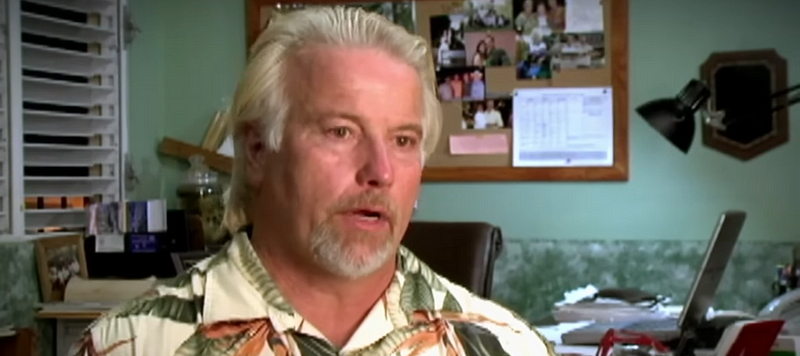
She started by filming David Wier, the school’s pastor and Director of Community Outreach. In some of the first footage she acquired, staff and students in a chapel sing, “God is love, high above, come and seek his joy.” David can be seen grimacing, hiding his face, and looking frightened. He doesn’t yet know that failing to sing enthusiastically will earn him beatings and other punishments, like solitary confinement in a 10' x 5' cell for days without enough food and with a only a coffee can for a toilet.
After the singing, Wier starts a sermon:
Jesus is calling each one of us here this morning to the father. We here at Escuela Caribe, we here at New Horizons Youth Ministry, will set out a structured discipline that will help you understand how to live your life, how to restructure and re-discipline this life that is in disarray. But greater than that, each of us sitting here this morning in this congregation can praise God that he [one or two words garbled] out and showing us the way.
Later, Kate sits in Wier’s office, luxurious compared to the grim barracks and cells the teens live in. She asks him to describe the program.
He says, “It’s a Christian therapeutic, residential boarding facility. That’s a long term for a place where kids that have just been in trouble can come and just get their lives straightened out.”
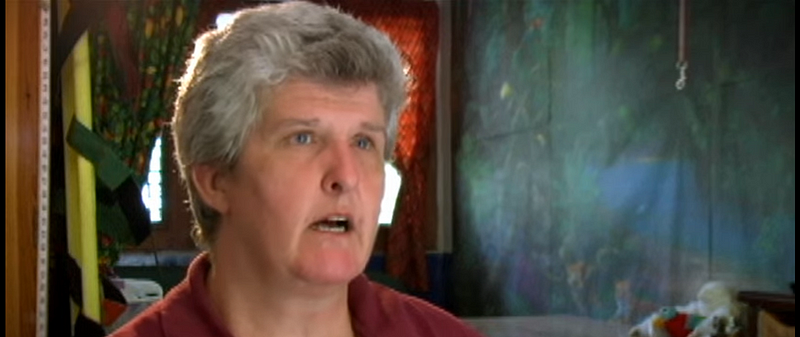
Next, Kate sat down with Medical Services Manager Cindy Hundley. She told Kate that people who are not Christians won’t understand, but that “accepting Christ” results in a “spiritual” effect that changes people for the better — that the impossible becomes possible.
Kate did not yet know that Cindy terrified inmates, whom she ordered punished in horrible ways, including forcing a girl who suffered from panic attacks to exercise until she coughed blood. Cindy told her the attacks were brought on by her “rebellion” and by demons (evil spirits) that possessed her body.
Kate did not yet know that staff forced a boy with a prosthetic leg to run for hours until his stump blistered and bled. I considered including a screenshot of his bleeding stump but decided it might be too traumatizing. If you want to see the evidence, I urge you to watch the film.
Cindy also ordered staff to force inmates not to speak to anyone for days at a time, and to beat them if they disobeyed.
She has no mental-health qualifications, and her medical experience is limited to having briefly worked as an EMT ambulance attendant.
Later, when Kate comes to understand that Cindy has ordered David tortured, she confronts Cindy, asking her about the school’s position on conversion therapy. Cindy denies that the school focuses on homosexuality:
How do we deal with kids that come down and say they have homosexual issues — or even claim to be bisexual? We really don’t even look at that. A lot of our kids have been hurt sexually by people. So many, as we have gone through counseling, we’ve come to understand that the reason they have come to enjoy the same-sex relationships is because they couldn’t trust the other sex. You have to get down to the root. Many of our kids go, ‘Oh, I’m so glad that I’m not a homosexual.’
Note that students who didn’t affirm that would be beaten.
Also note that decades ago, medical experts dismissed the sexual-assault theory of homosexuality. Overwhelming evidence shows that notion is false. As to Cindy’s assertion that, “We don’t even look at [homosexuality],” she knew David was an honors student who had been sent to Escuela Caribe because he told his parents he was gay. She knew perfectly well they sent him to the Dominican Republic to be turned straight.
In the film, Kate looks surprised by Cindy’s bold lie, and that moment marked a definitive change in how she conducted her film-school project.
The torture and attempts at conversion therapy she witnessed shook her to her core. She says, “I was surprised to find out why these kids had been sent here. They certainly weren’t the hardened criminals that I had expected.”
Instead of producing a film praising Escuela Caribe, she began to secretly collaborate with inmates. She helped David smuggle a letter out to his friends and teachers, and after he turned 18, she helped him escape.
I won’t describe any more of the film, because the conclusion is dramatic. I don’t want to spoil it. I’ll just note that it took a federal judge’s writ of habeas corpus to get David back to the U.S.
Before I conclude, let’s hear from Isaac Worley, who does not appear in the film and did not know either David or Kate. He was only 12 when his parents sent him to a Canadian program affiliated with Escuela Caribe. When he turned 15, they shipped to the Dominican Republic, where he spent most of the rest of his teenage years living in pain and fear.
Please read Isaac’s words with careful attention:
Canada- As a 75 lb 12-year-old in Canada, I was body slammed into the cabin wall then thrown to the ground by a screaming full-grown man for not singing loudly enough in chapel.
Escuela Caribe- I was held to a wall via a choke hold for not asking permission to enter/exit a room.
I witnessed students being slammed into various objects (kitchen tables, chairs, dressers, metal window slats) for minor infractions. I also witnessed what I consider psychological abuse on a daily basis… I believe putting a >>>child<<< into a small concrete cell with a coffee can to use as a toilet is also in the realm of abusive behavior.
I was fed a load of garbage, and told that I had issues I needed to deal with by counselors who had less experience than my cat in teen counseling.
Isaac’s opinion is backed up by data. Troubled-teen programs are not effective.
According to the National Youth Rights Association, “Discipline interventions like these programs have been calculated to increase recidivism by as much as 8%, compared to counseling intervention which decreases recidivism by approximately 13%.”
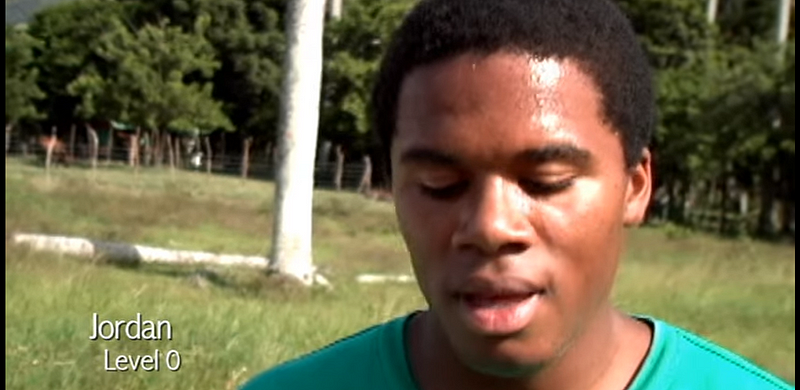
I would add that many of the teens in the “troubled teen” industry aren’t actually troubled. Recidivism is a meaningless term for teens like David, Isaac and Jordan, who were not criminals and had no history of violence. Recidivism is a meaningless term for a girl who was beaten to “cure” panic attacks.
I don’t know where conservative Christians get the idea that brutality can change children for the better, but they’re lobbying hard in Congress to keep the industry free of public scrutiny and federal regulation.
Please think about that when you think about troubled-teen boot camps and schools. Please remember David and tell people his story. Ask them to urge their elected representatives to regulate the industry.
Addendum: After David’s friends and neighbors helped him escape, Escuela Caribe shut down in the face of public outrage and legal scrutiny. They donated the facilities to another troubled-teen program. It’s staffed by some of the same people who ran Escuela Caribe. Similar programs are dotted around the Caribbean, in Central America, the U.S., and Canada. Teens who identify as transgender or gay arrive at these schools every day, many of them literally dragged.
David had something of a mental breakdown after he arrived home, too afraid to speak to the friends and neighbors who fought for his release. He spent years in recovery and is doing much better today. He eventually finished his high school education.
Shaken by what she witnessed, Kate no longer identifies as a Christian.

My writing is always free to readers who click my social media links, but if you’d like to browse more, click here to join Medium and support thoughtful independent writing and journalism curated by humans, not algorithms.
To get an email whenever I publish a new story, Click Here.


