
Meds vs. Meditation for Depression
Both can be effective, but is one superior?
This article is part of a Wise & Well Special Report: The United States of Depression.
I will never forget the moment a couple of years ago when my bupropion kicked in. I was sitting on the sun porch of an Airbnb on a family vacation. I had started taking the antidepressant about six weeks prior, but had not noticed much difference in terms of my anxiety and depression.
But that morning on the sun porch, shortly after taking my daily dose, I distinctly felt a flicker of well-being. Then it flickered out. Then the next day it flickered on again. Over the coming weeks, that sense of well-being grew from brief flickers to my predominant experience over the course of the day.
Then again, my mindfulness practice has also grown into something that profoundly shapes my experience of each day.
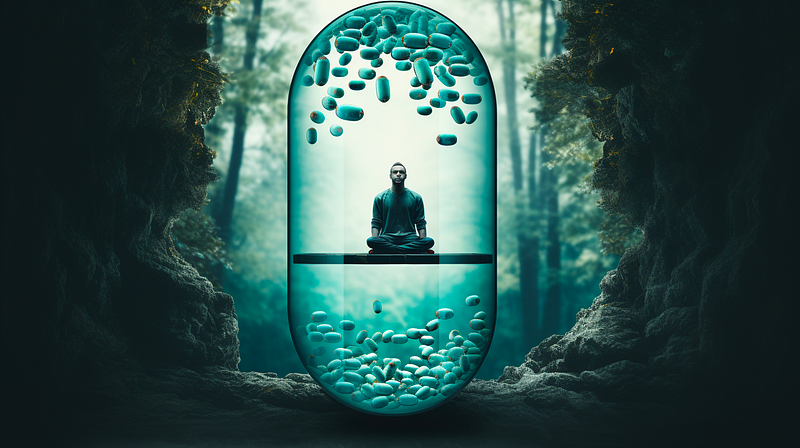
Which “med” deserves the most credit? Medication, or meditation?
Medication: a glass half-full
For many of us affected by depression, modern antidepressants have been literally life-saving. The first antidepressant medications to be approved in the US were monoamine oxidase inhibitors, or “MAOIs” (such as isocarboxazid), and tricyclic antidepressants, or “TCAs” (such as nortriptyline), as well as lithium. MAOIs and TCAs remain in use as second-line therapies, but they have more significant side effects than the more recently developed medications including selective serotonin reuptake inhibitors, or “SSRIs” (such as fluoxetine).
Other newer classes of antidepressants including serotonin and norepinephrine reuptake inhibitors, or “SNRIs”, and norepinephrine and dopamine reuptake inhibitors, or “NDRIs” — of which the bupropion I have been taking is the only example approved for the treatment of depression in the US.
Many medical conditions improve as a result of the “placebo effect” — the combination of the psychological effects of thinking you are being treated for your condition plus the fact that many diseases (like the flu, or a sprained ankle) get better on their own over time. Extensive investigation over many years has demonstrated that the placebo response rate of depression is right around 35%.
This highlights the fact that for some people depression is a transient response to circumstances that will go away on its own or as a result of placebo-induced positive thinking. That is not to say it will never come back, nor is this comforting news for those whose depressive symptoms persist. For such individuals, antidepressants are clearly more than just placebos.
A massive research project led by Andrea Cipriani, PhD, professor of psychiatry at Oxford University, reanalyzed previously published data from over 500 studies involving over 100,000 participants. Cipriani’s analysis confirmed that antidepressants are more effective than placebos. In contrast to the 35% response rate for placebos, the study concluded that about 50% of depressed individuals will respond to any given antidepressant medication (with some medications having a modestly higher response rate, and others a modestly lower response rate). Note that in this study, a patient was considered to be responding to a particular medication if they experienced a 50% reduction in their depressive symptoms.
This is not a huge increase over the placebo response rate. But while some use this information to downplay the efficacy of antidepressants, an extra 15% of patients experiencing at least a 50% reduction in symptoms is nothing to sneer at.
“Our study brings together the best available evidence to inform and guide doctors and patients in their treatment decisions,” Cipriani said in a statement. “We found that the most commonly used antidepressants are more effective than placebo, with some more effective than others.”
For those who do not respond to the first antidepressant they try, many will respond to a different medication, although the probability of responding to a new medication decreases with each medication tried. For those who fail to respond to conventional antidepressant medications, other types of treatment may be successful (including counseling, meditation, electroconvulsive therapy, transcranial magnetic stimulation, or emerging therapies like ketamine or psilocybin).
In addition, even an antidepressant that works wonderfully for a given individual can stop working over time. However, in such cases changing to (or adding) another class of antidepressant may result in renewed relief from symptoms.
In my case, I was prescribed bupropion when, after many years, escitalopram had stopped working by itself. And the combination is working well for me as a component of my personal mental health regimen.
Meditation: a glass at least as full
While I credit antidepressants for lifting me out of the depths of depression, I credit my meditative practices with transforming my daily experience of anxiety (which I perceive as a driver of my depression), how I respond to anxiety, and how I notice and appreciate everyday life as it unfolds in front of me.
That might sound nice, but does it jive with the scientific evidence?
Numerous studies have examined the efficacy of mindfulness as a therapy for depression. One of the most recent performed a head-to-head comparison of in-person mindfulness training to a common antidepressant. The researchers found the two therapies to be equally effective. In addition, mindfulness has been demonstrated to be as effective as cognitive behavioral therapy — a common form of psychotherapy used in the treatment of depression.
Similar to Cipriani’s analysis of published data pertaining to antidepressants, another recent study pooled and analyzed all the available data related to in-person mindfulness training in non-clinical settings. The study examined how community-based mindfulness classes affected the mental health of participants (whether or not they had a formal diagnosis of depression).
The analysis concluded that meditation classes do indeed reduce symptoms of anxiety, depression, and other manifestations of “psychological distress.” Additionally, the study found that these benefits lasted for months after completing the activity.
“For the average person and setting, practicing mindfulness appears to be better than doing nothing for improving our mental health, particularly when it comes to depression, anxiety, and psychological distress — but we shouldn’t assume that it works for everyone, everywhere,” Julieta Galante, PhD, professor of psychiatry at Cambridge university and lead author on the study, said in a statement.
In these studies, meditation typically took the form of mindfulness-based stress reduction training — the clinically standardized form of meditation as developed by John Kabat-Zinn, PhD — or similar approaches. These interventions are secularized practices derived in large part from the Buddhist Vipassana tradition. A typical prescription would be to encourage the participant to focus on the breath in an effort to foster non-judgemental acceptance of whatever is happening in the present moment.
There is very little research related to other meditative modalities, including practices that draw on the Hindu Vedanta and Buddhist Dzogchen traditions. Where practices based on the Vipassana tradition tend to take the form of a “self” within the meditator directing attention at different aspects of experience, these other practices go a step further and undercut the construct of self itself.
In my own mindfulness practice, I have found that meditation creates an opportunity for anxiety to settle and recede. The practice also brings the focus of my attention to the beauty and privilege of being a conscious creature in this present moment, in this universe. Placed in that context, many of my self-centered desires, worries, and concerns shed much of their apparent significance.
While the existing research indicates that meditation can be as helpful as other wellness activities or even medication, many aspects of meditation are difficult to standardize and quantify. While Kabat-Zinn has standardized a form of Vipassana meditation in a way that makes it ripe for scientific study, mindfulness-based stress reduction by no means captures the full spectrum of practice and experience.
As a result, it is possible that the research underestimates the potential of meditation with respect to mental health, and these challenges to research may prove challenging to overcome in the foreseeable future. But I feel no need to wait for the scientists on this one — I will continue to explore for myself the vast expanse of joyful existence available in each present moment as revealed by mindfulness and meditation.
Unintended consequences
Despite progress in both efficacy and tolerability, all antidepressants have significant side effects. Among the most troublesome are sexual dysfunction, weight loss, and gastrointestinal upset. Depression, stress, and anxiety can cause these symptoms on their own, so whether these symptoms get better or worse while taking a given antidepressant varies from patient to patient.
And they can be difficult to stop taking. Weaning too quickly can lead to feelings of fatigue and dizziness, not to mention worsening depression. And “too quickly” can mean anything from weeks to months depending on the half-life of the medication.
In contrast to medications, we tend to think of meditation as being essentially free of side effects. But careful examination is revealing that this is not the case. In some individuals, meditation can bring up past traumas in non-therapeutic ways, lead to nightmares, or have other adverse effects.
Willoughby Britton, PhD, professor of psychiatry and human behavior at Brown University, recently completed a study that carefully examined adverse effects experienced by meditators. He found that over half of meditators experienced at least one undesirable side effect, with 37% reporting side effects that interfere with quality of life. Most of these side effects were short-lived.
“Our ultimate goal is to maximize the efficacy of mindfulness-based meditation while minimizing harm,” said Britton in a statement. “In order to address risks and modify treatment accordingly, you need thorough and detailed knowledge about potential harms. Our study, the most comprehensive of its kind, provides a blueprint for how to accurately assess the risks of mindfulness-based meditation programs.”
One size does not fit all
What is clear from all this research is that there are no cookie-cutter solutions for any individual suffering from depression. People who fail to respond to one type of therapy or class of drug may respond to a different type of therapy or class of drug.
In my case, a combination of medication and meditation is what has sprung me from the clutches of depression, at least for now.
New options for those who fail to respond to multiple medications continue to emerge. In addition to electroconvulsive shock therapy (which remains the gold standard for treatment-resistant depression), newer therapies like transcranial magnetic stimulation, ketamine, and psilocybin are showing significant promise.
Ultimately, teamwork between patient and physician is essential to decide what modality — or combination of modalities — will be best for a given individual.
This article is part of a Wise & Well Special Report: The United States of Depression. If you or a loved one is anxious or depressed, make sure to talk to your doctor to discuss the full range of therapeutic options available to you. If you need help right now, don’t hesitate to call the confidential National Suicide Prevention Lifeline at 1–800–273-TALK (8255) for English, 1–888–628–9454 for Spanish.
If you enjoyed reading this article, consider subscribing to my weekly newsletter focused on better living through mindfulness. Learn more at https://www.realandpresent.com — Eric


