
Medium’s No Clickbait Policy May Be A Blessing In Disguise
Medium recently threw down against clickbait. Here’s a clip from their new distribution guidelines to prove it.
“Clickbait is content that’s designed to entice a reader to click. It often shows up in the form of deceptive or manipulative story packaging — a hyperbolic claim, a too-wide curiosity gap, a titillating image, etc. These stories do not follow through on their promise and often leave the reader unsatisfied.”
Whatever you think of Medium’s new clickbait policy, I think it actually may be a blessing in disguise.
Here’s why.
First, This Is Horrible News, Right?
Um. How do I get people to click on my article without being semi-clickbaity?
It’s like re-naming ‘Star Wars: The Empire Strikes Back’ as ‘Star Wars: Darth Vader Is Luke’s Father.’
Takes the surprise out of it, right? It seems like if Medium had their way, they’d want everybody to blatantly deliver the punchline in every headline. The truth is, whether Medium likes it or not, you have to have some clickbait in your shit.
Or else nobody would click.
The alternative is that you could be Chrissy Teigen and get clicks just because of your name alone.
But not all of us are super famous. So what’s an honest writer with a good story to do? We need clicks, but Medium’s clearly stated they don’t like clickbait.
The solution is to write non-clickbait clickbait, as Todd Brison stated in one of his latest Youtube videos.
I was thinking about non-clickbait clickbait around the same time that Todd made this video. The kind of headline that technically tells you the lesson inside it, but also drives curiosity.
“How in hell is that possible Tom?”
I can hear you asking that right now. The solution, friends, is to have two phrases in your headline. One to show what the article is about, and the other to drive clicks.
Here’s an example:
Here’s what it looks like on the backend:
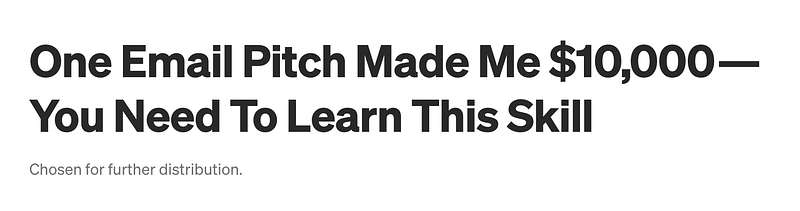
As you can see, it was chosen for further distribution.
It’s sort of clickbait but it’s also not clickbait. The “One email pitch made me $10,000" part of the headline is (probably) Medium approved.
The second part of the headline “you need to learn this skill” is reminiscent of some of the wildest clickbait we’ve ever seen on Medium.
So how was it chosen? I blended clickbait with non-clickbait.
This is the writing equivalent of making hollandaise sauce, so you got to be careful.
The headline of this article talks about how Medium’s new clickbait policy may be a blessing in disguise. The blessing is, it’s going to make us all much better headline writers.
Because we need clicks, damnit.
Not all of us are super famous. If I was former President Barack Obama, I could write an article titled “Farts” and get a million views instantly.
So we have to improvise, and Medium’s basically forced us to improvise. Well Medium, we hear you loud and clear. It seems as if we’ve been given an insurmountable ultimatum, but with the help of basic ingenuity, many writers are already surmounting the insurmountable.
Clickbait Won’t Ever Go Away
Sure, we’re not going to see the “10,000,000 Ways I 3,000x My Output This Year” articles distributed on Medium anymore. I’ll miss them (just like everybody else, right?) and I’ll bid them a fond farewell.
However, some form of clickbait will always be here. It will always be a part of the internet whether we like it or not.
I think NEW clickbait can be a hell of an art form in a vacuum. The people who can engineer ways to get millions of clicks with 7–9 words are geniuses.
Here’s one section from Medium’s clickbait guidelines I want to zero in on:
“These stories do not follow through on their promise.”
Medium: I love you, but I gotta disagree with you here. I know some writers here who write the most egregious clickbait ever and get thousands of email subscribers every month.
That means they’re following through on their promise.
That’s like, the definition of following through on your promise. When a restaurant says they have the best pizza in town — and they actually do — I come back for more.
And that’s what a lot of people do. They subscribe so they can get more.
For Medium to take such a black and white stance on clickbait seems sort of ignorant. Clickbait is what built Medium into what it is today. I agree that blatant clickbait needs to die a quick death, but to make believe that ALL content that entices readers to click is bad and doesn’t follow through on their promise is wrong.
I really like that Medium is pushing the boundaries of what content should look like on the internet, but I also think that as boundaries are pushed, sometimes they get pushed too far.
I hope that as more writers create click-bait and non-clickbait hybrids, they’ll see this issue isn’t as black and white as their distribution guidelines make it out to be.
Did you like my article? Consider signing up for my free masterclass “How To Make An Extra $1,000 Writing Online Every Month”


