
Medium vs Vocal: The Ultimate Head to Head Guide for Writers
The online publishing platforms compared in fine detail

Story last updated to include relevant platform changes: August 2021
— Hey there, still writing on the internet? Me too. It’s a tough gig that’s for sure, but we can agree it got a little less tough since Medium came along.
Medium has managed to do something amazing: pay writers to write about whatever they choose. Any writer too, not some special club of pre-approved journalists and authors, all of us are welcome to compete on Medium’s egalitarian playing field of attracting readers and getting paid for it. If you get reads, you get money, and that’s a serious win for artistic freedom.
This is why I was excited to hear about another website on the block that does the same thing, called Vocal. Vocal is younger than Medium, but they are both social journalism/blogging platforms that are open to all. There are slight differences in how each site is set up and run, and if you’re reading this, you’ll be wanting to know what those differences are.
So, I did a bit of investigation and wrote it all down. Let’s get into it.
Platform Origins
Firstly, a quick bit of history so you know what you’re dealing with.
Medium was started in 2012 by Evan Williams, the one time CEO of Twitter and the founder of Blogger. He’s a real mover and shaker as you can imagine and even popularised the terms “blog” and “blogger.”
Medium’s parent company is called A Medium Corporation and as of 2019, like most internet ventures, it is still not profitable, though continuously attracts good funding.
Vocal is much younger, founded in 2016 by Jeremy Frommer who runs Jerrick Media Inc, which will be renamed Creatd Inc shortly after it is listed on the NASDAQ.
Their Q2 revenue was just below $350,000 though I didn’t dig deep enough to work out how much of that is profit because frankly, all we need to know is both platforms have good investment backing and don’t look to be collapsing any time soon. So you can write with confidence.
Visitors and Readers
Both Medium and Vocal do not publish visitor stats but according to citations on Wikipedia, Medium had 60 million monthly visitors in 2016 and according to the current Medium front page, their monthly readership for 2020 is 120 million. That’s very good growth if accurate.
Vocal has a smaller readership. The latest figures I could find were for Q1 2018 where the site received 6 million monthly visitors on average. That’s a healthy contrast to 500,000 in Q1 2017. As noted: “By the third quarter of 2019, the company expects 17 million visitors to the site every month.”
Looking at those figures, you might think there’s little point to posting on Vocal, as it’s a much smaller platform, but smaller platforms have their own advantages, namely, it is easier to get noticed and attract fans. There are also other possible advantages to Vocal with regard to how they pay writers, which is covered below.
Paywalls
Medium has a metered paywall allowing visitors to read up to three premium articles a month before they have to pay to be a “subscriber” if they want to read more.
Premium articles are denoted by a star symbol and they sit behind the paywall. As of 2020, starred articles account for nearly all Medium content. Though an important caveat, Evan Williams announced in 2019 that all paywalled articles are free to view without restriction if a reader comes through Twitter, and even better news, authors will still get paid as normal.

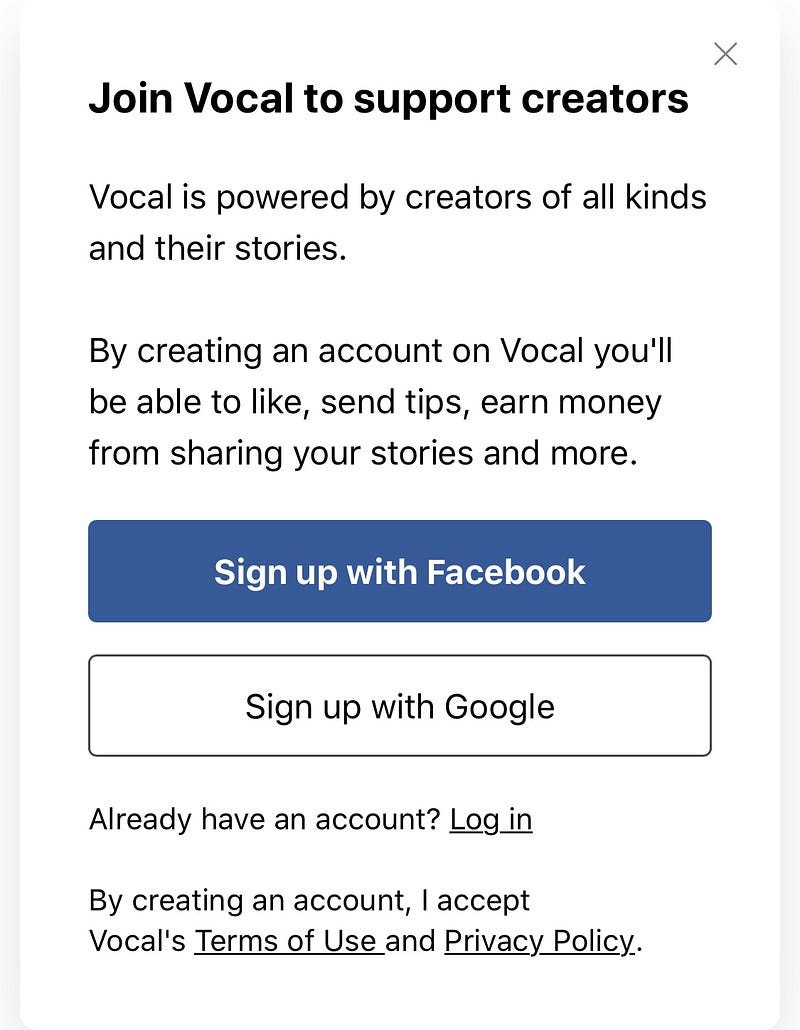
Vocal approaches the visitor issue differently, currently having no limit on reading time or views and anyone can read anything on the site without paying. Vocal does, however, prompt visitors to sign up if more than a few lines of a story is scrolled through. Registered members are then able to like, send tips (more on this later) and partake in other small site interactions.
Membership
“Membership” is when someone has signed up to the site. Both sites require membership registration to write, both have an option to pay to become a premium member, but to be clear, anyone can write on Medium or Vocal and make money without having to pay.
Paid membership for Medium costs $5/month or $50/year. The incentive to pay for Medium is to be able to read paywall content and listen to audio versions of selected stories.
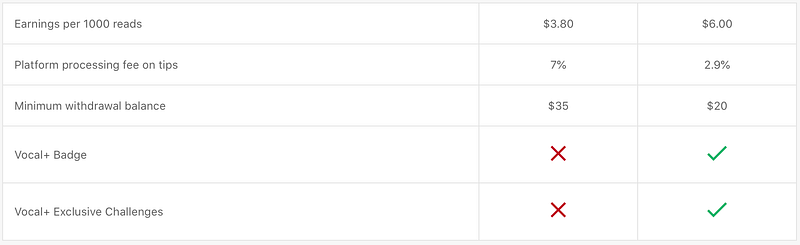
Paid membership for Vocal (known as Vocal+) costs $9.99/month. This is double the cost of Medium membership, however, as part of the incentive, Vocal increases the amount writers get paid for reads if they are premium members. They also offer Vocal+ members access to writing challenges with bigger cash prizes. We’ll talk about these challenges and earnings in general below.
Medium currently has 200,000–400,000 paying members. Vocal currently has over 1,200 paying members.
Note: The Medium membership numbers are undoubtedly higher than Vocal, but are much more of an estimate (200k-400k is a big margin of error after all). I’m guessing as Medium is not on the stock market, it has the luxury of being more obscure about its facts and figures than Vocal, who has shareholders.
Earnings
Let’s get to the juicy stuff. There are currently two ways to earn on Medium. These are:
- Payment for reads: if you are a part of the “Partnership Program,” that is free to join on the site.
- Very occasional bonus payments from Medium for exceptional articles.
The algorithm that calculates Medium payments is a little opaque. They say they pay more the longer a reader stays on an article, but there’s obviously a ceiling limit of earnings per read, and does this mean an author is penalized for writing shorter articles, such as poetry for example?
Medium also “includes reading time from non-members if they become members within 30 days of reading your story.” How do they know? Cookies? What if someone logs in from a different device? Lots of questions that I can’t seem to find exact answers to.
In Medium’s defense, they’re attempting to promote engaging articles, they undoubtedly pay well (I will testify to that), and they send out a monthly Partnership Program email with some facts and figures about what was paid out to writers that month, just for transparency. So I will forgive them for not laying their payment algorithms bare.
Since 2021, are four ways to earn on Vocal. These are:
- Payment for reads
- Tipping via the “Give Tip” button from fans
- Bonuses from the Vocal team
- Prizes for writing challenges
Payments for reads is much more transparent for Vocal. They pay $3.80 per 1000 reads for normal members and $6.00 per 1000 reads for Vocal+ members. This includes all reads, even from non-members and google hits. To be clear, this doesn’t mean you need to get 1000 views to get paid, an article can be viewed just a few times and you’ll get a few cents.
Then there is “tipping”, a function Medium does not have.
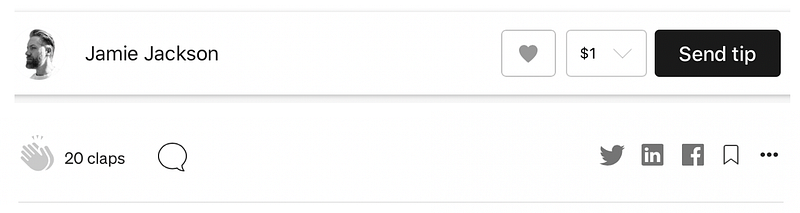
Tipping is a great way for people to send you a dollar (or ten) as a way of support. This is an option at the bottom of each article and directly from each writer’s profile. Vocal will tell you which article the tip came from so you can track what has attracted the most tips.
I love this system, and I think it is something that Medium needs to employ.
Since being a member of Vocal I’ve received three tips, at $1, $10, and $20. These, I have deduced, came from the Vocal team themselves as a sort of keep on truckin’ incentive, or for when they featured one of my articles on their social media highlights.
However, this has changed as Vocal have recently introduced bonuses. They wanted to seperate out fan donations (in the form of tips) and their own financial encouragement (now in the form of bonuses).
The only difference between tips and bonuses is that tips go straight to your Stripe account, whereas bonuses show up in your Vocal “wallet” — a running total of earnings that month from the site.
Finally, Vocal is known for its writing challenges, where you submit articles on a given subject and they are judged by the Vocal curators where the top three winners are awarded cash prizes of varying amounts. I’ve written about these writing challenges separately below.
It is worth noting that in August 2020, Medium launched its own writing challenge, which is addressed below.
Payment Set-Up and Transfers
Both platforms use Stripe to pay their writers. However, they differ slightly in how they use this service.
Medium sets up the Stripe relationship with themselves using your email, whereas Vocal requires you to set up a Stripe account separately, and then connect it to them.
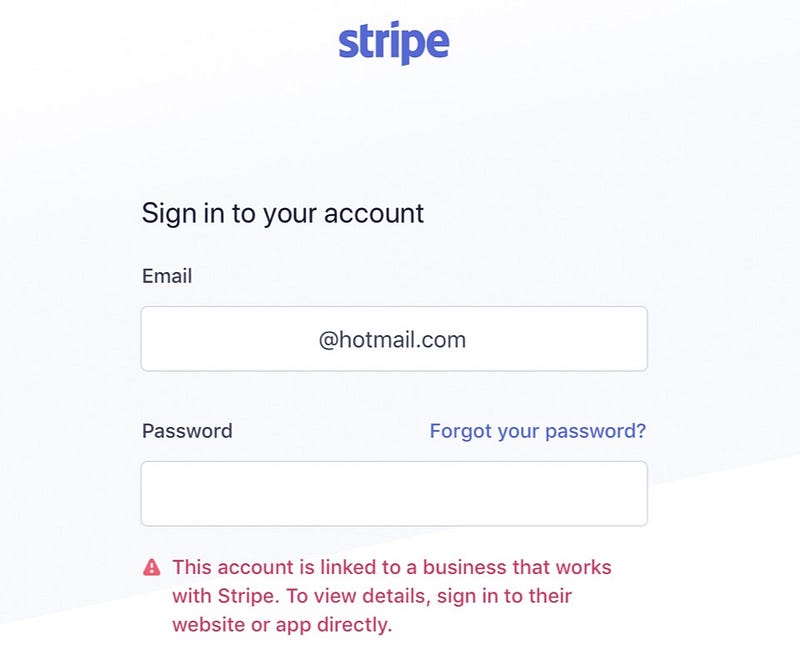
So what? Well, when I came to set up payments with Vocal, Stripe wouldn’t let me use my usual email address as it said “This account is linked to a business that works with Stripe.”
This is because Medium has used my email to set up their transactions. Not a big deal, but it meant that had to set up my Stripe account using a different email than the one I use with Medium, which I assume is now defunct for any Stripe use apart from Medium payments. Medium probably mentions this in their small print, but it was irksome nonetheless.
Both sites pay monthly into your bank account via Stripe, which has all worked smoothly so far.
Writing Challenges and Cash Prizes
Medium did not hold any “writing challenges” or competitions until August 2021 after it saw the success Vocal has had with using them to draw in members. Now both platforms are pushing this competition format.
Vocal normally has a couple of challenges running at all times on Vocal, with cash prizes for 1st, 2nd, and 3rd place. Some challenges are only eligible for paid members (Vocal+). These normally have higher cash prizes of $5,000, compared to the $1,000 first prizes for non-premium challenges.
Vocal recently doubled down on their prizes — In March 2021, to celebrate one year of writing challenges, Vocal paired up with Moleskine to run a challenge with a $20,000 cash prize, and it received nearly 10,000 entries. Another writing challenge about television has a top prize of $10,000.
Medium’s first writing challenge has a whopping $50,000 top prize, sith a change of grabbing $10,000 for another few luckily writers.
Personally, I love writing challenges, they are a great way to earn extra cash (if you can win them — I’ve entered 21 Vocal challenges to date and won nothing) and they stimulate creativity. It is also why, compared to the Medium challenge, lower writer numbers on Vocal can be an advantage, as there is less competition and more chance to win, but as the recent Moleskine challenge illustrates, competition grows fierce when serious money is at play.
Writing, Editing, and the User Interface
Medium’s greatest feature is its app. Well, it is for me. I write a lot on my phone and having a clear, distraction-free interface is amazing. It’s not 100% perfect but the fully functioning app makes writing, publishing, and reading on Medium a total joy. Vocal does not have an app. However, it does have a very decent phone-friendly webpage that works in a similar way to Medium’s app. Both sites allow you to write and publish from a phone quite easily.
My biggest bugbear about Vocal is that, unlike Medium, it does not save your work as you write. I’ve lost work (twice!) in the past simply because I’ve accidentally navigated back a webpage and hadn’t clicked “save” at the top of the screen beforehand. Not a major issue, but considering Vocal is a newish start-up and not building an autosave feature into their UI feels slightly archaic.
It’s also worth mentioning that Medium has more variation of heading types and other formatting features such as page breaks, than Vocal. This is just a stylistic preference, but I do like using several heading types in my articles and Medium offers that functionality.
Lastly, one very big difference that has now changed is both Medium and Vocal now allow post-publishing edits by the author.
Until June 2021, Medium allowed edits whenever — even if an article had been accepted into a publication — but Vocal omitted this feature to ensure articles were not adjusted to be “hateful or harmful”. Nonetheless, they acquiesced to pressure and introduced the “quick edit” feature to allow authors to change the body of the text if and when required; a sensible approach to treating writers like adults, I’m sure you’ll agree. Note, however, this feature is only available to paying Vocal+ members.
Photos, Images, and Embedding
Both sites accept images and image titles for source credits and so forth, but Vocal has an in-built integration with unsplash.com whereas Medium does not. This means it is possible to browse and embed a photo from Unsplash without leaving the Vocal text editor.
Author’s correction Aug 2020: Kate Feathers has helpfully pointed out that it is possible to click the plus button in a Medium article and select the magnifying glass to search and embed Unsplash photos directly from Medium. I did not know this and I have been using Medium for four years! Thank you for the correction, Kate.
Both sites also allow any other image to be uploaded, including embedded links and videos and present them in a similar way.
Publishing Process
Medium will allow anyone to register, write, and publish on their platform. There are no quality checks or approvals required. The steps are to write then publish.
Vocal works differently in that all articles need to be submitted for approval to the Vocal curators. Anything written needs to go through a quick submission process of write, submit, then publish.
I say quick because this never seems to take more than a few hours. Vocal says within 24 hours, but it is always speedier, lightning-quick compared to submitting a draft to a Medium publication that may sit on it for a week or ten days (we’ll talk about how Vocal handles publications in a bit).
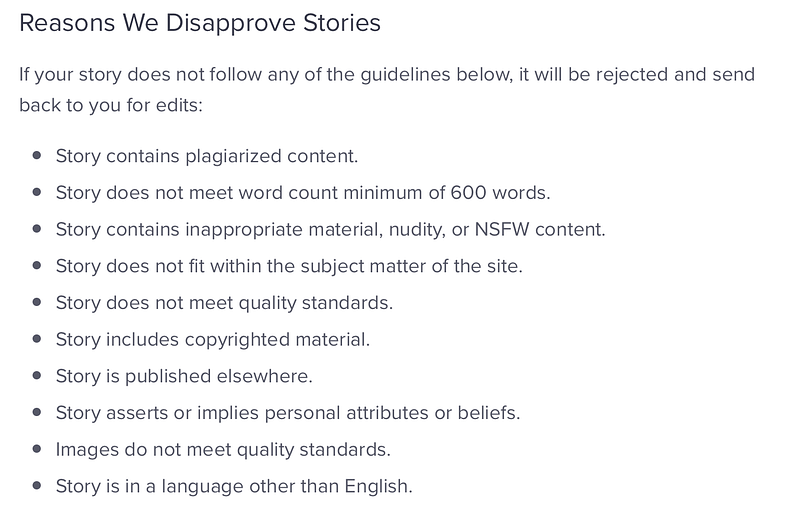
Vocal’s criteria for rejection are posted below. Note they have given themselves some wiggle room for rejecting just about anything if they feel the need.
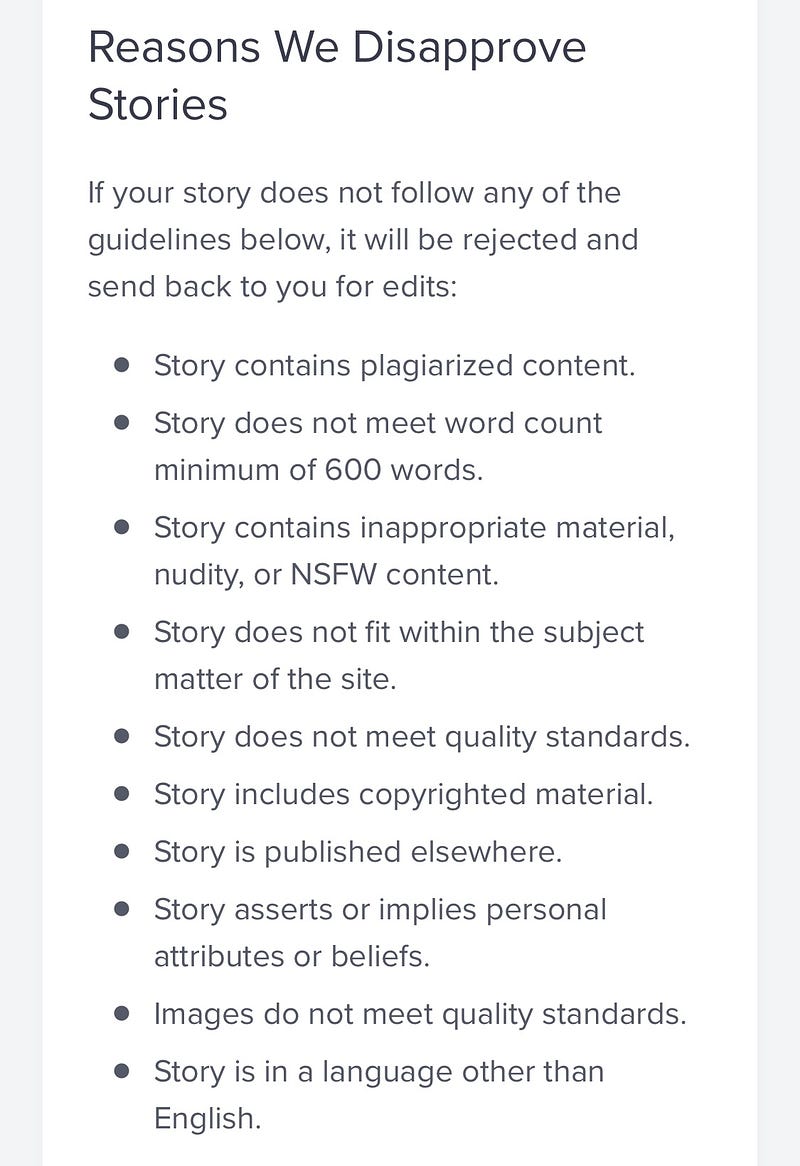
I had an article rejected by Vocal based on a comment I made about religion (I said Christianity is a guilt-based religion). It prompted me to see if anyone else had experienced this; a quick Google confirmed they had. It seems Vocal are very cagey about publishing anything containing religious opinion.
Vocal also treats some political opinion with some caution. They added a disclaimer to the top of an article I wrote about Trump, as shown:

This isn’t a judgement on Vocal, merely a statment of fact about their processes. They moderate much more readily compared to Medium, using that extra approval step to sometimes intervene in what is and isn’t published.
Publications, Tags, and Listings
Medium has publications whilst Vocal does not. Instead, it has “communities”.
In Medium, a writer can publish an article (or have it saved in a draft format) and submit it to a publication within the Medium ecosystem. In Vocal, when a writer submits an article for approval (the extra “submit/approval” step we talked about earlier), they must also select which community the story fits into. The communities used to be shown on the Vocal front page, but are now found in full under Communities on the top menu bar.
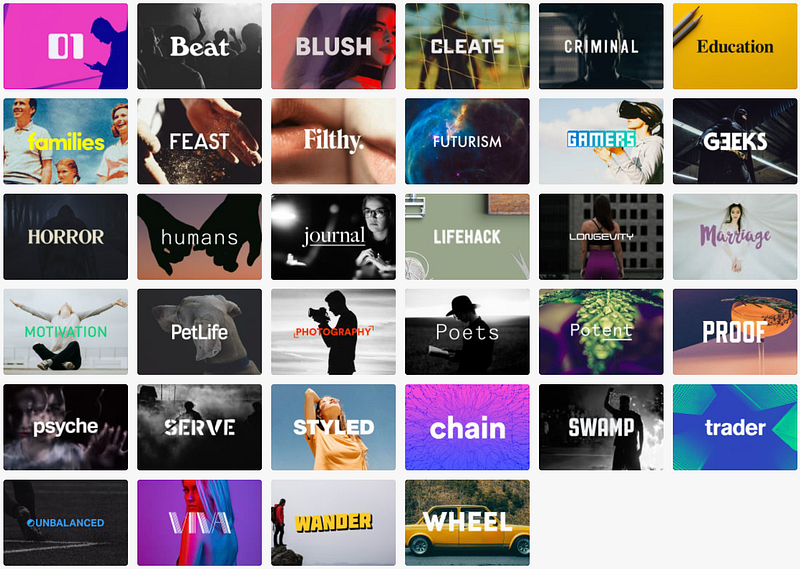
Sometimes it’s difficult to work out which community your article fits into, but when published, the Vocal curators will move it to one of their liking.
Being accepted into one Vocal community or another doesn’t seem to make much difference, whereas an article being accepted into a Medium publication can make a massive difference, as publications vary so greatly in readership numbers and exposure.
Medium also has “tags.” Up to five tags can be added to any published article. Tags help readers find relevant articles they might be searching for, and it helps with denoting who are the “Top Writers” in certain topics.
As Vocal funnels everything into a community when published, they do not have the nuance of tags, though there is a second-level category that you can choose when publishing on Vocal, e.g. Community = Psyche and Category = Anxiety.
Followers and Comments
Vocal does not have the ability to follow other writers, nor does it have any comments or discussion functionality.
It does, as mentioned, allow anyone who has signed up to like (“heart”) a post, but that’s about as far as the social side of Vocal expands.
Medium place much more emphasis on promoting a writer community. Each article written has a comments section, writers are encouraged to follow each other and article “likes” are dished out in the form of claps, where a reader can give a single clap for a story, all the way up to 50 claps, depending on their preference. Medium users can even clap for and respond to individual comments, promoting conversation and connection between writers that is lacking on Vocal.
Top Writers
The only other difference between these sites that I have identified is that Medium awards people the“Top Writer” title in particular tags, whereas Vocal does not have such a system.
How Do I Become a Medium Top Writer?
A good question. Here is Medium’s answer. There are 73 tags, that need to be used exactly, where someone can be recognized as a “Top Writer.”
Medium says that, within these tags, if you display quality, frequency, and a loyal readership, they will award you a “Top Writer” title.
For example, I was given a “Top Writer in Entrepreneurship” title recently, most likely because my Tony Robbins coaching article that went viral, and it has the Entrepreneurship tag attached to it.
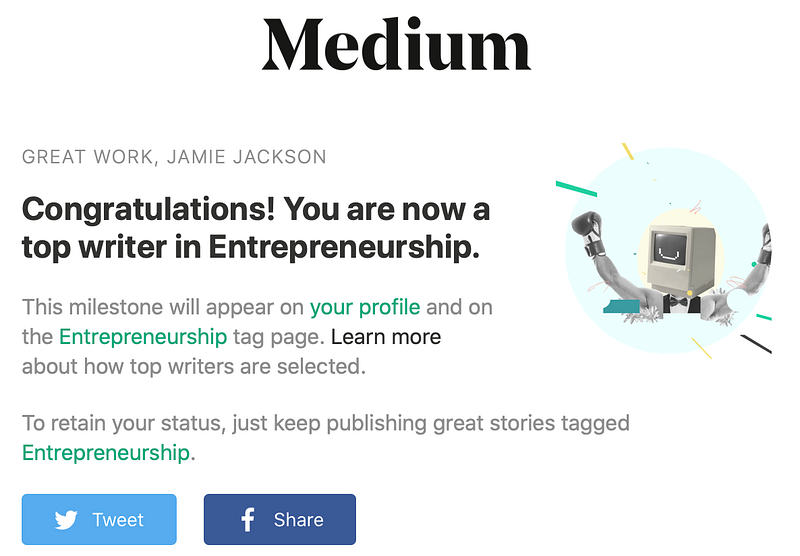
It is worth noting that at the beginning of 2021, Medium removed nearly all indications of top writers from their platform. They still award “top writer” titles to writers, but such accolades are no longer viewable on writers’ individual Medium profiles and don’t seem to have much impact — perhaps they affect the algorithm (how visible your work is) but who knows.
Vocal does not have top writer titles, but writing challenge winners get a badge on their profile for first through third place wins, which feels nice.

They also do “creator spotlights” on their blog and social media to highlight the work of individual writers. Medium also does this through their newsletters, but they pick out individual articles, rather than the writers themselves.
Double Publishing
Medium does allow articles to be published elsewhere. This is evident because they encourage writers to add the links to the other copies of an article so search engines can know which is the main link to use.
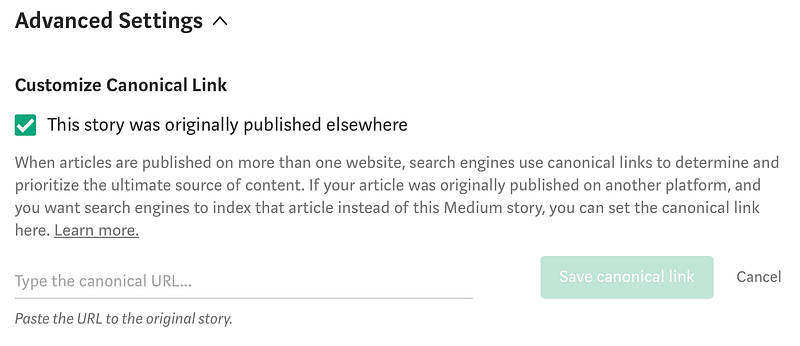
It’s also worth noting that some Medium publications also publish articles by writers on their own websites, though publications will be clear about this in their terms of submission, e.g. The Good Men Project website that also runs the Hello, Love publication.
Vocal does not allow articles to be published elsewhere. This is stated in their reasons for rejection.
As a bit of anecdotal evidence, Vocal is pretty hot on this. They emailed me a couple of weeks ago noting that an article I submitted was similar to one found on Medium. I had deleted it off Medium and republished on Vocal after rewriting it, but clearly, Vocal’s algorithm still found similar wording in the cache history of the former article. I had to confirm it was my work, not plagiarised, and they duly published my submission, but that’s some slick detective work they undertook.
Update: Perhaps in a bid to bag more Medium writers, Vocal seem to have drastically relaxed their stance on double-published articles. I recently read an approved Vocal article that had “originally posted on Medium” linked at the bottom of it, testament to Vocal’s more lax attitude in this area.
I would also add double-publishing can be important to writers as we often want to showcase our best writing on our own blog or website. Food for thought on that.
Conclusions
On balance, there’s no real advantage between one site over the other. Both look to have bright futures and have a similar growth trajectory, Vocal is just younger and Medium hit the ground running because of the “former Twitter CEO” gravitas propping it up.
I haven’t been on Vocal as long as Medium, but I do enjoy it very much. Having a second place to write means I can be more free and easy about my “brand” and “message” and all that boring crap writing folk have to worry about, that can get in the way of just having fun and being creative.
Please do check out Vocal (and Medium if you’ve just stumbled across this article and aren’t yet familiar with it). Both pay writers to write and that in itself is a wonderful business model. And not a banner ad in sight.
Sign up to Medium for more stories like this
If you enjoyed this article, read more stories from Jamie Jackson and thousands of other writers on Medium for $5 a month by clicking here.
Note: The author will get an affiliate bonus for your sign up which will cost you nothing extra.