
Medium vs. Upwork: Which Platform Is Best for Writers?
Pros, cons, and why you should probably write on both

I started writing on Medium with no know-how in January 2020. I committed: I woke up every day at 6 a.m. before work, made an excessively large coffee, and wrote until 7:30 a.m. Sometimes I’d write after work, and I’d always make time on the weekends. Since January 3rd, I’ve missed waking up early to write once.
In January, three of my blog posts were curated in five total topics and I wrote in three publications: The Startup, The Helm, and Fearless She Wrote. At the end of that month, I made a whopping $8.53.
A quick aside: I think it’s important for the (new) Medium community to be honest about potential earnings. We can’t compare ourselves to the Medium legends and expect similar results, it would drive us mad. Is $8.53 embarrassing? Yes. Do my spidey senses tell me that many new Medium writers experience similar results and wash themselves with shame, after reading overnight success stories from other writers? Yes. Is it important to be honest, even about making pocket change, in hopes that someone reads this and gives themself grace? Yes.
My $8.53 was laughable, but I was excited nonetheless. For the first time in my life, I got paid to write — a paid writer! — nevermind that calculating my average hourly pay was horrific. I was paid. I was proud, and I had a plan.
I planned to double my earnings month over month. This seemed extraordinarily difficult but feasible. Old blogs still trickle in some cash, and followers follow a compound effect. After momentum builds, Medium earns you a passive income from your past blogs and new followers.
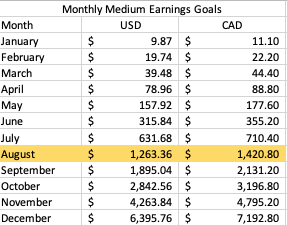
Why 2x every month? I’ve worked in tech-startups since I was 19, and doubling growth is an indication of a healthy startup. From the get-go, I viewed my writing as a business. This irks some writers, and that’s fair — but I believe blogs are a product, you are the manufacturer and your followers are your customers. And in this case, Medium is the medium (ha.)
You’ll notice in August, I change the formula for September, expecting 1.5x growth, following suit with the startup plan. Successful new startups see high growth at first, but it’s difficult to maintain as the company scales. Is it possible? Absolutely: High growth is maintained by some of the world’s best startups. But I also anticipated writing will be a difficult journey, so I baked some grace for myself into my plan. If I hit my September goal by December, I’d be over the moon. October-December goals were “stretch goals”, I didn’t let them scare me.
Now in April, here’s how I’ve made out so far:
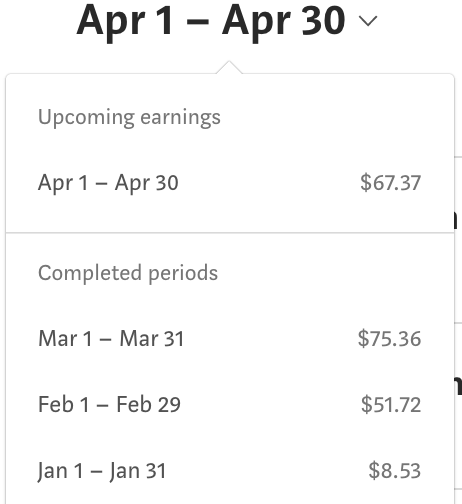
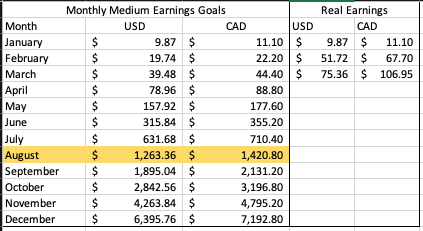
Nearing the end of April, I’m at $67. I won’t hit my goal from Medium alone, but I far surpassed into considering my earnings from Upwork this month (we’ll get to that), in addition to my full-time job. I recognize I’m the ultimate Medium newbie, but I learned some key takeaways nonetheless.
Medium Is Not for Quick Cash
If you dream of a freelance career, Medium cannot be a reliable sole income source. Don’t take it from me — take it from experienced writers on here who will tell you, time and time again: income streams. income streams. income streams. Don’t put all your writing eggs in the Medium basket.
You’re Writing for an Algorithm
Originallym what I loved about Medium was curation. Early in January, a real human (!) would read my work within hours and curate it. Publications found me this way and invited me to become a writer for them. I knew nothing about Medium, didn’t know what curation was until it happened, and didn’t know how publications worked. Curation saved me that month.
Despite that, remember the wholly blessed $8.53 I made? Medium is still an algorithm that pushes your writing out to viewers. While this can be incredible and helpful, it also puts you at the mercy of a Great Unknown Algorithm. Medium can change their algorithm whenever, and they don’t need your permission.
For example, curation has changed recently. If you don’t post to a publication, your piece can take weeks to filter through curation, if at all. If you’re writing timely pieces, by the time curation comes around, you might no longer be relevant. Well, that sucks.
But — There’s No Barrier to Entry
This part’s incredibly important, and it’s the main advantage of Medium that helped me get a quick start on Upwork.
If I follow the startup theme I mentioned (I am, for the record) then I’d do it an injustice by not mentioning barrier to entry. As new companies emerge, they must consider the barrier to entry: In other words, how high must they jump over the fence to protect the older companies they’re trying to disrupt? If you wanted to start an e-commerce platform tomorrow, you’d have to beat out Shopify, Amazon, and eBay (good luck). If you wanted to start a restaurant, you’d need food and liquor handling licenses, a building to rent out, etc.
Medium has no barrier to entry for writers. You don’t even need to be part of the partner program — I wasn’t for the first few weeks (I told myself I had to make more than $5 to pay Medium back $5). You don’t need to fill out a resume, sell yourself, set up a website, or commit to anything.
You need internet access, and a phone or laptop. And you need to write.
You Build a Portfolio
If you eventually venture off into freelance-land, you’ll quickly notice your portfolio is Queen (let me be). Clients need proof of your writing ability. When I started on Upwork, I used my Medium blogs as portfolio examples.
Quick tip here, because it took me an embarrassingly long time to figure this out: To save your Medium work, go into edit mode in your story. Copy all. Go into Google Docs to paste; the formatting follows better than pasting directly into Word (also, clouds are good, I’ve been brainwashed to believe). Then, save your Google Docs file as a PDF onto your hard drive (I’m not brainwashed that fast).
Sure, I could write content without Medium, but Medium gave me an incentive. I had an itch to wake up early every morning, refresh my Medium Partner Program page (I say refresh because I never closed the damn tab), and see a few more cents — maybe a whole dollar! — trickle in.
I wasn’t hungry for the money per se, but I was starving for validation of my capacity as a writer, so I kept writing.
So I wrote. And I wrote. And I wrote. And I built a portfolio.
You Build a Brand
What you write on Medium is yours. It has your name on it. When someone clicks “Follow” on your profile, they want more of you.
Medium, unlike ghostwriting or freelancing, doesn’t take credit for your work. It’s phenomenal. You can use your Medium following to drive traffic to a mailing list, coaching, your website, your product, or your services. You can build a brand and only realize you have one halfway through your writing journey, then capitalize on it because you already built an audience.
If we keep following the startup theme (we still are), building a brand and following before releasing a product on Medium is like when Starbucks releases a new drink. They already have loyal fans they’ve earned over time and some are bound to try the new drink with minimal marketing efforts, thanks to the sheer numbers.
Compare that to a new mom and pop coffee shop opening down the street: This coffee could be infinitely better, but they have no street cred or value associated with their name. They’ll need to either price much, much lower (and advertise that low cost) or advertise heavily (which is pricey for a new business).
Your brand on Medium gives you (free!) leverage if you choose to eventually offer paid products and services. If your brand is strong enough, you’ll have potential clients reach out to you, asking if you can offer x y and z. It’s inbound marketing, and Medium is great for it.
But Wait, Is My Writing Getting Worse?
There’s a lot to this one, and I’ll do a full blog post on this eventually, but writing exclusively on Medium at first made my writing worse. Huh? Bear with me.
Before Medium, I wrote on Linkedin occasionally. I never thought of the one-sentence paragraph rule, of avoiding “walls of text,” of formatting and headings and images and tags and a million other things that are not writing. I just wrote. I wrote to inspire, wrote to engage, wrote to make people feel something.
But on Medium, I kept reading blogs on how to 10x my earnings; how and why to write a listicle, wait, no, I shouldn’t, that means I’m a bad writer and lazy; how I should optimize for curation, wait, no, curation is dead; how I should optimize for SEO, wait, no, I should write for publications, wait, no, I should write for Medium’s editorial publications?
Frankly, it’s whiplash. I got caught up in it. I tried to keep up: I wrote listicles and how to’s, I shortened my paragraphs and found pretty pictures. But the combination of always feeling like I’m doing something wrong and the pressure to keep up, not make a fool of myself, paralyzed me.
The 1,000 words that previously took me an hour to write now took three. I overanalyzed everything. I lost my flow. I lost getting lost in writing, which is truly the best part, and I lost my love for words. Also, I fucking hate blogs with only one-sentence paragraphs. Is that even a paragraph?!
I felt an itch to escape blog-writing madness because the expectations seemed too narrow. I wanted to explore other mediums (ha.) and purposes or writing. I wasn’t going to commit to a book. True to my millennial/gen-Z hybrid self, I wanted to dabble. Which, my friends, is where Upwork comes in.
Upwork
Before Upwork, freelancing felt too distant, far from reach. I didn’t want to prospect or cold-call potential clients. I didn’t want to build a website. I didn’t want to quit my full-time job. Similar to Medium, Upwork has a low barrier to entry, albeit slightly higher.
Upwork requires a profile similar to LinkedIn: You provide previous work experience, your education, and a catchy bio to draw clients in. Upwork gives you 20 free “connects” to bid on open jobs and then you purchase more.
With the free connects, I bid on entry-level jobs. Available jobs are never-ending; each refresh offers you 15 new options. The client selects their preferred experience level (entry, intermediate, expert), explains the gig, and lists their budget for one-time projects or their estimated time-length for ongoing, hourly projects.
My first gig was writing ad-copy for a vacuum on Amazon. It was horrifically boring, but I was once again over the moon that someone was paying me to write something for them! My second gig was writing for a tech company’s blog, which led to my third with that same client. My fourth gig this month is an ongoing contract, writing blogs and social media posts about women’s empowerment.
Within 20 days of Upwork, I have about $200 in my pipeline.

In review means the client is reviewing my work before releasing payment. Pending means I’ve been paid out by the client, but Upwork needs to process it. Available is what I can withdraw at any point.
Twenty-three days on Upwork ~$200. Four months on Medium ~ $200. I should mention that my full-time job picked up significantly this month in the midst of the pandemic. My ~$200 on Upwork + writing on Medium was part-time: From 6:30–8 a.m., another hour in the evenings, and 5–6 hours over the weekend.
I was offered a contract on Upwork for $35/hour, 30–40 hours a week for the first 3–4 months and then 20 hours a week moving forward. I couldn’t take it, keep my current full-time job and maintain an inkling of a soul, so I passed. But opportunities on Upwork are endless.
That, along the other reasons listed below, is why you should consider freelancing on Upwork (in addition to writing for Medium).
(More) dependable cash flow
I’ll never say freelancing is dependable cash flow, but considering current events, no cash flow is a dependable cash flow.
That being said, employers are flocking to freelancing platforms to find cheaper labor compared to full-time employees with benefits, vacation time, 401K plans, etc. Within a couple of hours, they find a capable freelancer to take on a project and churn it out faster than perhaps a full-time employee, who is caught up in internal red tape, internal meetings, competing priorities, and the like.
For you, that means you can also find work within hours. You can customize the work you take on — prefer one-time gigs, hourly gigs, ongoing gigs? Upwork has it all. You have a large safety net with the sheer number of opportunities, so long as you’re willing to stretch the type of work you’ll do (which you should do, but we’ll get back to this).
You’re less dependent on an algorithm. I’m sure Upwork has and uses an algorithm (who doesn’t?), but you’re working one-on-one with real people, who, should Upwork go under once day, you can contact individually and continue your business relationship outside the platform.
Another random tip: Keep an excel sheet of your clients, their organization, and the work you did. This also builds your portfolio and if Upwork disappears one day, you have an external record of who you worked for.
But you’ll never “make money while you sleep”
Despite the dependability of freelancing cash flow, it’s tied directly to the hours you put in. You work by the hour or by the word and are paid accordingly. Blogging, on the other hand, continues paying out after the job’s done. The blog you wrote last month is suddenly resurfaced through Medium’s algorithm or someone shared it on their social feed, and money trickles in without you having to work any harder.
Personal finance gurus tell you that financial freedom is found after you free yourself for hourly or input-based pay. Financial freedom is also subjective: For me, it means not being dependent on an algorithm. I don’t need hundreds of thousands, I need more control. Not to mention, when your work is your passion, the hours are work you enjoy.
That being said, income streams are important. Do both.
Clients will rip your writing apart — and it’ll make you better
I sent over the draft for my second gig, giddy with excitement. The next day, my client returned my work with more redlines than I knew Microsoft Word could handle. I felt defeated and embarrassed: I know I’m not a top tier writer, but am I this bad?
I swallowed my pride and cut. cut. cut. The client wrote “fluffy” and “useless” in the margins. He wrote “No point in this sentence” and “This is wasting their time.” I sent back my revisions and received a 5-star review.
Working directly for someone means meeting their expectations and staying accountable for your work. On the other hand, when a blog doesn’t work out, you have the escape of a hundred other factors that could’ve impacted its success.
As well, each client prefers a different style, voice, and has a different goal for the piece. This increases your flexibility as a writer. I’m pushing my boundaries in ways I wasn’t pressured to when I wrote for myself. At first, the stretch hurts, then the muscle burns; but I diversify my writing toolkit for the better.
Basically, it’s yoga. But on a page. Ya feel?
It’s not a popularity contest
This could be a me thing, but social media drains me. I deleted my Instagram, Snapchat, and Facebook years ago, with only LinkedIn remaining. I felt free without pressure to compete with others and compare myself to them; I was liberated from fabricated expectations that weren’t even real for the ones who created them.
Anything with followers is a popularity contest, Medium included. Maybe I have an addictive personality, but the burn to open the app and check for new notifications, followers, earnings is exhausting. I love it, and I hate it. And because Medium is tied to a) money, b) followers, and c) writing — inherently personal and vulnerable — I’m all the more affected by this particular popularity contest. I take it personally.
Upwork measures the money you’ve earned and ratings you’ve received from clients, the closest they come to a “popularity contest.”
Always be sellin’
Writing is not your get out of jail free card from capitalism, I’m sorry. I wish it were. It pains me to say so, but your writing is selling. You’re selling your brand, your voice, your opinions. You’re selling every word, every message. You cost your readers time and mental capacity; it’s easy to forget this when your payment isn’t direct and your client doesn’t interact with you.
If you make any revenue from your writing: Medium, Upwork, or elsewhere, you are selling.
Pitching to clients on Upwork reminds you of this, and you’ll return to personal blogging in a new light. If you’re not confident of your writing ability, you’ll fake it ‘till you make it because you need a client to believe you and trust you with their baby, whatever that is. You can find great templates for Upwork pitches online, but I use this one:
Hi there,
My name is Negin Safdari and I’m a native English speaker with a double-degree in Communication and Business from the University of Waterloo, in Canada. While I’m new to Upwork, I’m an experienced copywriter. I’m a Top Writer on Medium (a blog-writing website) in two categories: I attached some samples of my writing. I can write in various tones and voices, so I attached a diverse sample.
I believe I’m a great candidate for this role for a number of reasons:
[highlight reasons in list] 1. 2. 3.
Please let me know if you have any questions. Thank you for your consideration,
Negin
I’m sure I’ll iterate as I go, but being new on Upwork means I have little street-cred. When I started, it showed me at $0 earned with 0 reviews, so I leveraged my (limited) success on Medium. It worked. I started using this template halfway though, and according to Upwork’s stats on how I rank compared to other freelance writers, I’m hired more often on my pitches than the average.

Final Thoughts
If you want to make a living from writing, I, alongside many others, suggest you diversify. Medium is a phenomenal platform that gives you a voice, a stage, and an audience — but doesn’t put yourself at the mercy of an algorithm.
Stretch yourself beyond blog-writing, bring your learnings back to Medium, and get paid while you do it. Drive potential clients from Medium to Upwork with high-quality blogs and create a positive feedback loop. The goal isn’t to stop blog-writing, because money isn’t the only driver. The goal is to build your toolkit as a writer, to achieve whatever personal aspirations drive you to put words on a page, and to support yourself financially.