
Medium SEO: How to Optimize Your Stories for Search Engines
Best practices to find the right audience

You've done everything right. You've followed all of Medium’s guidelines and made sure your article stands a chance of getting curated.
But as a copy or content writer, there are a few more steps to take to help your story reach the right audience. You need to optimize your Medium stories for search engines so they rank higher and stand out.
SEO stands for Search Engine Optimization, which is a set of tasks designed to improve a website’s ranking in search engines to increase traffic to the website.
Writing with SEO in mind makes it easy for your ideal client to find you and also helps you grow your audience. As a writer on Medium, these are the things to do to ensure your stories are optimized for search engines.
Research Google Keywords
Before you start to write your article, you should know what your primary keywords are. Conduct keyword research to know the phrases your target audience searches for and you’re able to rank for.
Researching keywords help you know the keyword competition and its popularity. You want to use your keyword throughout your story.
Knowing where to plant keywords makes all the difference. Avoid keyword stuffing. Keyword stuffing is loading a story with keywords to the point where it feels unnatural in an attempt to manipulate its ranking in Google search results. Here is an example of keyword stuffing:
We specialize in custom-made handbags. Our custom-made handbags are handmade. If you need custom-made handbags for any occasion, please contact our custom-made handbag expert at [email protected].
Search engines are extremely smart and can’t be tricked. The key is to place your keywords where it feels natural and not forced. Here are places to put your keywords:
Story title and subtitle
Your story title and subtitle should be clear and tell your audience what they are about to read. Avoid clickbait. If you choose to go for a clickbait type of title, make sure your article delivers on that promise. It’s important to use high-quality titles.
You want to mention your primary keyword once in your title or subtitle and it’s better if it appears early on in the title.
But sometimes it’s not possible to use your keyword early on because it will make your title look weird. Search engine optimization is important, but your title should be written for readers too.
If you’re not able to start your title with a keyword, just include your keyword as early as you can. Keywords shouldn’t be forced. Place them where it feels natural. You can also place keywords in subtitles.
Introduction, body, and conclusion
These play a key role in your SEO as well. After you’ve written your perfect title and subtitle the work doesn’t end there.
Your introduction, body, and conclusion should also have keywords strategically placed in it, but do not overstuff. If it feels unnatural when you read it out loud, it’s best to remove it.
Format Your Story for SEO
Formatting is very important when it comes to SEO. Improving your story’s user experience (UX) can help with your SEO.
You don’t want people bouncing from your story back to the search engine results. A high bounce rate tells Google that your story didn’t give the reader the satisfaction or they didn’t find what they were looking for.
Your search engine rankings will dip when this happens a lot. To avoid a high bounce rate, make your articles easy to read.
Search engines should be able to make out the different sections of your article. Use sub-headers, bullet points, and numbered lists to make your story look pretty.
SEO Settings for Your Story
SEO title
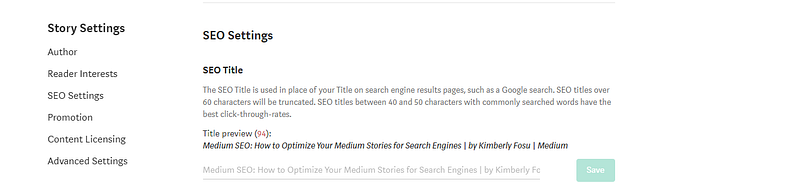
Your SEO title is how Google will present your article in search engines. This is a perfect place to use your keywords.
Google will truncate your SEO title if it’s more than 60 characters. This means your readers will only see the first 60 characters of the title and the rest will be cut off, so make sure your primary keyword is in the first 60 characters.
Your SEO title should be informative and compelling to click. It should be clear what your reader will get. It should include the phrases your audience will enter into Google.
To edit your SEO title, go to edit story → click on the three dots … → More Settings → SEO Settings.
SEO description
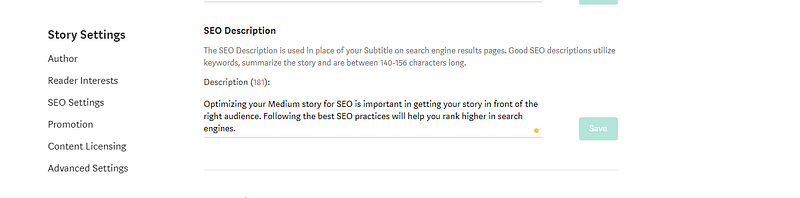
The SEO description is 140–156 characters long and is used in place of your subtitle on search engines. Good SEO descriptions contain keywords and it summarizes the story.
The SEO description should make your reader want to read more. It should promise them what they will get by clicking on your story.
Make it brief and include your keywords at the beginning. SEO descriptions longer than 156 characters are allowed to give more information, but it will be truncated.
If you don’t write an SEO description, Google will automatically create one for you using the content of your article, which might not contain any keywords at all.
Canonical links
Google searches for content that is unique and not duplicates of other content.
If you need to publish content that is already published on another website, use a canonical link which tells search bots to ignore the duplicate content.
This link points the crawler to the original copy and helps you avoid duplicate content penalties.
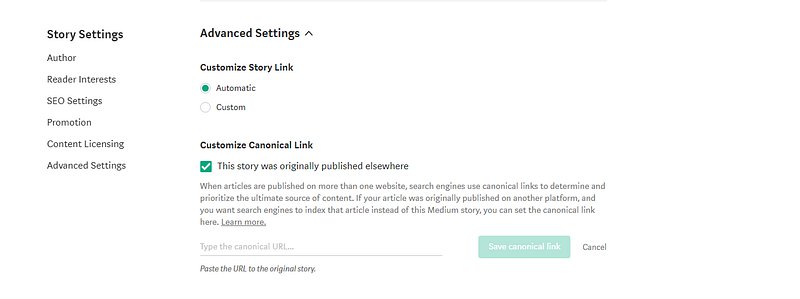
“Search engines use canonical links to determine and prioritize the ultimate source of content, removing confusion when there are multiple copies of the same document in different locations.
Sites that publish an overabundance of duplicate content without indicating a canonical link may be penalized in search engine rankings.” — Medium
To set the canonical link follow these steps:
Go to Menu → More Settings →Advanced Settings → select “This story was originally published elsewhere.”
Enter the link and click “Save canonical link.” Click “Publish” to publish your changes for an already published post.
Story link
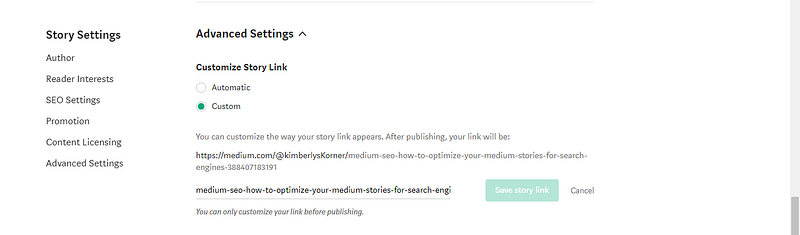
You can customize your story link and make it SEO friendly. Include keywords in your story link.
Backlinking to Other Websites
A backlink is created when your story is linked to another website. Backlinks are strongly correlated with ranking higher on search engines.
Google gives more visibility to articles that many other pages on the web are linking to. A great way to achieve this is to link to them from your other websites.
You can achieve this by publishing high-quality content that increases the odds of people linking to. You can also try reaching out to people in your industry and offer to exchange backlinks to help each other.
Internal Linking to Your Other Posts
Internal linking is one of the easiest SEO best practices to use. All you need to do is add a link from one story to another story. You don’t just want to add a bunch of irrelevant internal links or overstuff your story with links.
For example, if you are writing an article about the difference between copy and content writing and you’ve already written about tools to help a copywriter succeed, it’s appropriate to link the two.
Use Images
Search algorithms love images as much as readers do. Add a featured image to your story.
Use images that are unique and stand out. It should be one you are allowed to use. Posts with images will show in more places on the internet than those without any visual content.
Alt text is used by the readers with visual impairment and should have a description of what is in the image. Search engine crawlers use alt text and rely on it in trying to determine what the article is about and how to rank it.
Popular Stories
Make your story popular by sharing them across your social media pages. Search engines prioritize highly popular content.
This is especially important within the first few hours of publishing your story. The more time readers spend reading your article, the higher the chances search engines will notice it and bring it to the front to be discovered by the world.
Don’t forget to use popular and relevant tags to help readers find your story on Medium.
Key Takeaways
Medium is all about quality. No matter how much SEO knowledge you have, if your article is hard to read and filled with false information, it simply won’t work in your favor.
Publishing original, helpful content is the only way to rank higher in Google searches.
When it comes to word count, there is no magic word count for SEO content. But as far as best practices for SEO go, you should always aim to write at least 300 words.
However, your content will be more likely to rank if it thoroughly explains the topic, which often can’t be done with just 300 words. You need to be able to explain the subject fully.
Avoiding duplicate content is one of the most important SEO best practices to keep in mind.
Send signals to search engines that your site is active and up to date by regularly publishing new content and also refreshing old stories on your site.
Ensure all of your content provides the best, up to date, and most relevant information on a consistent basis to improve your search rankings.
For further reading:


