
Medium Isn’t Getting Any Better
We don’t need the new CEO to be another gatekeeper of so-called “good” writing while diverse voices are sidelined.
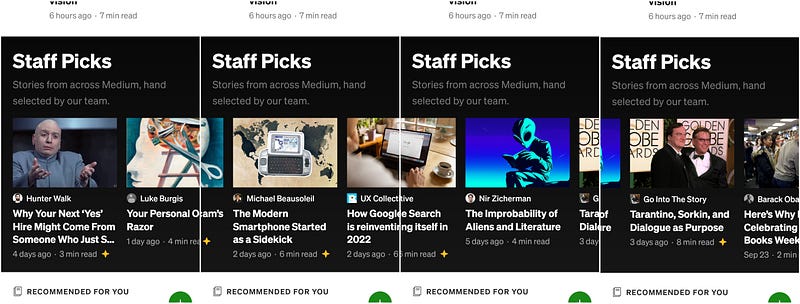
Hey, let’s have a little chat about Medium, beginning with the “Staff Picks” above. Notice anything… unusual? I just took the screenshots tonight and was non-plussed to discover that all 7 slots are occupied by male writers.
Virtually any time I look around the platform these days to see what sorts of stories are being promoted, I see a whole lot of men, and more often, in topics like data science or productivity.
The same thing goes for the “Trending on Medium” category, and if you’ve been here as long as I have, you know that the platform is not exactly trustworthy or transparent about the work it allows to flourish. For a couple of years now, writers have been complaining about Medium pulling their work from distribution or even kicking it out of the trending category as if a piece might be doing “too well.”
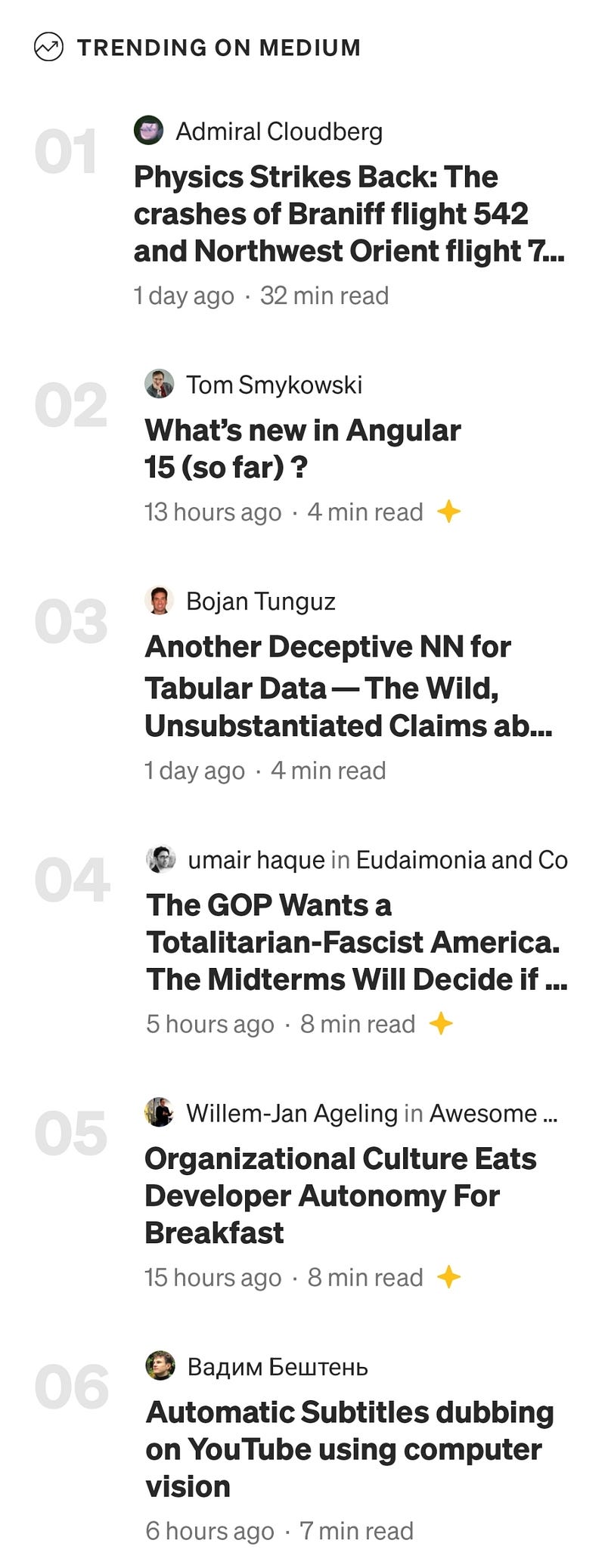
Do you ever look in those slots and wonder where the female writers went? And where have the vulnerable personal essays gone?
I do.
As far as I understand it, Medium hasn’t “officially” announced this change, but they’re pivoting to a new direction where they value writing from experts and writers with credentials. CEO Tony Stubblebine indicated off of Medium that some of those distribution changes had already begun last month.
While weighting expertise is all well and good within certain topics, it’s hardly a simple solution to poor quality pieces on the platform. What and who does Medium consider to be an expert, anyway? How do they screen so-called experts and differentiate them from scam artists? And how do they stop this move from becoming more elitist gatekeeping?
Remember, the writing industry has long been hindered by gatekeepers. Women, people of color, the poor, and writers who somehow upset the status quo — traditionally, it’s been hard to break through in any meaningful way if a writer doesn’t get enough corporate support.
It’s troubling to think that Medium is no longer a place where otherwise marginalized voices might flourish and be heard.
I’m certainly concerned where the weight of “expertise” leaves writers like myself.
It’s not that I have zero credentials. I’ve been published in many places across the internet, and I’ve worked for other businesses as a writer for many years.
But I have never thought of myself as an “expert,” and I really don’t think that all writing and blogging should be limited to experts, either.
For a long time, I’ve been wondering about the future of the personal essay on Medium. I’ve been writing on the platform for more than four years, and the personal essay is my specialty. It’s how I support myself and my daughter, and back in the day, back when Medium actually utilized humans for distribution more than programs and algorithms, I made good money writing those personal essays.
And no, my personal essays are not perfect. They have never been perfect and I have never tried to pretend that I am a perfect writer.
If anything, I’ve believed that my imperfection is part of my charm. At least, part of what resonates in my work. Over the years, I’ve praised Medium and asked where else can a fat single mother, a neurodivergent (hello inattentive ADHD, autism, and slow processing speed) college dropout who’s survived a significant amount of trauma and tragedy build an audience with her writing?
I’ve even taken to Twitter to thank Ev Williams for everything Medium has done for me back when my personal essays were being taken seriously by Medium’s once-human distribution team. I’ve often wondered over the years if Ev didn’t see my words as a compliment. If he was perhaps… unhappy to hear that a single mom like myself was making a good living on his platform.
Maybe that’s too far from the goal. Maybe a lot of folks at the top think a writer like myself shouldn’t make good money writing on Medium. I’ve certainly heard enough of those comments since beginning to write on Medium in 2018.
And so, I was nervous when Tony Stubblebine was announced as the new Medium CEO. I was nervous because I used to write a lot for his publication Better Marketing, but I’d become very disillusioned with that side of Medium over the years.
As some of you may know, I’ve had a lot of issues with the self-help side of the platform, and particularly with some of the top male writers who do not practice what they preach, who use ghostwriters to publish so frequently, or who bully and criticize female writers for… not being putting up with their crap.
There’s a very distinctive culture at the top of Medium, and it is very much a “bro culture.” Often, the only way female writers can remotely thrive in such a culture is to play along. To pat the backs of the biggest male egos, to parrot their so-called self-help values, and to never speak up about the many micro‐ or macro-aggressions they’ve experienced here.
That means I’m really not surprised to watch some of the drama unfold now that Jessica Wildfire has been speaking up about some of the problems with the corporate side of Medium.
She’s recently expressed her displeasure with Medium’s new CEO tolerating bullying aimed at her, seemingly because it sides with him, and I’m not surprised because his attitudes so far are the same attitudes I’ve had to get used to since I began publishing on the platform in April 2018.
It’s true that I was trying to be cautiously optimistic, especially since he brought back the mobile app editor. Still, the concerns keep piling up.
Now, CEO Tony mentioned in some initial comments on Jessica’s work that there was a period where Medium relied upon human curators. Yeah, I remember that period well. That’s when I made good money here, and I felt great about pouring everything I had into Medium. That’s when it seemed like Medium was a place where you could put in the work and actually get somewhere.
I replied to Tony about that time period, but so far, he hasn’t replied to this comment of mine:
Hey Tony, so between 2018 and 2020—that's when I was doing especially well on the platform with views, reads, fans, and pay. Things began taking a bad turn for me when the so-called relational model rolled out and it suddenly felt like I was struggling to be seen or heard.
If that means I benefitted from human curators—what does that mean for writers like myself today? As if I was good enough then, but not today. While I may not be an "expert," I have a writing voice that resonates with many people and I have been around on Medium for long enough to see that it's done genuine good. Essay writers like myself aren't out to puff ourselves up with "expertise" or "credentials." We can still have extraordinary life experience as mothers, trauma survivors, cult survivirs, neurodivergent brains, and vulnerable writers, cultural critics, etc.
When my work was very visible on Medium, other sites took note. My posts here have been positively quoted by The Today Show, and many other news and entertainment agencies. You could look up a current event or culture issue and my commentary would be among the first hits on Google.
Between 2018 and 2020, Medium did such a stellar job of guiding the right readers to my work, and I understand that I'm far from the only female Medium writer with that experience sort of experience.
The change in the algorithms was devastating. Since then, it's been exhausting getting our hopes up again and again that Medium is going to value our writing and distribute our work. My followers STILL complain that it's hard to find me on the platform. They've been saying that for at least 18 months now.
As time goes by, I am increasingly of the mind that Medium doesn't want me here, so, my sentiments echo much of what Jessica is saying in her piece.
For a long, long time, it's felt that Medium as an entity doesn't REALLY care about the fact that it was giving marginalized voices a place to build an audience. In some cases, we do wonder if Medium sees us as a problem. And we wonder if that's why quality editors have been let go.
You talk about providing value to Medium subscribers but I wonder about the value offered to the writers here. If you don't value us, and don't invest in us, if you don't think that popular indie writers with voices that have proven themselves on this platform for years (while suffering through the ridiculous changes) are doing good work that deserves distribution, I think that says a lot about the type of subscribers/readers you prefer. In that case, that means Medium is not so much a place where words matter. It's more about who toes the company line.
And honestly, just taking a look at the editors picks today suggests that you all really do think the personal essay is dead. I suppose I would be smarter to move away from Medium as well, if that’s the case.
However, Tony did reply to a different comment I made on Jessica’s work. He replied to this one:
Tony, do you think it's possible that "divisive" women on the platform are really just fed up? Jessica has been here for years. Are you seriously just looking at a couple of her posts and deciding she sounds divisive and that's the problem? That it couldn't possibly be distribution that's negatively impacted us?
Women suffer a lot within the writing industry. Even online, we're often dominated by male bloggers and told that all we're good for is telling other women how to write for women. We get death threats, violent and vulgar hate mail, we're talked down to as "mommy bloggers," while our male colleagues name-drop us in their writing courses as it serves them and then take credit for any of our success (claiming they "gave" us their audience, etc). When we bring up gender disparities in blogging, we're told that men are just "better" in these fields.
We're so tired, Tony. We're tired of getting our hopes up about Medium being a platform that takes us seriously. We're tired of seeing views go down when we know from experience that Medium is perfectly capable of distributing our work to the readers who want it—because that's what Medium used to do.
Here’s the thing, though. Tony didn’t so much respond to my concerns as much as he simply told me I was wrong to be concerned. That I hadn’t interpreted him correctly. So, rather than addressing my concerns like sexism, he said this:
Hi Shannon,
Would you be open to reading my full response in context?
I'm just not sure we are on the same page. Specifically, I want to make sure nobody thinks I have a problem with her being divisive. I'm just taking her at face value that she thinks she is so that I can explain how that would show up in the current platform dynamics.
Totally agree that Medium used to be able give a lot more distribution to the top posts. I was here for that and think there has been a massive unnecessary dillution of attention. And then separately that the top posts are overly weighted to engagement signals rather quality.
I’m not the enemy on this--I took this job to make Medium better. And even that response above to Jessica is part of that work. That’s me taking the time to give more information to a top writer.
I went back and reread what Tony had written in his link above. He said:
Have mostly been replying to Jessica privately in case I'm misunderstandng her. But this response deserves more public visibilitity. A lot of people believe this but it's basically wrong
I have people telling me we changed the distribution model and it's been great for their page views. And I have other people telling me we changed the distribution model and it tanked their page views.
But mostly I think people are wildly underestimating how much traffic patterns can change for reasons of taste and competing articles.
The period that I think people are referring to had zero changes to the recommendation and curation part of distribution that involve Medium employee opinion or heuristics about what is worth distributing. I know that's very specific wording, but I'll explain the caveats below. I can't remember when the last major change was--probably six months ago at least.
And then the first change that I oversaw started on Monday and is minor as in less than 5% difference in results. It'll announce on our blog once it gets a bit more data behind it. I think most people are referencing page views swings of 50% or more and are referencing a time period prior to Monday. So I don't think this change is behind any of the opinions.
We did change three things.
1. We removed a notification about what was curated or not. The message had become severely outdated and was wildly misunderstood. But the changes that made the message outdated, namely a swing toward algorithmic curation decisions, happened well before my time. Nothing in this change of messaging should affect your page views or earnings.
2. We introduced a true following feed and reads by followers is up (despite what you might think based on your personal experience of this change). This should be good for high affinity authors. But for some authors and publications, readers reacted by realizing they don't want to read much of what that author/pub publishes and they unfollowed. Previously that feeling had been hidden by our recommendation algorithm because it could figure out which things an author published that you wanted to read.
3. We introduced a "show less like this" button to readers and are factoring that into recommendations. This is a change in the recommendation algorithm but it is reader driven. Is Jessica a divisive writer who generates a lot of these? I don’t know the answer. Our current data is that this isn’t a massive change in anyone’s traffic and is fairly accurate in representing the interests of the readers.
There's a lot of detail in there. But #2 and #3 are the opposite of us "gripping the steering wheel." Those are changes that put the reader in control. That's why I don't think anyone should currently be thinking that their page views changed based on some whimsical changes that Medium made to the algorithm.
Now, that said, I do want to make changes to what we recommend, especially in advice categories. We have a lot of very credible writers who get swamped by under-informed, but more virally crafted content. The <5% change above is human driven. But it's too early to go in depth on that and you can count on me making an announcement on our blog when it's ready.
Again, I replied to Tony, but he did not reply to me. I wrote:
Thanks for the link, Tony.
I think [the] problem with answers like this is that we’ve all been here before. We’ve been repeatedly told by Medium that the changes shouldn’t be impacting us negatively, or shouldn’t be impacting us much.
For years now, we’ve been told that Medium was getting better and that we were going to benefit from that. And yet we’re still experienc[ing] the same issues with readers who can’t find our work and our monthly views going down. In our experience, the improvements rarely amount to improvements.
Even as a reader, Medium is no longer very interesting. And there's no hope for growth like there used to be with publications like Human Parts or member features. Remember when member features first existed and actually meant something? One of my first stories here got featured and put me on the map.
What I'm saying is that none of the so-called improvements above mean much or can be taken seriously if we're still seeing the same Medium problems. I mean, my views are currently more in line with my first six months on Medium when I had just a fraction of followers.
We've invested so many years here trying to build an audience, reach a measure of success where we truly love what we're doing, but then the needle keeps changing. We can't relax and do our best work when views keep going down. We don't know if enough readers will ever even get to see our work to make it make sense that we're putting in so many hours of writing and research for a single post.
It’s true that CEO Tony isn’t on the same page with writers like me or writers like Jessica Wildfire. To be on the same page, I think he’d have to take us seriously, and I’m not convinced that he does.
Just the fact that the editors picks would be given to mostly men, and just the fact that personal essays are rarely given prominence on Medium anymore says a lot to me about the writing that Tony considers to be “quality.”
Can we be painfully honest here? If anyone expects Medium to be a place for diverse voices where writers are able to spend hours on work that’s free from typos or other errors, Medium has to pay writers accordingly. They have to employ paid editors too.
I miss the days of Medium when we had actual member features that could bring a newbie writer into a bit of Medium fame. I miss the days when I actually got to work with an editor on one of my essays — an editor who wasn’t trying to change my voice into something it’s not.
And good grief, I miss the days when there was some actual transparency about where our work was distributed, and you know, when distribution actually did something.
While I consider Jessica Wildfire to be my superior in terms of talent in writing and blogging, I also believe that we each have a very distinctive voice. I’m not convinced that voice is something that can be taught, and that’s why many online writers rely upon gimmicks, clickbait, formulas, promises, and self-help that’s toxic or simply too good to be true.
Both Jessica and I have worked on Medium for years to build our audiences. We’ve both worked in writing in one way or another before coming to Medium. We’ve both worked on honing our voices, and we’ve both shown that there’s a market for our writing — but our readers need to be able to see our work.
I don’t know what Jessica’s stats look like, but mine are more in line with my first six months on the platform. Back when I had only a fraction of the followers I have now.
It’s true that I haven’t been able to keep up with my old publishing schedule due to my current medical issues, but I still have an enormous catalog of evergreen content that’s been popular on Medium. I’m not convinced that it makes sense that I’m losing about 10K views per month unless it’s because Medium’s leaders (and its algorithms) don’t take me seriously.
At any rate, it tells us a lot about the Medium machine if a writer who’s invested years of full-time work on the platform keeps losing views.
Again, I’m not the only writer experiencing this, and while it’s been an ongoing issue long before Tony came on board as CEO, it’s hard for me to imagine that he can’t understand our concerns are legitimate.
Tony seems to be suggesting that Medium currently penalizes writers who are seen as “divisive,” or perhaps polarizing, because such writers encourage users to click “show less like this.”
That explanation makes little sense to me because an effective Medium knows how to direct the right readers to our work. That’s what Medium used to do so well.
Furthermore, if anyone is going to be seen as divisive on the internet, it’s women with opinions. For Pete’s sake, when I’ve written about suffering through vaginismus during my marriage, men told me that they would have killed a woman like me. Women chastised me for oversharing. Talk to a few popular female writers who write with vulnerability and you’ll discover that we’re judged pretty harshly by a segment of readers. Far more harshly than they judge white men who compare themselves to Rosa Parks, or who suggest that anyone who disagrees with them are as hateful as nazis. Men who claim that “burnout is a badge of stupidity” get lauded as gurus while women who say our male colleagues have talked down to us, taken our credit, and lacked basic empathy are bullies to say anything at all.
Men who run writing courses like pyramid schemes and who share fake or unauthorized testimonials are “gutsy” in a good way, while women who speak up for themselves and other female writers are called bitches, unhinged, or full of themselves.
Even when we’re not running around trying to flash credentials everywhere as if our word is divine truth.
We just want to make the world a better place, support our families, and be heard.
Besides, if Medium values writers who more or less appeal to everyone… where is the diversity? Some of the best feedback I get comes from readers who tell me that my writing helps them see the world in new ways.
Lots of readers aren’t ready to be challenged in that way, but that doesn’t mean the market for such work is small.
In my experience, Medium leadership has long been hesitant to truly invest in its indie writers. To value us. Every time we get our hopes about Medium making some great improvement, we’re disappointed to discover that it’s not meant for us.
Time after time, Medium leaders appear to value existing famous voices, or those within traditional publishing. Even that recent email celebrating Medium’s success as a platform for words that matter felt like a real slap in the face for indie writers who’ve been here plugging in the hours and trying to keep up with some constantly moving goalpost.
Let’s be honest.
Barrack Obama doesn’t need Medium. Jeff Bezos doesn’t need Amazon. These folks can publish open letters anywhere, and there will be twenty-five publications willing to cover one single piece ad nauseum.
Who really needs Medium? Female writers.
Disadvantaged writers. Neurodivergent writers. Writers with disabilities. Single parent writers. POC writers. Writing survivors. Writers with unique, engaging, and challenging voices who haven’t been taken seriously by traditional publishers.
You want to fix the internet? You want to fix Medium?
Give folks the writing they can’t get anywhere else. Quit trying to be Mic, Inc, and Business Insider. So many online publications today are “pay to play,” which means that far too many articles you read online are little more than paid advertisements funded by flush corporations.
Medium’s future has always made more sense as the platform where indie writers can flourish. At this point, it’s become a content mill.
How can we hope to hold onto subscribers if the platform won’t value unique voices, and its top voices have felt pushed to the limit for years?
Personally, I came to Medium in 2018 to escape the gig economy. To get away from content mills. Funny how that worked out while there were actual humans behind the distribution, and somebody at Medium believed that personal essays matter.
I’m still crowdfunding for my ongoing lipedema treatments and next surgeries. Please share the link to help raise awareness of the disease they call fat.
If you love my work and want to support my efforts to break cycles of stigma and shame through awkward honesty, visit me on Ko-fi. From there, you can follow and support my future projects, and subscribe to my newsletter.
If you’re not already a Medium member, consider a paid membership today. Signing up through this link means a portion of your membership will directly support my writing on the platform.