
FICTION | GAME | MEDIUM ADVENTURERS LEAGUE ⚔️
Medium Adventurers League — Rules of the Game
The guide to the Medium Adventurers League (MAL) rules and game dynamics
Medium Adventurers League (MAL) is a choose-your-own-adventure (CYOA) world. Your decisions influence the stories playing in this world.
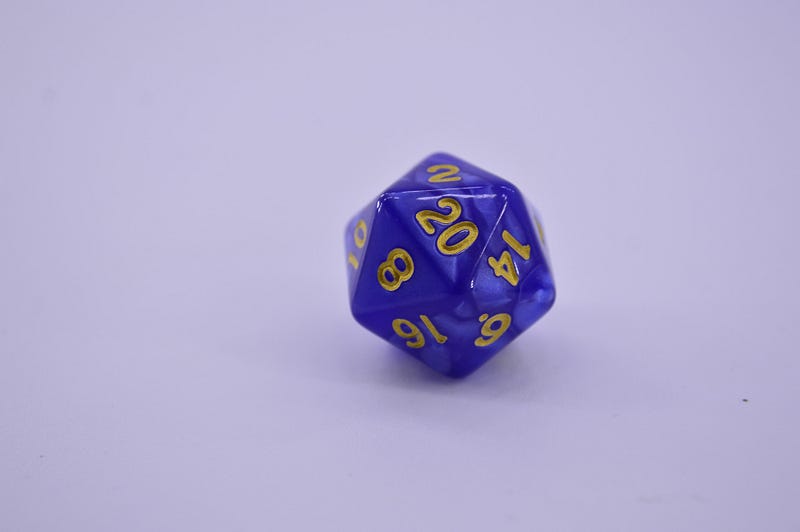
But unlike most of the CYOA stories on Medium, the success of your decisions is not guaranteed. We added an element of chance. Sometimes, you must roll a die — the twenty-sided one known as the D20. That’s the one shown in the header image.
The following sections introduce you to the game’s rule system.
Stats
Your character’s stats determine their bodily strength, guile, or health, among other things. Your stats are not static but will change throughout the game, for example, based on which quests you solve. Your emphasis on specific stats will impact how you resolve challenges throughout the stories.
Attributes
Your character has four attributes that describe their overall skill in specific tasks:
- Brawn
- Wits
- Magic
- Charm
Brawn describes your bodily strength, fortitude, and fighting skill.
Your character doesn’t like to solve challenges with raw force? Use Wits to solve them with trickery and quick thinking or to solve puzzles.
Every character knows fundamental Magic in MAL, but only a few master the mystic arts. Magic can be used in many challenges, but items modifying your Magic are the hardest to get. (See “Item Modifiers” below.)
Who needs muscles if you can use Charm to overcome challenges with your silver tongue?
When you start, you decide how your character approaches challenges and assign your attributes’ beginning values. One attribute starts at 3, one at 2, and the remaining two at 1.
Example: You create a clever fighter and assign the 3 to Brawn and the 2 to Wits. The fighter is strong and knows how to swing a weapon, but they are clever and move silently too. Your fighter’s Magic and Charm start at 1. They only know parlor tricks and aren’t very eloquent.
Fluctuating Stats
Some stats don’t have a fixed value but possibly fluctuate during quests. These are called Health and Reputation.
Your Health describes how much damage your character can sustain (yes, some monsters or folks might try to do your character harm). This stat starts at 5, and can vary as you take damage, but be careful — 0 means you are dead. Any armour that you gain will give a bonus to Health, but you start with no armour. You can assume that when you return to your guild hall, your armour is repaired by the guild’s smiths, but Health needs to be regained through rest or healing potions.
Reputation ranges from positive to negative scores, and is strongly influenced by your decisions. Honourable and heroic acts earn you increases to Reputation, while treacherous and evil deeds cost you. The starting value is 0 because nobody knows your character yet — they neither love nor hate them. If you ever reach a Reputation of -10 or lower, you become infamous, while a 10 or more means you are a known hero. Your value in this stat will determine which guilds are willing to accept you.
Item Modifiers
Throughout the game, you can find or acquire items. Most of these are common items like a sword or a suit of chainmail. Some rarer items have special powers that modify your stats or give rare benefits. A magic sword might give you a +2 bonus to your Brawn. This will be displayed in the game like this:
You find a “magic sword +2 (Brawn)”.
Other items offer rare benefits like magic chainmail that defends against a monster’s special attack. This will be shown like this:
You find “magic chainmail (prevents bite attack)”.
Special items can be rare, very rare or legendary.
Encounters
Kinds of Encounters
When your character gets into a difficult situation like a fight, we call that an Encounter. The game has four kinds of Encounters: physical, social, magical, and trickery.
Combat Encounters are resolved with Brawn or Magic, sometimes, you can use Wits to escape, but usually, it is too late to Charm your problems away.
Social Encounters are generally resolved with Charm; sometimes, you can use Wits to fool somebody. Magic or Brawn can present an easy way out of a Social Encounter, but they will (!) have consequences. Using Brawn in a Social Encounter means you rely on physical intimidation. Such threats or acts of violence will cost you Reputation. The same is true when your character manipulates someone with Magic.
Only Magic can resolve Magical Encounters.
Wits is your primary stat in Trickery Encounters, but sometimes there are other ways.
How to Roll
Every quest will feature at least one Encounter, and you must roll a D20 to determine success. You will need a physical D20 or a dice-rolling app like this one.
What happens when you are asked to roll? You roll the die or press a button and add the required attribute and applicable item bonuses to the dice roll result.
Example: Your warrior fights a group of goblins. You have to roll Brawn to swing your sword. Let’s assume your warrior’s Brawn is 3, and they have a magic sword +2 (Brawn). You roll the D20. It shows an 18. Awesome! Now, you add 3 from your Brawn and 2 from your magic sword to make a total of 23 (18 + 3 +2).
To simplify this, you can just add the bonus from your current weapon to your brawn score — but remember that this is a bonus, in case you later lose the weapon!
Very simple weapons like a hand axe or a dagger add +0 to Brawn, while fighting unarmed leads to a -1 penalty to Brawn.
Challenge Rating — The Difficulty of an Encounter
Every Encounter has a Challenge Rating that ranges from easy, medium, and hard to very hard. It determines the minimum number you must reach with your dice roll + stat and modifiers.
- Easy = your result must be a 10 or higher
- Medium = your result must be a 15 or higher
- Hard = your result must be a 20 or higher
- Very Hard = your result must be a 25 or higher
- Some encounters might require repeated rolls
When stats and other bonuses are taken into account, the key things to remember is that equalling or exceeding the challenge rating means you succeeded at the task.
A roll of 1 is always a fail, regardless of how many bonuses you have.
Every quest is built up of at least one story and requires at least one Encounter per story. Quests are ranked by the highest challenge rating of all its stories. A “hard quest” will have at least one Encounter with a hard Challenge Rating.
Example 1: Let’s assume the previously mentioned fight against a group of goblins is an easy encounter. You have to achieve a 10 or better to win. The result of 22 means the warrior beats the goblins.
Example 2: Let’s assume it is a very hard encounter. In that case, the 22 isn’t enough, and the warrior cannot defeat the goblins. The game will tell you in that case what happens next, for example, if your character takes damage, or if there is a possibility to run from the fight.
Ready? You can start the game right here:
Did you like this story? Why don’t you read my other fictional tales? You can also support me by subscribing to my email list or joining Medium with my referral link. You can also support me on Ko-fi.


