
Meditation — To Restrict or Liberate?
Are you failing at Meditation? Here is a sure-shot way to make you Meditate.
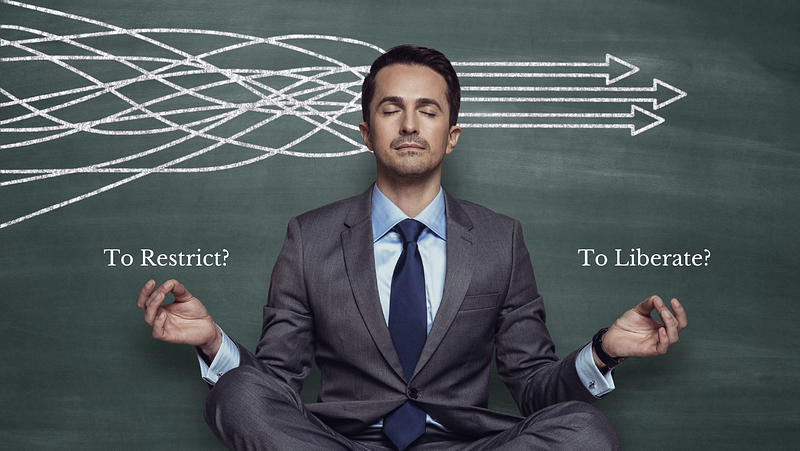
Meditation, Mindfulness, and Minimalism (MMM) have become the mantra for the millennials. There are numerous meetup groups, WhatsApp, and Facebook communities practicing the MMMs. Meditation is perceived grossly, and here is a snapshot from the Patanjali Yoga sutra (as in Wikipedia) which explains the true innate meaning and difference between Dharana and Dhyana.
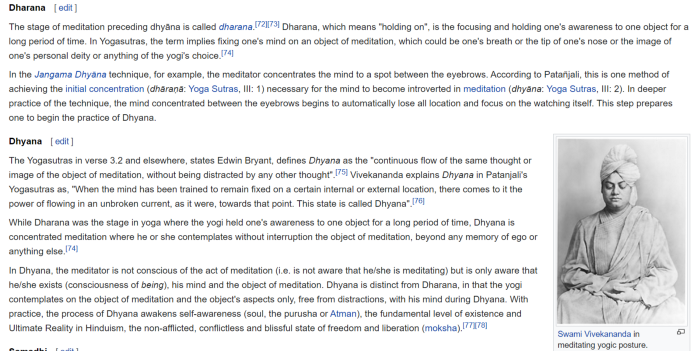
In a nutshell, what people think of as Dhyana is essentially a Dharana (focusing or concentrating breath or on a light or between eyebrows, etc.). So, here is my simple technique to get started on the first step toward Meditation (Dharana).
During my initial days of practice, I could not sit and focus on one particular thing or breath. The more I tried to focus, the more my thoughts wandered or got diverted. I am sure you all might have faced the same situation. Eventually, the quest to focus the mind on one particular object fails, and you let go of the practice once and for all. With a little bit of thought to it, I decided to introspect and understand why I could not focus or begin the state of Dharana.
Here is my simple finding, which allowed me to begin with Dharana.
How to Meditate?
I am sure you might think that my answer would be, “Sit in a place with crossed legs and an erect spine and focus on controlling thoughts by concentrating on one thing.”
A Big NO!
Here is my explanation: Let us lock up a person within a room for several days, saying that there is no access to TVs, Mobiles, his choice of food, and any other earthly daily desires. Will the person become mad in a few days?
The more you restrict a person, the worse he longs for such desires. If you free a person and liberate him rather than limit him, he shall come back to the very same room you wanted to lock him up with happiness.
Let us use the same context for Meditation. If you try restricting your thoughts, you may succeed for a short time. However, the more you limit, the more your thoughts will wander, and the worst case is that you may not meditate again as I did. Such is the power of limiting distractions. Instead, allow the thoughts to wander and keep observing them. Let it wander, and don’t restrict it at all. Just observe and enjoy the places it wanders. It shall go to your past or future, think about friends, spouse, job, money, health, and whatnot. Just enjoy the wandering, and that is it. I am not here to define the meaning or the proper meditation process but share the method I use in my daily life.
One might be wondering how wandering of thoughts can become a meditation.
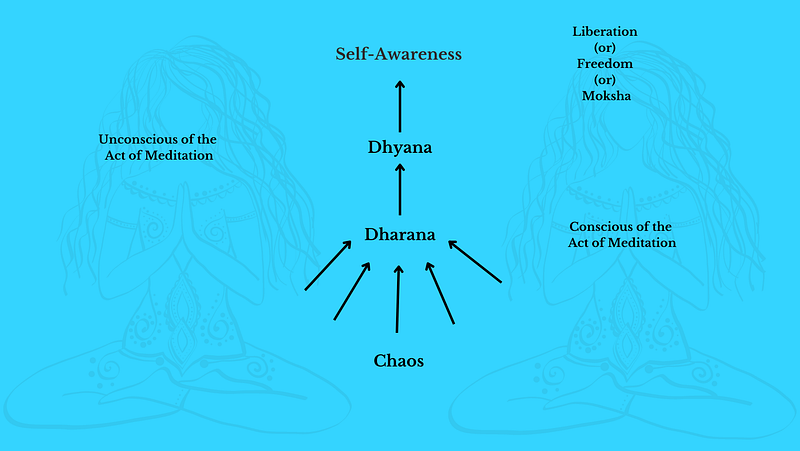
The more you wander in the streets, say for shopping, the more you get tired at the end of the day. The same applies to your thoughts. The more you allow it to wander, you are liberating it and offering freedom to wander. An hour later, your mind reaches a state of tiredness (not literally), which slows the thoughts (say 1000 different thoughts may become 100 others). Upon consistent practice, the number of thoughts reduces gradually. You achieve a state of mindfulness or null-ness or focusing on something → focusing on one thing — -> which is the commencement of Dharana. Thus, Meditation is not about restricting but the liberation of thoughts.
Why don’t you try this and share your experience?
PS: as you allow your thoughts to wander, you may get tired, and you may fall asleep — which is okay.
I hope this helps you to kick start your journey towards self-awareness!
If you enjoyed this story, you might subscribe to receive my newsletter first!


