avatarRahul Bhadani

Free AI web copilot to create summaries, insights and extended knowledge, download it at here

2154

Abstract

on-science-ae37bf7ab4f9">my previous article</a>. Any state can be described by a Hermitian matrix called a density matrix (or sometimes just <i>density</i>). We use ρ to denote a density matrix. The trace of the density matrix is 1.</p><p id="b007">As we are mortal beings, devoid of god-like powers, we can only measure things rather than direct observations of microscopic systems. Hence, if a state of the system, <i>𝓗 </i>is specified by the density matrix ρ (which is the ground truth in the way that only a divine being knows), and we make some measurement M, that returns a value ω. The measurement M itself is a Hermitian matrix. We do several such measurements and receive multiple ω. In such case, the following condition holds:</p><figure id="a065"><img src="https://cdn-images-1.readmedium.com/v2/resize:fit:800/1*2ogKdXqfigBFgeAo2JM7Bw.png"><figcaption>Equation 1: Measurements</figcaption></figure><figure id="e155"><img src="https://cdn-images-1.readmedium.com/v2/resize:fit:800/1*Ul4QvymHsLyWsOeqe72Wjg.png"><figcaption>Figure 1. The process of making a measurement</figcaption></figure><p id="714e">A set of M (M_\omega in Equation 1) is called positive-operator valued measurement or POVM in short. For continuous values, the sum in Equation 1 can be replaced by the integration. <i>I</i> in Equation 1 is the identity matrix.</p><p id="3267">Now, let’s say, for some reason, we receive god-like power and magically know what ρ is, then the probability of obtaining a value ω for the measurement M is given by</p><figure id="21e1"><img src="https://cdn-images-1.readmedium.com/v2/resize:fit:800/1*AclsiS55Q4X60dBAbq7rfQ.png"><figcaption>Equation 2. The probability of getting ω as a result of a measurement M.</figcaption></figure><p id="a29a">You can check that sum of Equation 2 is indeed 1 using Equation 1 and the fact that the trace of ρ is 1.</p><p id="4655">If a system <i>𝓗, </i>(say electron) has two states: ρ1 and ρ2 corresponding to clockwise and counter-clockwise spin with a probability of λ and (1-λ). Now, we want to know if we can get some value ω by making a measurement M. What’s the probability that we can get ω?

Options

This can be given by</p><figure id="57d4"><img src="https://cdn-images-1.readmedium.com/v2/resize:fit:800/1*tVKBIwUwh4rqIgYezYAzvA.png"><figcaption>Equation 3. Generalized probability of ω as a result of a measurement M.</figcaption></figure><p id="274f">Thus effective, a state of the system is given by a probabilistic mixture λρ1 + (1-λ)ρ2.</p><p id="451b">For a vector <i>u</i>, if the norm is 1, then it is a pure state in quantum mechanics. Thus, <i>u </i>is a state of the system measured as <i>|u</i>⟩⟨<i>u|. </i>If the state is not a pure state, it is a mixed state.</p><p id="6c5a" type="7">A pure state cannot be written as a probabilistic mixture of other states.</p><p id="86bc">For many pure states u_i, we can have <i>|x</i>⟩ = \sum_i x_i <i>|u_i</i>⟩ as a new vector, and a quantum-mechanical superposition, not to be confused with the probabilistic mixture.</p><h1 id="4b13">Hermitian Matrices are Observables or Physical Quantities</h1><p id="22d6">If we have a Hermitian matrix X, and its eigenvalues as x_i, then the projection matrix corresponding to the eigenspace is Ex_i and X = sum_i x_i Ex_i. x_iEx_i is nothing but the spectral decomposition of X (not much different from what you already know from Linear Algebra or Machine Learning classes).</p><p id="f069">We can have more than one eigenvector corresponding to a single eigenvalue, and diagonalization is X = sum_d x_i <i>|u_i</i>⟩⟨<i>u_i| </i>is not unique, however, spectral decomposition will be unique. The expectation and variance of Ex (the set of all Ex_i) are given by <i>TrρX</i> and <i>TrρX² — (TrρX)² </i>respectively.</p><p id="9f05">I hope this article was helpful in understanding what the measurement and states are in quantum systems. This is helpful for understanding qubits and other fundamental concepts of QIS.</p><h1 id="939f">References</h1><ol><li>Quantum Information: an introduction by Masahito Hayashi</li></ol><p id="15ab" type="7">Follow me on LinkedIn, and Medium for more content like this.</p><p id="3b8c" type="7">Did you enjoy this article? Buy me a Coffee.</p><p id="dc7f" type="7">Love my writing? Join my email list.</p></article></body>

Measurements in Quantum Systems and Fundamental Theory

Oculus Mall. New York City. Picture taken by the Author

In my previous article, I briefly discussed Hermitian products and their importance in Quantum Information Science (QIS). However, the story has just begun. At the heart of quantum systems is a postulate that I will roughly interpret as “the mere idea of measuring a quantity changes it”.

The mere idea of measuring a quantity changes it.

As you may recall, elementary particles such as electrons can have spins: clockwise and counter-clockwise. However, we won’t know which electron is spinning clockwise and which one is spinning counter-clockwise with cent-percent certainty. We are mortal beings and we can only talk about the probability of getting either clockwise spin or counter-clockwise. That’s the gist of the uncertainty principle informally.

In a system like an electron, the description of its condition may be described as a spin — speaking in an oversimplistic manner. Such a description may be referred to as a state.

Recall the Hermitian matrix from my previous article. Any state can be described by a Hermitian matrix called a density matrix (or sometimes just density). We use ρ to denote a density matrix. The trace of the density matrix is 1.

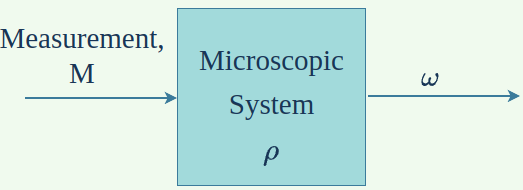
As we are mortal beings, devoid of god-like powers, we can only measure things rather than direct observations of microscopic systems. Hence, if a state of the system, 𝓗 is specified by the density matrix ρ (which is the ground truth in the way that only a divine being knows), and we make some measurement M, that returns a value ω. The measurement M itself is a Hermitian matrix. We do several such measurements and receive multiple ω. In such case, the following condition holds:
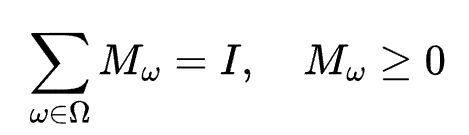
Equation 1: Measurements
Figure 1. The process of making a measurement

A set of M (M_\omega in Equation 1) is called positive-operator valued measurement or POVM in short. For continuous values, the sum in Equation 1 can be replaced by the integration. I in Equation 1 is the identity matrix.

Now, let’s say, for some reason, we receive god-like power and magically know what ρ is, then the probability of obtaining a value ω for the measurement M is given by
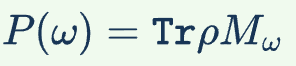
Equation 2. The probability of getting ω as a result of a measurement M.

You can check that sum of Equation 2 is indeed 1 using Equation 1 and the fact that the trace of ρ is 1.

If a system 𝓗, (say electron) has two states: ρ1 and ρ2 corresponding to clockwise and counter-clockwise spin with a probability of λ and (1-λ). Now, we want to know if we can get some value ω by making a measurement M. What’s the probability that we can get ω? This can be given by

Equation 3. Generalized probability of ω as a result of a measurement M.

Thus effective, a state of the system is given by a probabilistic mixture λρ1 + (1-λ)ρ2.

For a vector u, if the norm is 1, then it is a pure state in quantum mechanics. Thus, u is a state of the system measured as |u⟩⟨u|. If the state is not a pure state, it is a mixed state.

A pure state cannot be written as a probabilistic mixture of other states.

For many pure states u_i, we can have |x⟩ = \sum_i x_i |u_i⟩ as a new vector, and a quantum-mechanical superposition, not to be confused with the probabilistic mixture.

Hermitian Matrices are Observables or Physical Quantities

If we have a Hermitian matrix X, and its eigenvalues as x_i, then the projection matrix corresponding to the eigenspace is Ex_i and X = sum_i x_i Ex_i. x_iEx_i is nothing but the spectral decomposition of X (not much different from what you already know from Linear Algebra or Machine Learning classes).

We can have more than one eigenvector corresponding to a single eigenvalue, and diagonalization is X = sum_d x_i |u_i⟩⟨u_i| is not unique, however, spectral decomposition will be unique. The expectation and variance of Ex (the set of all Ex_i) are given by TrρX and TrρX² — (TrρX)² respectively.

I hope this article was helpful in understanding what the measurement and states are in quantum systems. This is helpful for understanding qubits and other fundamental concepts of QIS.

References

  1. Quantum Information: an introduction by Masahito Hayashi

Follow me on LinkedIn, and Medium for more content like this.

Did you enjoy this article? Buy me a Coffee.

Love my writing? Join my email list.

Quantum Computing
Quantum Physics
Quantum Information
Qiskit
Quantum Mechanics
Recommended from ReadMedium