avatarTim Ward, Mature Flâneur

Free AI web copilot to create summaries, insights and extended knowledge, download it at here

5306

Abstract

Kannon’s white, concrete statue is massive, as tall as a six-storey building. The elevated hillside raises her up so high she gazes down upon the whole city like a guardian angel. While many shrines and temples in Kyoto are over a thousand years old, this one is surprisingly new. Constructed in 1955, the Ryōzen Kannon was built as a memorial to the two million Japanese who died during World War 2. We lit incense and placed our sticks in the giant urn before Kannon, and said a silent prayer for our families.</p><p id="fdd4">To the left of the Kannon statue we found a giant, golden “wishing ball.” The instructions were to put your hand on the ball and walk around it clockwise, three times, so that your wish might come true. Well, who can resist a giant golden ball of good luck? We paid our 200 yen donation and took our turns. This is one of the paradoxical things about Buddhism: it is both a philosophy based on the premise that desire is the root of all suffering, and so one must purge desire by walking the 8-fold path of righteousness; and yet Buddhists embrace cultural superstitions for wish fulfillment and avoiding bad luck.</p><figure id="d588"><img src="https://cdn-images-1.readmedium.com/v2/resize:fit:800/1*[email protected]"><figcaption>Who can resist the Wishing Ball!</figcaption></figure><p id="43f6">Just next to the Ryōzen Kannon we came across a sign enticing us to look at “art works of Nirvana.” Teresa rolled her eyes, but I insisted, so we removed our shoes and stepped inside what turned out to be a large, church-like space filled with seats, encircled by a 360-degree, floor-to-ceiling death scene of the Buddha — one of the most iconic moments in Buddhist history. Around his golden, larger-than-life corpse, mourners gathered: celestial divinities and magical beings from the entire Japanese spiritual pantheon, including demons and dragons, wild animals, even a weeping elephant, all grieving for the dead Buddha. It was dazzling to behold. We learned from the attendant that the mural was a reproduction of an 850-year-old tapestry possessed by Kodai-ji Zen Temple, just next door.</p><figure id="a177"><img src="https://cdn-images-1.readmedium.com/v2/resize:fit:800/1*[email protected]"><figcaption></figcaption></figure><figure id="f6f3"><img src="https://cdn-images-1.readmedium.com/v2/resize:fit:800/1*[email protected]"><figcaption></figcaption></figure><figure id="7a2b"><img src="https://cdn-images-1.readmedium.com/v2/resize:fit:800/1*[email protected]"><figcaption></figcaption></figure><figure id="7b74"><img src="https://cdn-images-1.readmedium.com/v2/resize:fit:800/1*[email protected]"><figcaption>Mourners for the Buddha include a demon, a dragon and an elephant!</figcaption></figure><figure id="c70c"><img src="https://cdn-images-1.readmedium.com/v2/resize:fit:800/1*[email protected]"><figcaption>Celestial goddesses fly around the sanctuary ceiling.</figcaption></figure><p id="c775">Wandering further along the hillside above Gion, we hit a densely touristed area which even before noon was thronging with visitors, including many wearing Japanese kimono. This is one of the main things tourists do when visiting Kyoto. They make parts of Gion seem like old Japan — except for the incessant Instagram-photo taking!</p><figure id="d538"><img src="https://cdn-images-1.readmedium.com/v2/resize:fit:800/1*[email protected]"><figcaption></figcaption></figure><figure id="b3f5"><img src="https://cdn-images-1.readmedium.com/v2/resize:fit:800/1*[email protected]"><figcaption></figcaption></figure><figure id="f1fa"><img src="https://cdn-images-1.readmedium.com/v2/resize:fit:800/1*[email protected]"><figcaption>I’m convinced that under the umbrella, this woman is taking a selfie!</figcaption></figure><p id="ba3e">We now followed the busy path back towards the center of town, passing the great Yasaka Pagoda, truly the most striking landmark of the area. Founded in the 7th century, the pagoda was originally part of a large temple complex. It was destroyed and rebuilt several times during struggles between rival sects over control of this most auspicious monument (The current pagoda was rebuilt “recently,” in 1408).</p><figure id="5a06"><img src="https://cdn-images-1.readmedium.com/v2/resize:fit:800/1*[email protected]"><figcaption></figcaption></figure><p id="8760">Not far from the pagoda we came across a most peculiar shrine, known as the Yasaka Kōshin-dō. It seemed part Shinto shrine, part Buddhist temple, but is in fact something in between. Kōshin is a Japanese folk religion which venerates the three monkeys we know as “See no evil,” “Hear no evil” and “Speak no evil” (you can see them on the altar of the photo below). From what I have subsequently <a href="https://www.coco-papaya.com/gb/blog/ethnic-decoration-handicrafts-from-around-the-world/the-three-monkeys-of-wisdom-origin-and-meaning#">read</a> about the Kōshin cult, the monkeys mean: “not wanting to see what could be a problem, not wanting to say anything about what you know so as not to take a risk, and not want to hear so that you can act as if you don’t know.”</p><figure id="ecca"><img src="https://cdn-images-1.readmedium.com/v

Options

2/resize:fit:800/1[email protected]"><figcaption>Balls on the wall behind the shrine to the three monkeys!</figcaption></figure><p id="4db5">The core of the cult is the belief that three “worms” or evil spirits reside in each person; once every sixty days, these spirits go and repent their misdeeds to the divinity Ten-Tei. Ten-Tei then punishes them by shortening the life of the person they inhabit! And so, while followers of the Kōshin cult do their best to be good, what is most important, if you are a believer, is to stay awake that one special night every sixty days, so the spirits can’t sneak out of your body and rat you out to the divinity! The cult was formally disavowed by the Edo government in the 19th century, but apparently persists all over Japan.</p><p id="ed44">The Kōshin shrine offers everyone — cult follower or not — a way to tame those desires that get you in trouble by writing them down on a little soft ball, and then hanging the ball on the shrine wall like a Christmas ornament. The desire supposedly gets transferred to the ball. There are several walls in the shrine draped with long chains of bunches of these brightly colored desire-balls.</p><p id="7783">But this is not like Buddhism, where you might expect the purged desire to be extinguished. No, according to Kōshin, <i>desire</i> for something is what blocks you from obtaining what you want. By purging yourself via the ball ritual, you will actually have your wish come true, and not get in trouble with the spirits—providing you can really stop desiring it! Hmmm….seems to me there’s a Catch-22 at work here, but it does not seem to stop thousands of people from hanging a desire-ball up on the shrine!</p><figure id="add8"><img src="https://cdn-images-1.readmedium.com/v2/resize:fit:800/1*[email protected]"><figcaption>Tim at the Koshin shrine, overwhelmed by balls of desire!</figcaption></figure><p id="b83e">On the walk home, we stumbled upon another little shrine literally round the corner from our guesthouse. <i>Yasui Konpiragu</i> Shinto shrine is famous all across Japan for its ability to sever the threads of fate that bind us. For example, ending bad relationships, business ventures, or even destructive habits. The ritual involves crawling through a hole in the rock, then writing down the relationship one wants to sever on a special Shinto paper, pinning the paper to the rock, and then crawling back out through the hole. A line of about fifty people waited their turn, most of them young women in their teens and twenties. I could only imagine the pent-up heartache in that long line.</p><figure id="c1b2"><img src="https://cdn-images-1.readmedium.com/v2/resize:fit:800/1*[email protected]"><figcaption></figcaption></figure><figure id="9950"><img src="https://cdn-images-1.readmedium.com/v2/resize:fit:800/1*[email protected]"><figcaption><i>The ins and outs of Yasui Konpiragu</i> Shinto shrine: cutting the thread of fate.</figcaption></figure><p id="d7d5">This ritual is clearly serious business for those patiently waiting their turn, and though I have a tendency be flippant about the many varieties of superstition that seem literally woven into the fabric of Kyoto’s streets, I also keep in mind that there is far more about the world that I don’t know than I do know. For instance, I later discovered a remarkable travel blog by a man named Donny Kimball who performed this ritual at Yasui Konpiragu. He credited it with freeing him from a destructive addiction. You can read his story, and more on the background of this ancient shrine, here:</p><div id="d770" class="link-block"> <a href="https://donnykimball.com/yasui-konpiragu-8d64ad8c0e86"> <div> <div> <h2>Yasui Konpiragu</h2> <div><h3>Situated in the heart of Kyoto's Gion district, Yasui Konpiragu is a spiritually potent shrine that can help you sever…</h3></div> <div><p>donnykimball.com</p></div> </div> <div> <div style="background-image: url(https://miro.readmedium.com/v2/resize:fit:320/)"></div> </div> </div> </a> </div><p id="7ed0">Indeed, belief itself can be a powerful force for transformation. So if a hole in a rock, a ball on a wall, or a walk around a golden globe sets you up for it, well, isn’t that a miracle?</p><p id="4740">**</p><p id="8b6d">Tim Ward is the author of <i>Mature Flâneur: Slow Travels through Portugal, France, Italy and Norway.</i></p><div id="72cb" class="link-block"> <a href="https://www.collectiveinkbooks.com/changemakers-books/our-books/mature-flaneur-slow-travel-europe"> <div> <div> <h2>Mature Flâneur from Changemakers Books</h2> <div><h3>In the aftermath of the pandemic, author Tim Ward and his wife, Teresa, decided to leave their home and professional…</h3></div> <div><p>www.collectiveinkbooks.com</p></div> </div> <div> <div style="background-image: url(https://miro.readmedium.com/v2/resize:fit:320/0*Ycu-d6tx1reQmqbP)"></div> </div> </div> </a> </div></article></body>

Mature Flâneur

Meandering Through Old Kyoto

Overwhelmed by the balls of desire
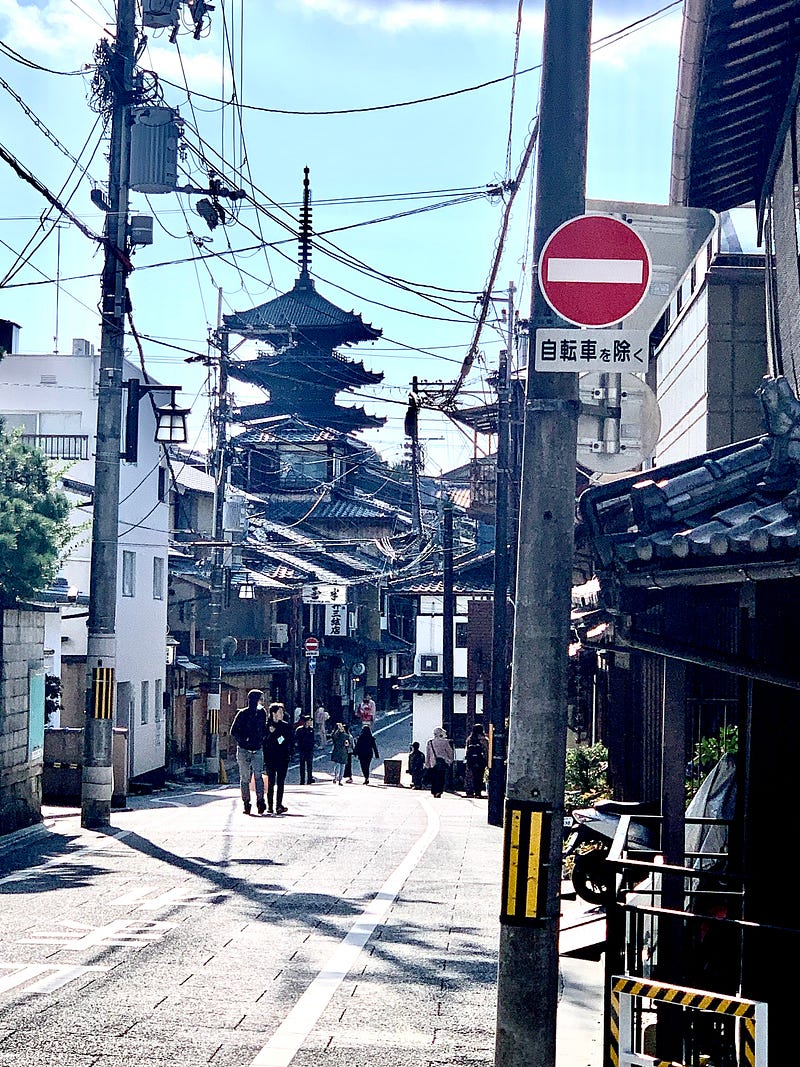
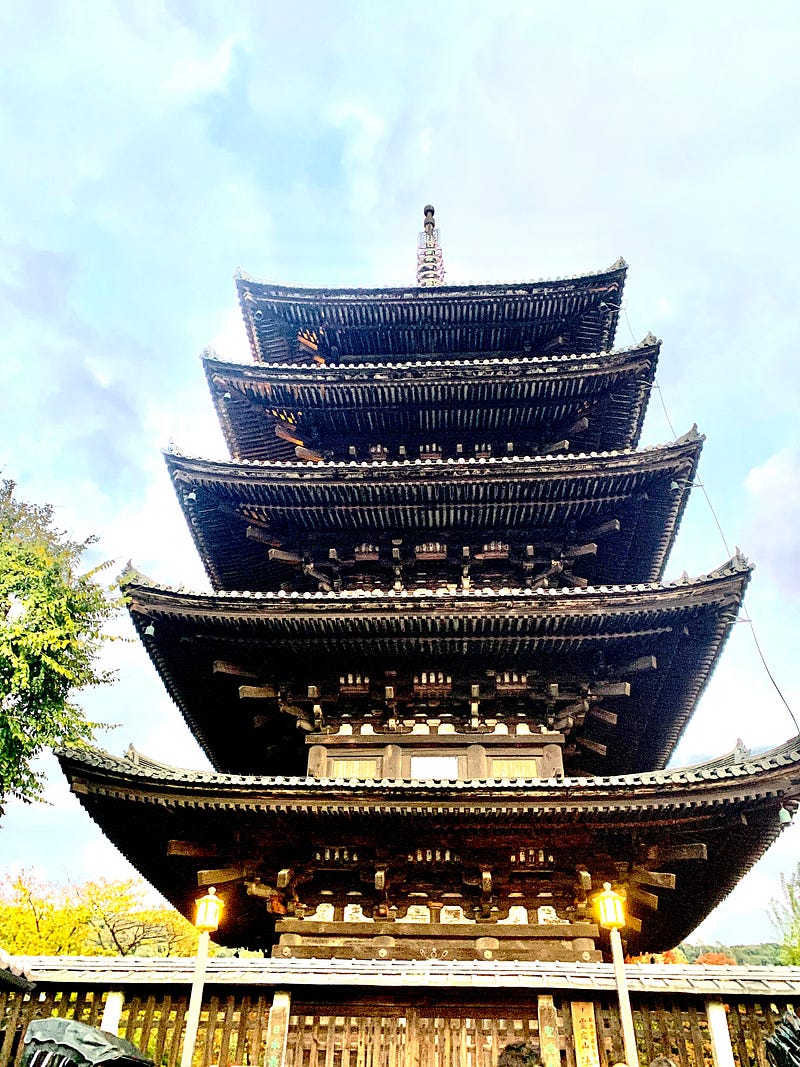
Where new and old Kyoto meet: 600-year-old Yasaka Pagoda peeks through a skein of electrical wires. All photos by Tim Ward

By happy circumstance, we found ourselves bound for Japan. Teresa (my beloved spouse and business partner) and I had a short assignment in Manila. Those of you who have followed this blog for the past two years will understand what a shock this was to our systems. We are used to a life of frivolity and flâneuring. Maybe the occasional zoom session. But…ugh! This client wanted us to show up to work in the Philippines in person. It seemed rude. But we did it anyway. In compensation, I was able to negotiate a brief stopover in Kyoto when our assignment was done.

Kyoto is our favorite city in Japan, and this was our third visit. The city can overwhelm a visitor with its multitude of charms. There are over 2,000 Buddhist temples and Shinto shrines in the old capital, as well as museums, parks, gardens, monuments, and so many places to shop. However, in racing around to see everything, there is always the risk one will not actually experience anything.
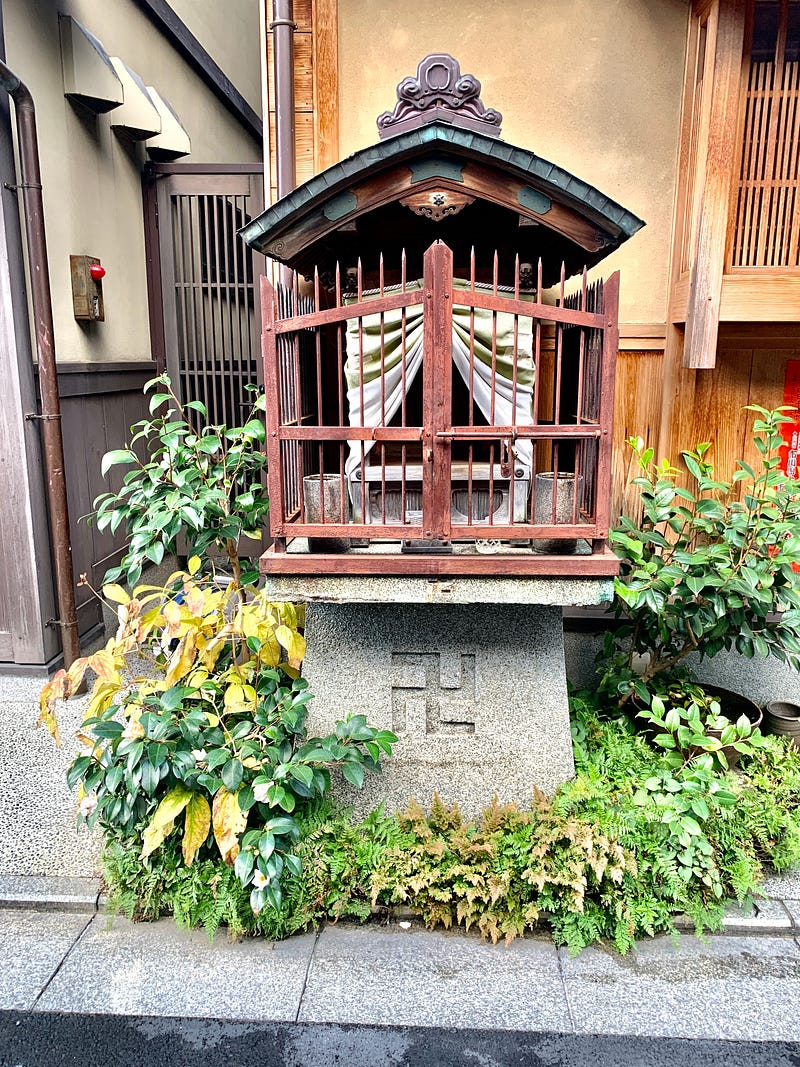
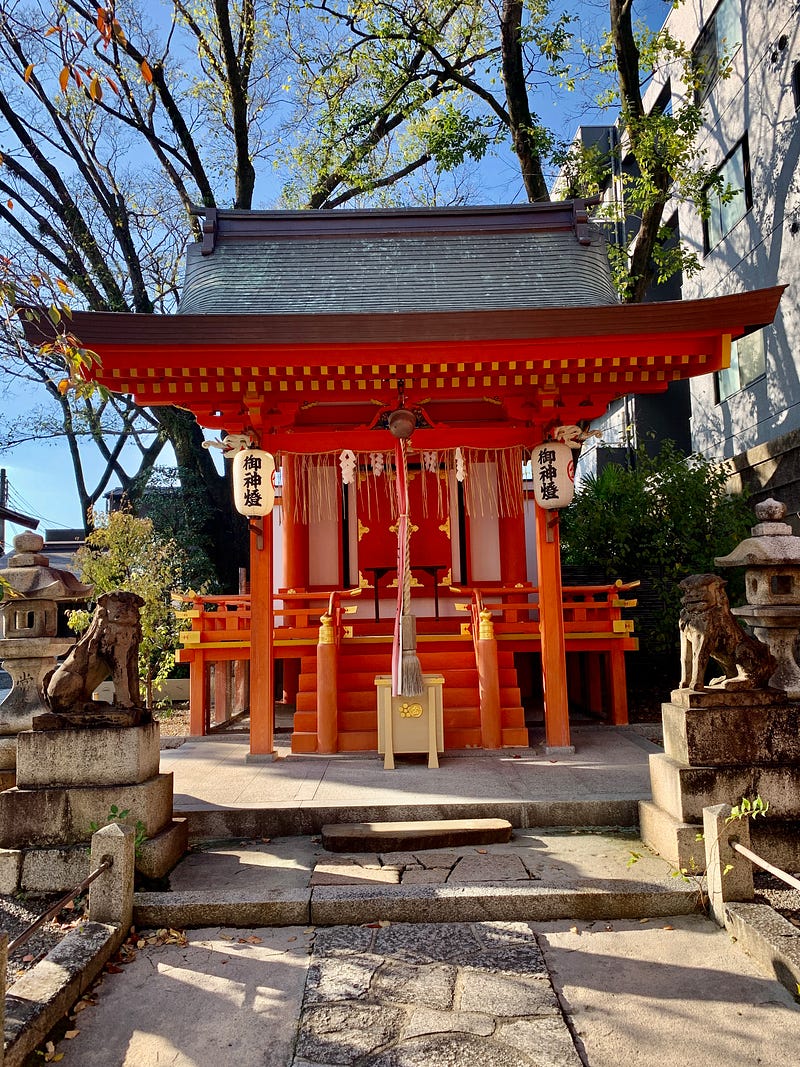
In Gion: Left, a tiny Buddhist shrine; the symbol under the altar is an ancient Asian swastika. This sacred symbol was appropriated by the Nazis’ but it did not originate with them. Right, a lesser Shino shrine.

This visit, we decided we would just relax and meander, without feeling that strange sense of obligation one often has when visiting a major city, to leave no sight unseen. Since we started full time travelling two years ago, we have really embraced the slow travel ethos of the flâneur (Which I wrote about in Mature Flâneur, below), and looked forward to simply strolling around Gion — the “old town” of Kyoto, which is where we love to stay.

Our first morning we set out from our little guesthouse in the crisp fall air, and plunged into the narrow backstreets. What’s peculiar about Gion is that some streets are much like the rest of modern Kyoto: rather bland residences, shops and apartment blocks. Then, one turns a corner, and steps back two centuries. Suddenly the houses are all traditional, with dark wood façades, tiled roofs, and delicate gardens in the tiniest of green spaces.

We found one little alley that we had to practically squeeze through, that opened into a small, brightly decorated temple courtyard on one side, and an array of coffee kiosks and gift shops on the other. The residents have taped signs on their doors in English, saying “Private residence: No photos.” I could all too easily imagine tourists opening the front door and snapping a picture of some poor person sitting in their living room in their underwear.
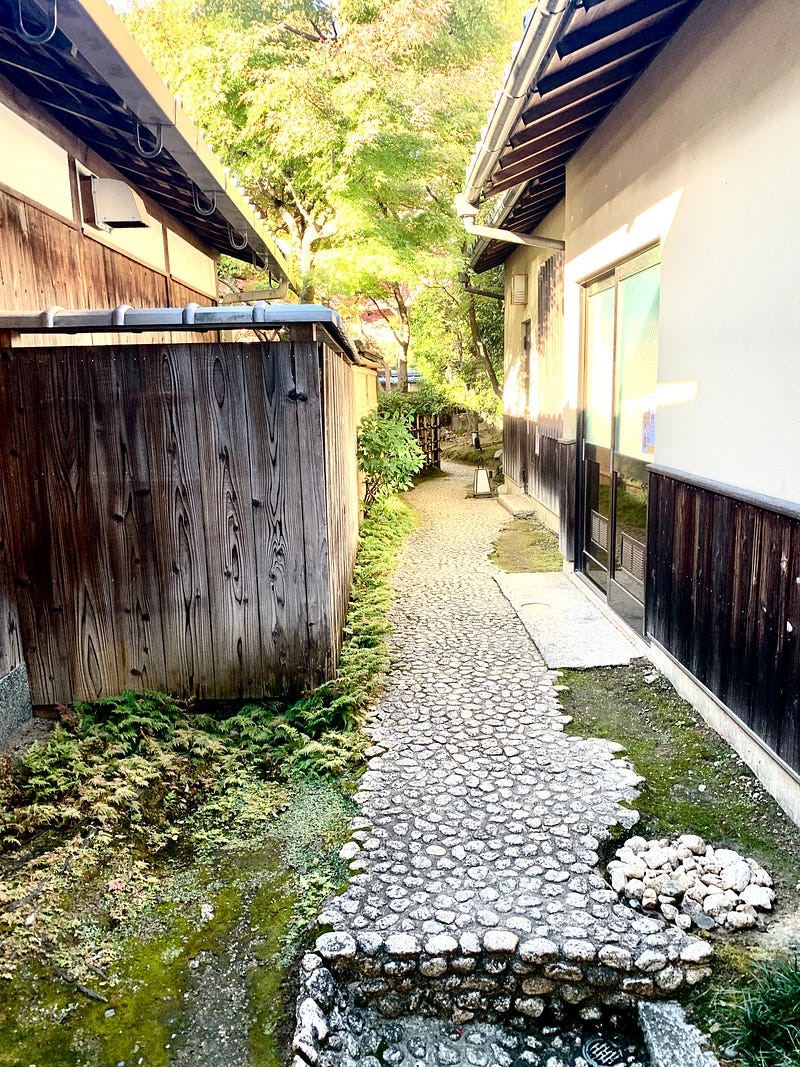
This is in a city?

Back on the street, we climbed up the hill at the edge of town and found ourselves in a vast open lot near a Buddhist temple in honor of Kannon. Kannon is one of my favorite oriental divinities, also known as Guan-yin. She evolved from an ancient Chinese goddess of mercy brought into the Buddhist pantheon in the seventh century as a female incarnation of the Bodhisattva of Compassion, Avalokiteśvara.

An old Chinese monk once explained to me that this bodhisattva was originally male, but when he came from India to China, he saw the suffering of the Chinese people was so great, he knew that as a masculine divinity he could not possibly reach them. So Avalokiteśvara transformed himself into a woman, because only as a woman would the Chinese people know that she truly felt their deep suffering. Kannon/Guan-yin thus can be considered the first trans divinity of Buddhism!
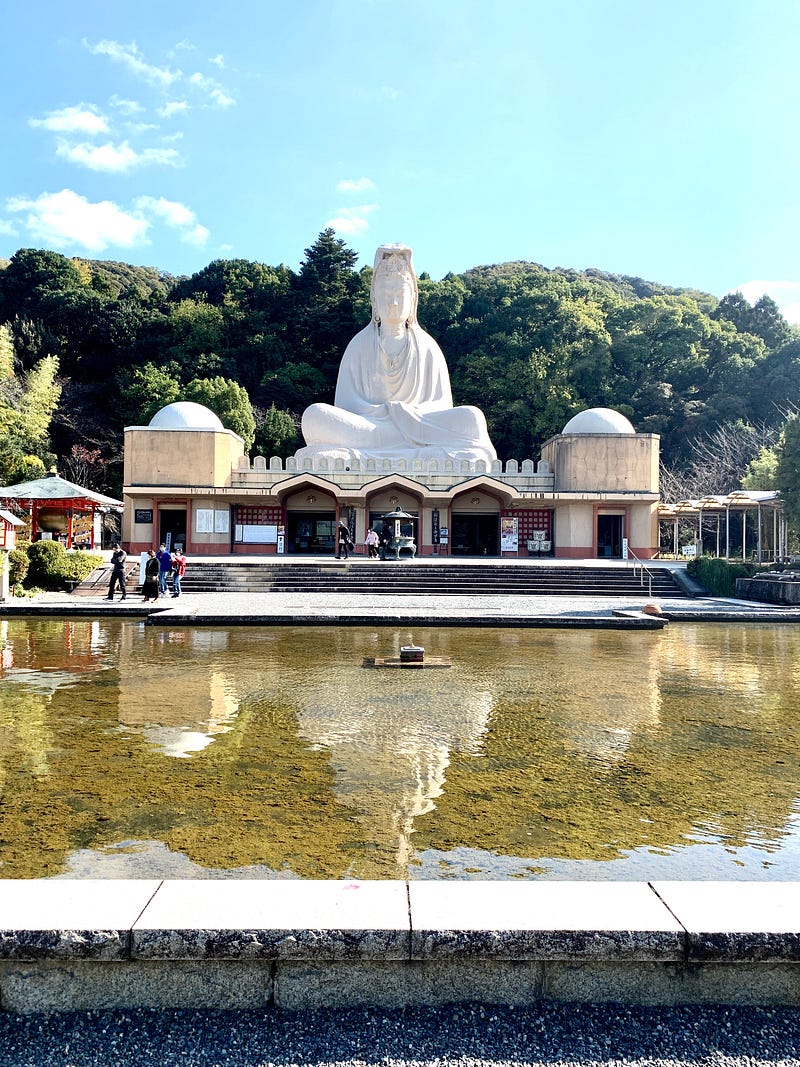
Kannon’s white, concrete statue is massive, as tall as a six-storey building. The elevated hillside raises her up so high she gazes down upon the whole city like a guardian angel. While many shrines and temples in Kyoto are over a thousand years old, this one is surprisingly new. Constructed in 1955, the Ryōzen Kannon was built as a memorial to the two million Japanese who died during World War 2. We lit incense and placed our sticks in the giant urn before Kannon, and said a silent prayer for our families.

To the left of the Kannon statue we found a giant, golden “wishing ball.” The instructions were to put your hand on the ball and walk around it clockwise, three times, so that your wish might come true. Well, who can resist a giant golden ball of good luck? We paid our 200 yen donation and took our turns. This is one of the paradoxical things about Buddhism: it is both a philosophy based on the premise that desire is the root of all suffering, and so one must purge desire by walking the 8-fold path of righteousness; and yet Buddhists embrace cultural superstitions for wish fulfillment and avoiding bad luck.
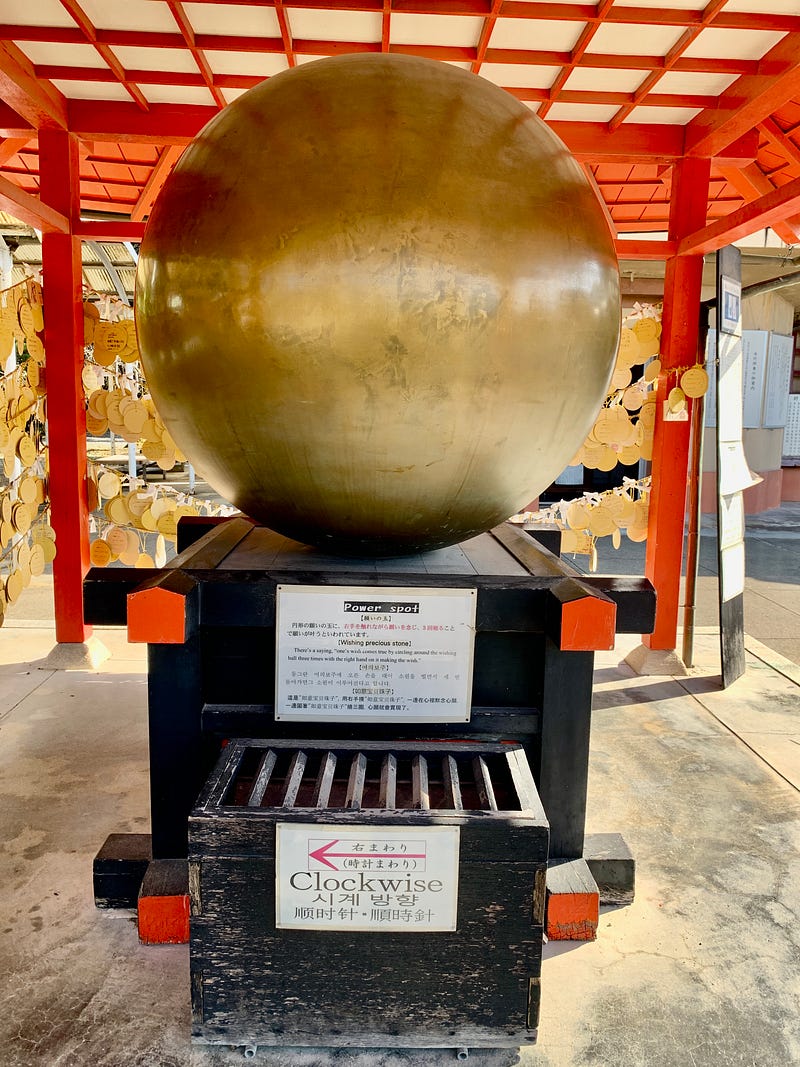
Who can resist the Wishing Ball!

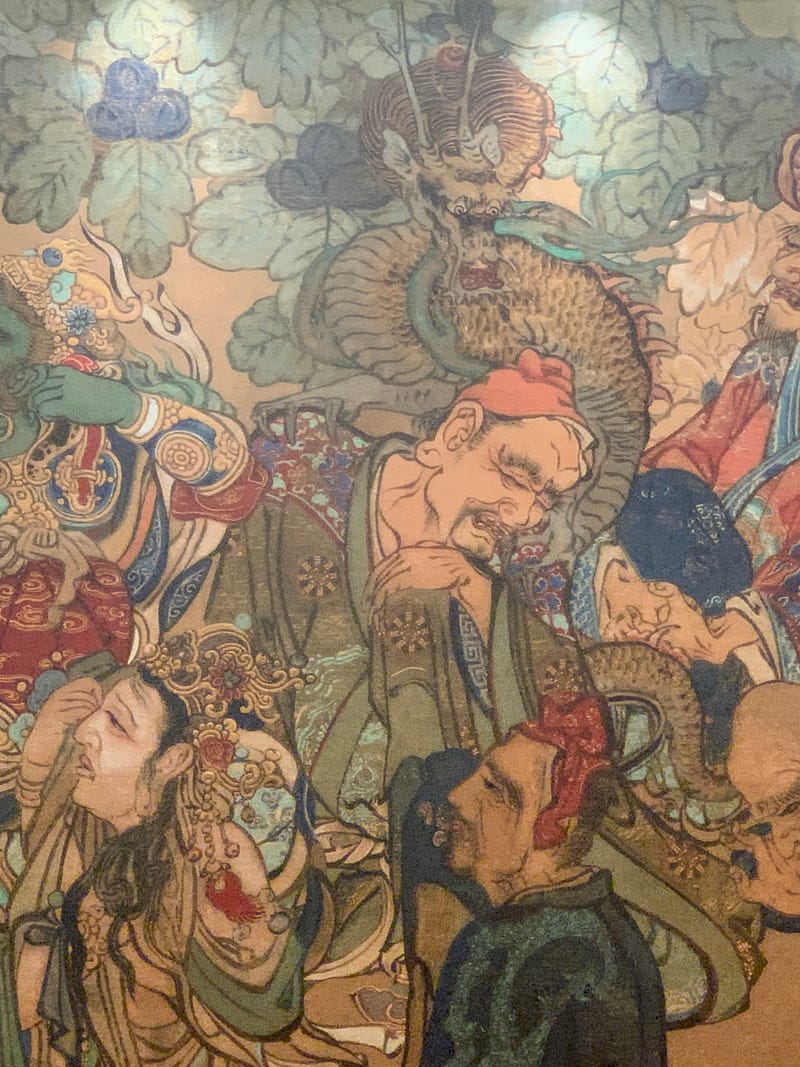
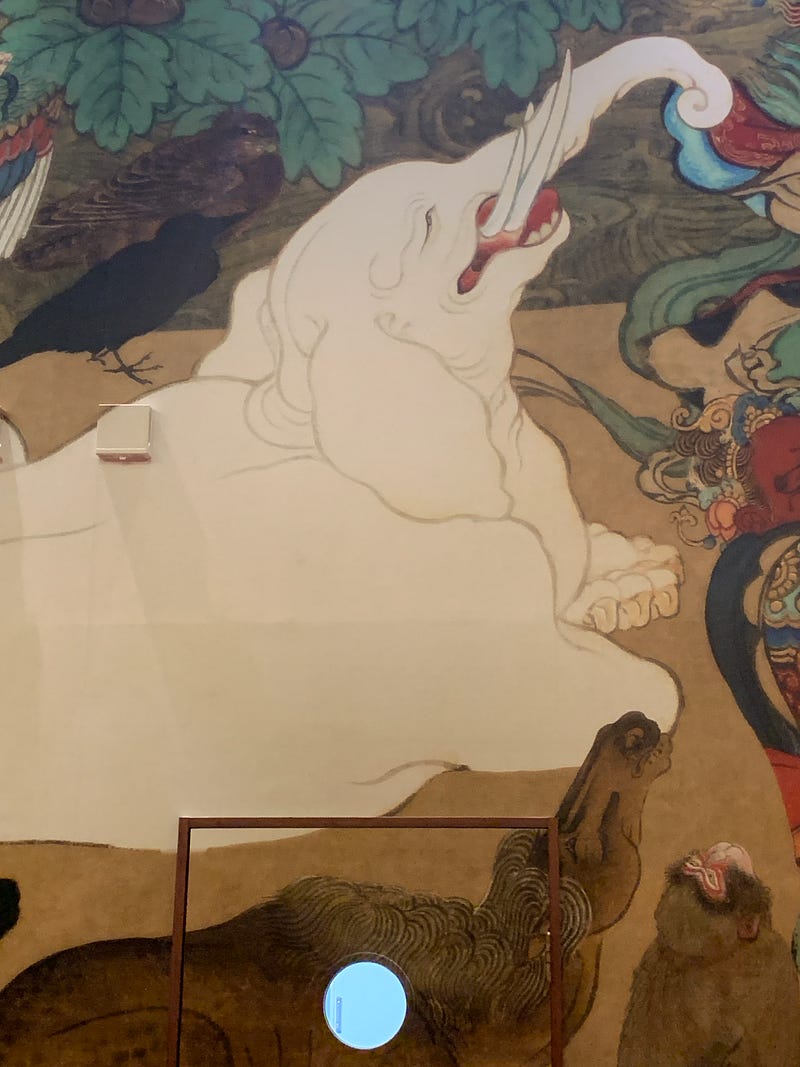
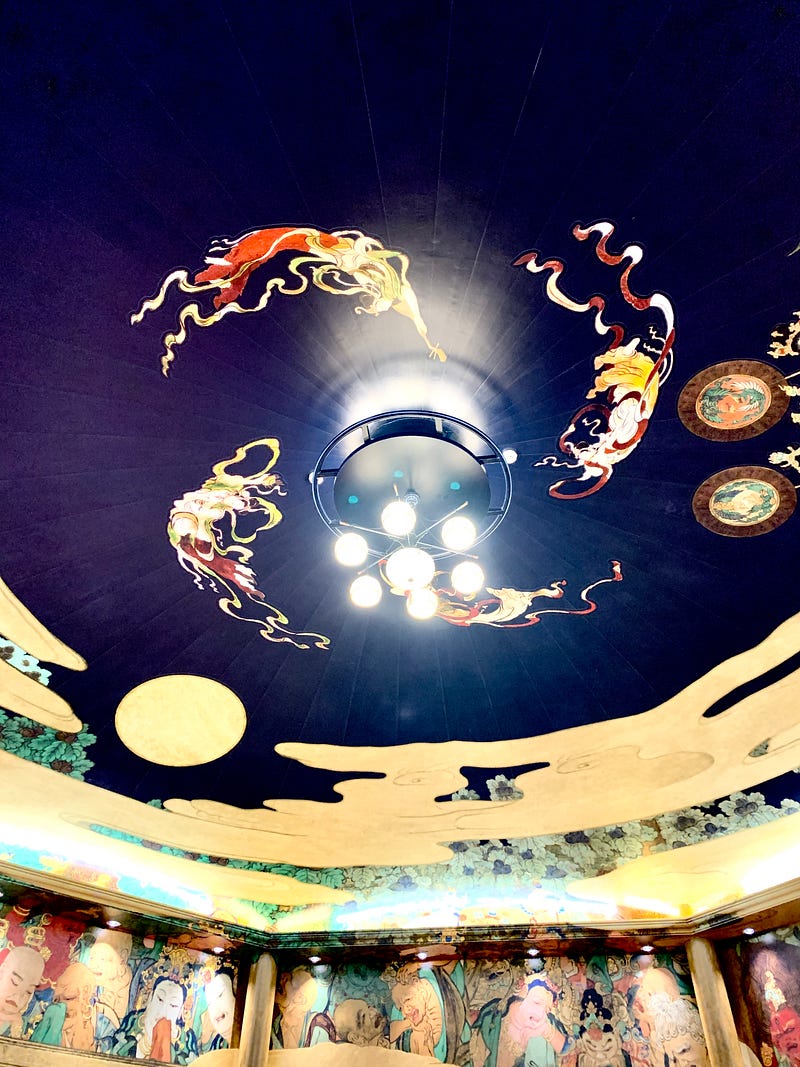
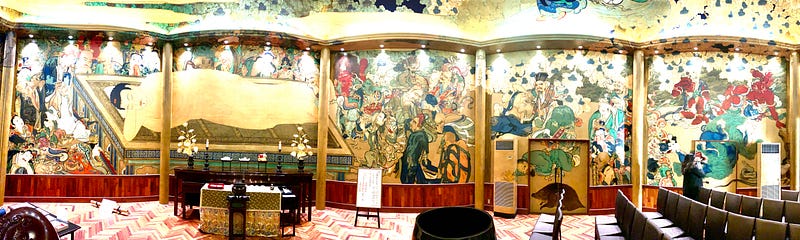
Just next to the Ryōzen Kannon we came across a sign enticing us to look at “art works of Nirvana.” Teresa rolled her eyes, but I insisted, so we removed our shoes and stepped inside what turned out to be a large, church-like space filled with seats, encircled by a 360-degree, floor-to-ceiling death scene of the Buddha — one of the most iconic moments in Buddhist history. Around his golden, larger-than-life corpse, mourners gathered: celestial divinities and magical beings from the entire Japanese spiritual pantheon, including demons and dragons, wild animals, even a weeping elephant, all grieving for the dead Buddha. It was dazzling to behold. We learned from the attendant that the mural was a reproduction of an 850-year-old tapestry possessed by Kodai-ji Zen Temple, just next door.
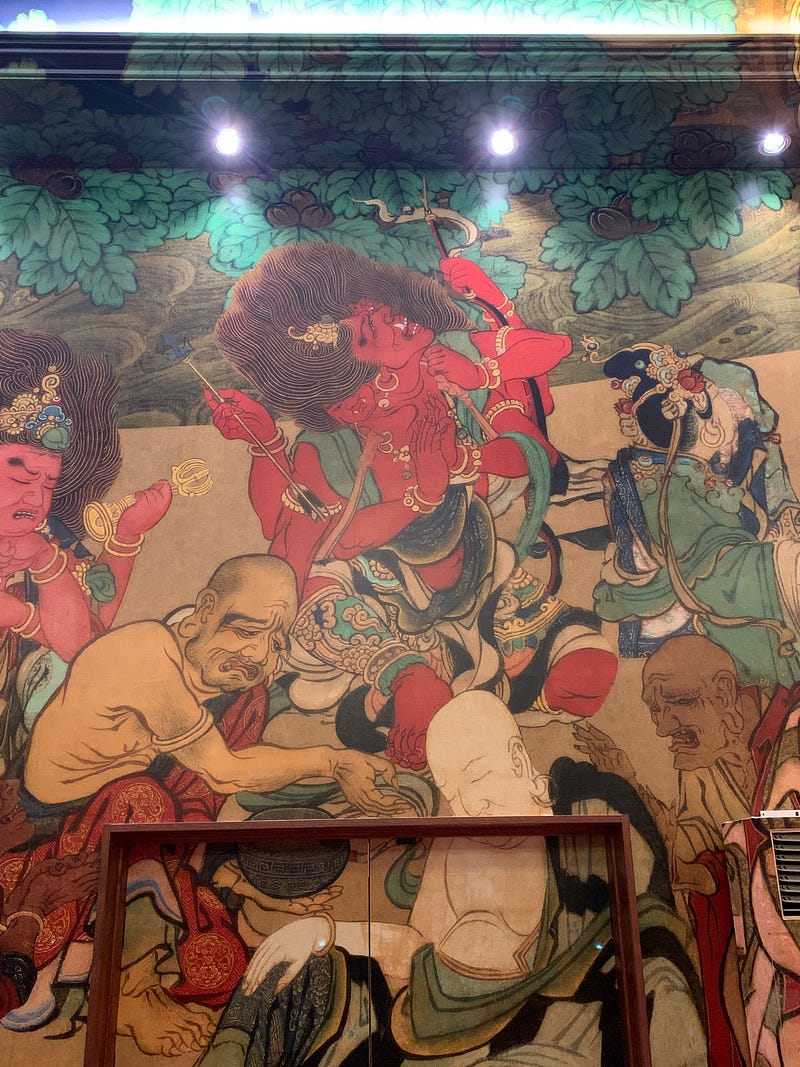
Mourners for the Buddha include a demon, a dragon and an elephant!
Celestial goddesses fly around the sanctuary ceiling.

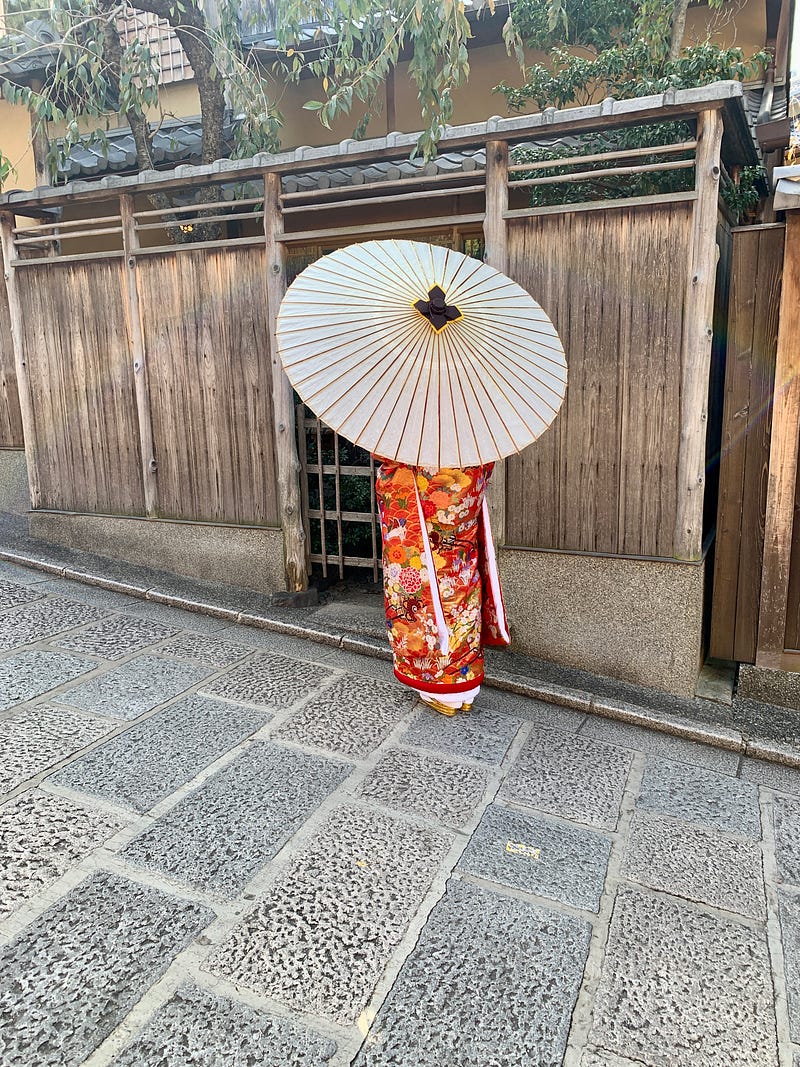
Wandering further along the hillside above Gion, we hit a densely touristed area which even before noon was thronging with visitors, including many wearing Japanese kimono. This is one of the main things tourists do when visiting Kyoto. They make parts of Gion seem like old Japan — except for the incessant Instagram-photo taking!
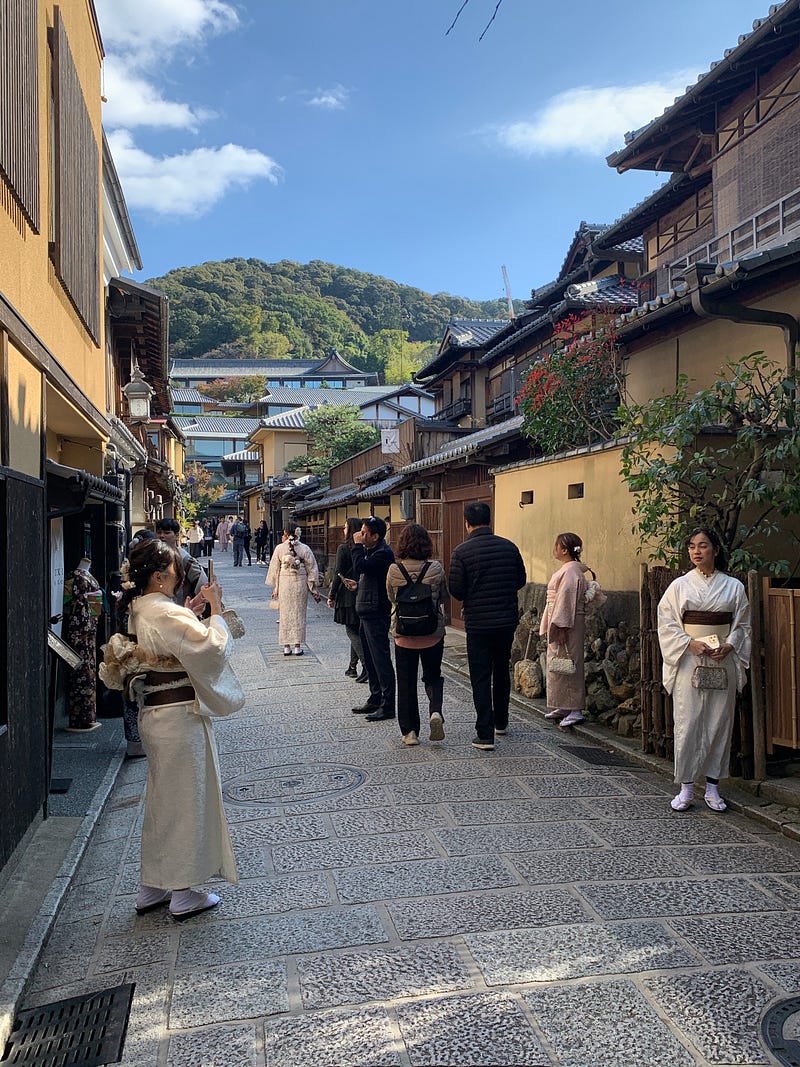
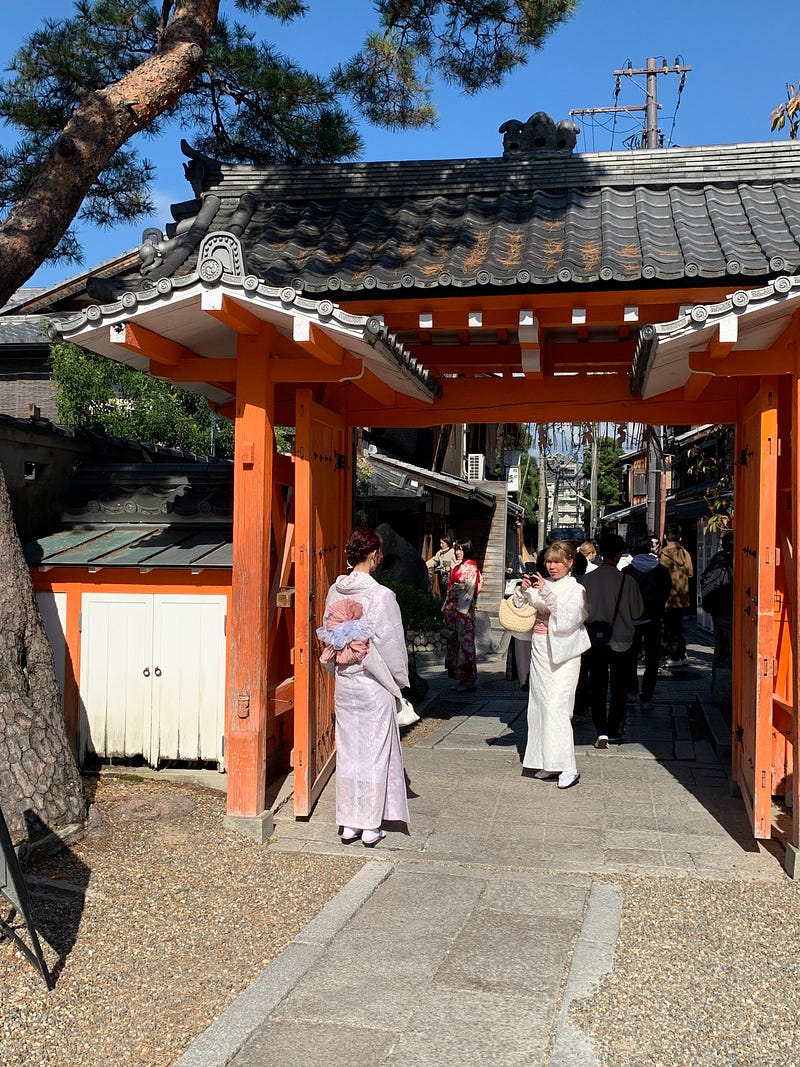
I’m convinced that under the umbrella, this woman is taking a selfie!

We now followed the busy path back towards the center of town, passing the great Yasaka Pagoda, truly the most striking landmark of the area. Founded in the 7th century, the pagoda was originally part of a large temple complex. It was destroyed and rebuilt several times during struggles between rival sects over control of this most auspicious monument (The current pagoda was rebuilt “recently,” in 1408).
Not far from the pagoda we came across a most peculiar shrine, known as the Yasaka Kōshin-dō. It seemed part Shinto shrine, part Buddhist temple, but is in fact something in between. Kōshin is a Japanese folk religion which venerates the three monkeys we know as “See no evil,” “Hear no evil” and “Speak no evil” (you can see them on the altar of the photo below). From what I have subsequently read about the Kōshin cult, the monkeys mean: “not wanting to see what could be a problem, not wanting to say anything about what you know so as not to take a risk, and not want to hear so that you can act as if you don’t know.”
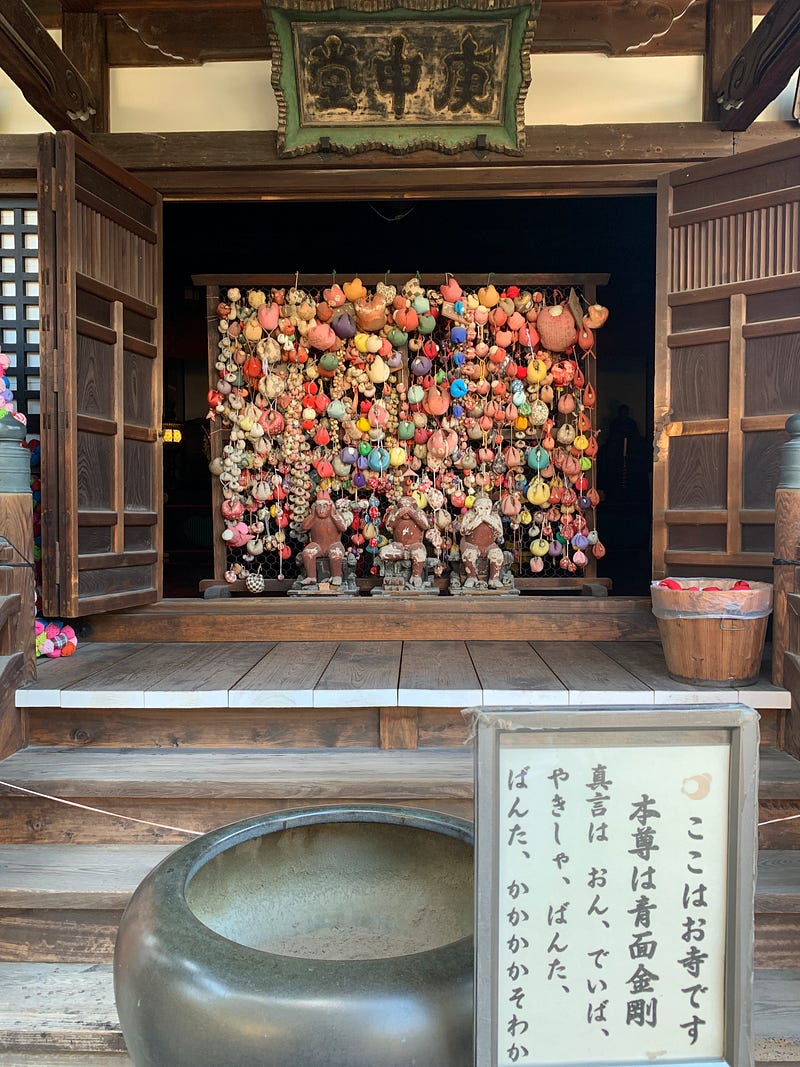
Balls on the wall behind the shrine to the three monkeys!

The core of the cult is the belief that three “worms” or evil spirits reside in each person; once every sixty days, these spirits go and repent their misdeeds to the divinity Ten-Tei. Ten-Tei then punishes them by shortening the life of the person they inhabit! And so, while followers of the Kōshin cult do their best to be good, what is most important, if you are a believer, is to stay awake that one special night every sixty days, so the spirits can’t sneak out of your body and rat you out to the divinity! The cult was formally disavowed by the Edo government in the 19th century, but apparently persists all over Japan.

The Kōshin shrine offers everyone — cult follower or not — a way to tame those desires that get you in trouble by writing them down on a little soft ball, and then hanging the ball on the shrine wall like a Christmas ornament. The desire supposedly gets transferred to the ball. There are several walls in the shrine draped with long chains of bunches of these brightly colored desire-balls.

But this is not like Buddhism, where you might expect the purged desire to be extinguished. No, according to Kōshin, desire for something is what blocks you from obtaining what you want. By purging yourself via the ball ritual, you will actually have your wish come true, and not get in trouble with the spirits—providing you can really stop desiring it! Hmmm….seems to me there’s a Catch-22 at work here, but it does not seem to stop thousands of people from hanging a desire-ball up on the shrine!
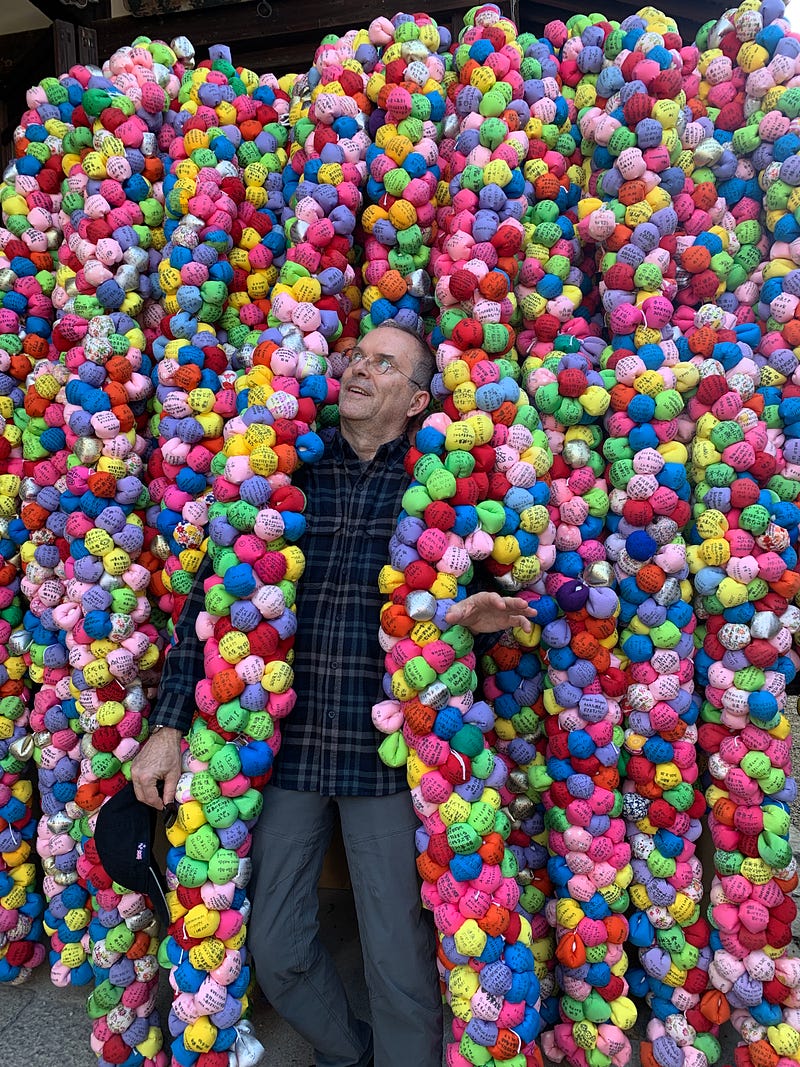
Tim at the Koshin shrine, overwhelmed by balls of desire!

On the walk home, we stumbled upon another little shrine literally round the corner from our guesthouse. Yasui Konpiragu Shinto shrine is famous all across Japan for its ability to sever the threads of fate that bind us. For example, ending bad relationships, business ventures, or even destructive habits. The ritual involves crawling through a hole in the rock, then writing down the relationship one wants to sever on a special Shinto paper, pinning the paper to the rock, and then crawling back out through the hole. A line of about fifty people waited their turn, most of them young women in their teens and twenties. I could only imagine the pent-up heartache in that long line.
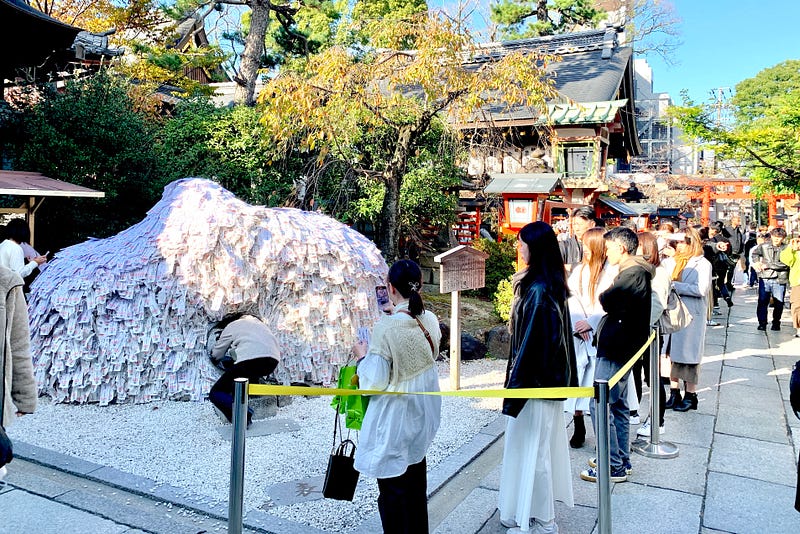
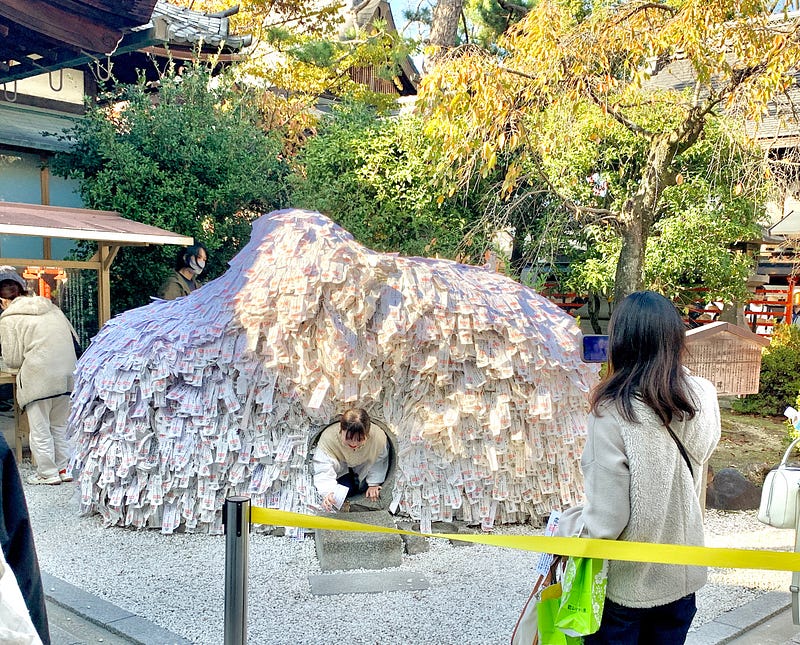
The ins and outs of Yasui Konpiragu Shinto shrine: cutting the thread of fate.

This ritual is clearly serious business for those patiently waiting their turn, and though I have a tendency be flippant about the many varieties of superstition that seem literally woven into the fabric of Kyoto’s streets, I also keep in mind that there is far more about the world that I don’t know than I do know. For instance, I later discovered a remarkable travel blog by a man named Donny Kimball who performed this ritual at Yasui Konpiragu. He credited it with freeing him from a destructive addiction. You can read his story, and more on the background of this ancient shrine, here:

Indeed, belief itself can be a powerful force for transformation. So if a hole in a rock, a ball on a wall, or a walk around a golden globe sets you up for it, well, isn’t that a miracle?

***

Tim Ward is the author of Mature Flâneur: Slow Travels through Portugal, France, Italy and Norway.

Japan
Kyoto
Fall Colors
Globetrotter
Travel Writing
Recommended from ReadMedium