
Me Vs. Misty Copeland
Two ballerinas. Two very different stories.
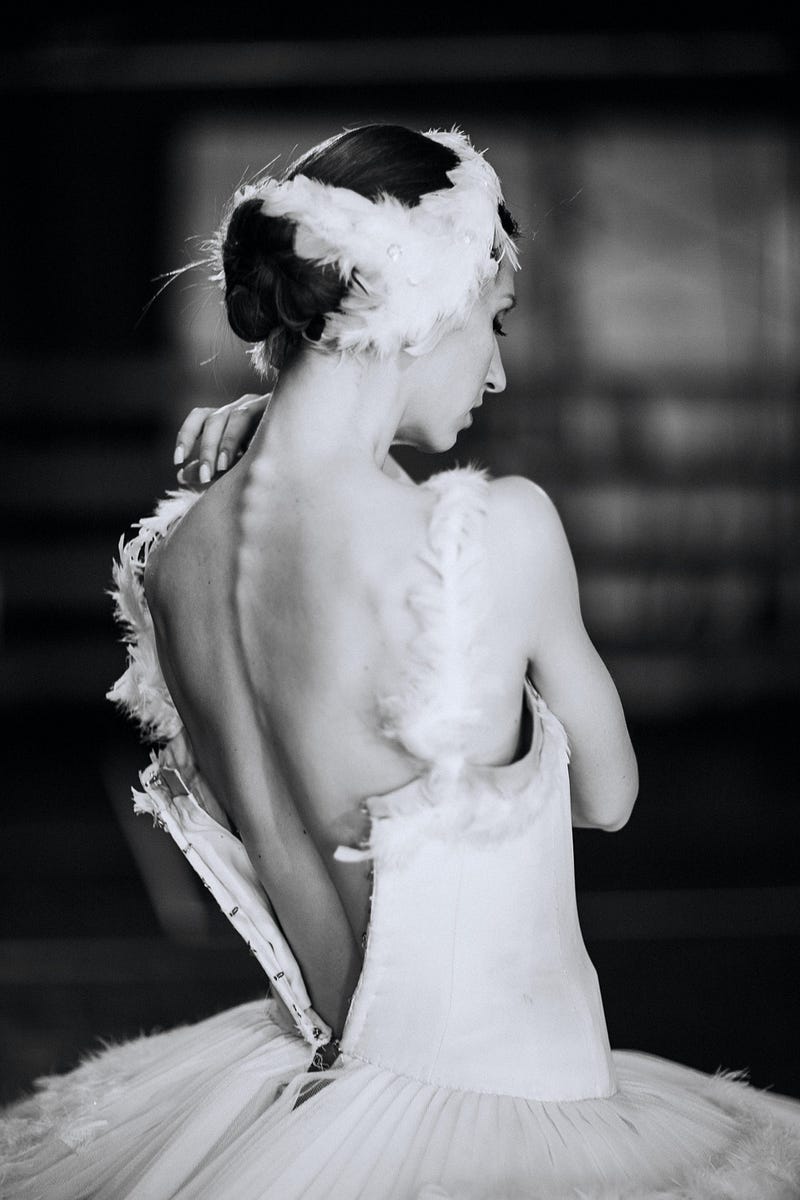
My story draws an audience of natural curiosity.
Most people have never known a professional ballerina and they don’t have any idea about the world you grow up in to become one.
Misty Copeland broke the mold. She took her talent to the center of the spotlight and defied anyone to say her body shape was incorrect. I give her so much credit and admire her more than I can say.
I will never pretend to know what it’s like to grow up in the snow white world of ballet as a Person of Color but I know what it is to grow up in that world. There is, however, a big distinction between Misty and I that is beyond skin deep.
She wanted it.
Misty’s story is one of perseverance and changing the shape of beauty. Mine is a story of desperation and despair, being tortured and trapped, and revelations about just how dark that world can be.
Why is my story so shocking to people? Because most people who grow up being primed to be professional ballerinas are people who want to become professional ballerinas.
Their permanently damaged feet are a price they’re willing to pay and the pain, sprains, broken bones, and chronic issues of a misshapen skeleton are just part and parcel of the world that they love. Any chance of shining in it makes them protective of it.
And until Misty Copeland came along, it wasn’t a frequent discussion of eating disorders and body dysmorphia though it was largely assumed.
The life of a dancer in any skill field boils down to decades of practice for years of professional background and if you’re really lucky and extremely talented — one or two choreographers might even shine a spotlight on you. Most people cause permanent damage to their bodies and never make it in an industry so cutthroat it makes the writing world look like a breezy park day.
I’ve always wanted to be a writer and the idea of how much rejection I will face when I try to publish holds me hostage. I never wanted to be a ballerina but I was forced into the center of a stage and danced like a trained monkey with a smile on my face that was faked and forced.
I’m not protective of the world that I grew up within and feel no need to shelter your eyes from the truth. Because I never wanted it. At any given time in my 20-year span spent dancing, the girls on either side of me hoped I’d break my neck so they could take my place, unaware that I’d have given it away gladly… were I only allowed.
Misty showcased the racism and body image issues of the world and I gladly continue to turn the spotlight once shone upon me to light up the dangers and damage of the industry. A world of darkness and pure hell where killing yourself slowly is actively encouraged.
I’ve told my story in pieces. Some parts have never seen the light of a screen because I do not like to type them. I do not want to revisit every moment of a childhood lost and of dreams I didn’t dare to consider having. The absolute worst parts of the story are backspaced away every time I try to get myself to write everything that happened.
A ballerina is beauty and delicate grace to the eyes that behold her but she’s anything but delicate. She is pure muscle, forged in fire, encouraged to smoke — discouraged from eating, broken down to pliable fragments.
I see the ballet world as a cult. People who are there happily don’t talk about the poison-laced beverages. And who would ever endure so much pain and such a hard way of life unwillingly?
Me. I did.
Ballet slippers were placed on my feet at two years old and from that moment on until my meniscus cartilage gave way in my right knee at the age of 22 — I was absolutely nothing else in this world. Reduced to my footwear, I was defined by a talent I never wanted and my only worth was my weight.
Ballerinas weigh more than they appear to. Male ballet dancers must look a certain way as well — they should not have the bulging muscles you would think it would take to lift us single-handedly in a split above their heads. Pure, lean, toned, muscle. Both genders. We are exceptionally strong but do not appear to be. Dancing that line takes a type of discipline that to accomplish without any desire to do so makes it feel more like torture than talent.
A torn meniscus is a serious injury but not totally uncommon in the dance world. For it to tear out completely — to be free-floating inside of your knee as happened to mine — requires decades of weakening. It requires ignoring pain you should not ignore. It requires dancing through injuries you should not dance through. It is a career-ending injury.
In my case, it was life-saving.
When little girls would tell me how much they wanted to be just like me, I’d say silent prayers to gods I never believed in that they never had to know the nightmare behind that dream.
When little girls look up to Misty Copeland — they’re admiring someone for the right reasons. Girls growing up in ballet studios across the country owe a debt to Misty that they may never fully understand. The girls in schools like the one I went to — schools built solely for the purpose of creating a conveyor belt of ballet talent — know a mixture of how things were done both pre- and post-Copeland.
It’s changed since I grew up in it. Not enough. But it has. There may be fewer stereotypes placed of the perfect body of a ballerina but eating disorders and body dysmorphia persist. Where once the body of a prima would resemble that of a pre-pubescent girl, curves are now accepted, yet still…they’re only accepted to a point.
And that point is a talent so undeniable that to keep it off a stage would prove a detriment. No matter what, a ballerina will always be required to have more muscle than body fat to accomplish the performances, and that continues to elicit harsh and pointedly unkind remarks with every morsel of food placed in a mouth that should crave nothing more than a carrot and a cigarette.
For every stride this country makes in the image of a woman — any woman — there are still so many wasting away in the shadows of the ‘fat’ image they’re warned against. Models were seen as giving the masses poor body images so those with the once-coveted tiny frames were left to wilt in favor of more realistic images. Models can waste away to nothing because they’re not even required to have as much muscle. A ballerina walks a tightrope.
You need fuel to build muscle but you’re told the fuel will make you too fat to dance. And the mold may have been broken but don’t think for a second that choreographers haven’t been trying to tape and glue and shame it back together.
Shame.
That is what they teach you. To be ashamed.
Still hungry after a meal? Shame on you. Want dessert? Shame on you. Indulged on your birthday or a holiday? Shame on you.
You do not drink soda or alcohol. You do not eat anything that isn’t absolutely necessary to keep you anything above alive. Because every drop or scrap above and beyond that is an empty calorie put in an empty vessel that is nothing more than a tool.
You are a moving prop. You are manhandled to the point that a harsh touch is simply a known part of your reality. If your positioning is off the desired picture that’s being created, you will be physically forced into it.
If you happen to be injured at the time, that is not a justifiable excuse, and no one cares. They move you. Maybe a rough shift of your head to correct your neck in a movement so hard a white-hot flash of pain surges through you. Maybe your arm is grabbed, twisted, smacked, and reversed unnaturally until you get the point about how it should look. Maybe someone grabs your thigh so close to your crotch that you blush discomfort you will never speak.
You are not a person. You are a moving piece of art and the fact that you breathe is an annoyance — dare to speak and you’ll simply be cast away to the shadows of the corps — dancing your life away to never been seen.
Pas de deux, or partnered ballet, training begins around the age of ten. I was being lifted by boys who had their hands in places other girls my age were being taught shouldn't be touched.
I was younger than that when I was introduced to opiates. We’d be numbed from the pain of our bodies telling us to take a break in order to keep us dancing. I’d swallow what I was told to swallow and a strange itchy fog would take the pain away. Somehow I still remembered my eight counts.
I was given my first cigarette when I was 12 and told it would stop the hunger. I was taught how to make myself vomit at 15. This is what they called taking pride in my body and watching my weight. Nothing was ever seen as being wrong with it. It was normalized. Encouraged without being commanded. The weight of ballet was much more than body size. It was complete bodily destruction.
I lived at the school from the age of seven and my regular education took a backseat to that of ballet training. It was seen as an unwelcome intrusion. I remember my friends back home being jealous that homework was frowned upon. They had no idea. While they had homework to do, after it was done they could play and be kids.
My day… my life… began and ended with ballet.
I’d have given anything for homework.
The dream was my mother’s. She hated me and my talent for ballet gave her a reason to get me out of the house and a subject to discuss in my favor. She was fake with her friends and would brag about her children. While my brother, the child she wanted and loved, had so many subjects to dissect with delight, I was the unwanted disappointment of a one-trick pony. Nothing else I ever did really mattered. I was going to be the prima ballerina in all of New York City… or I was going to be gone. Either way, she was fine with it.
The only thing about me that held any worth was my ability to dance. Her words would ring in my ears as I felt useless throughout my life in every other capacity. She called me useless when I was injured too badly for my career to continue. My life had finally become my own but I believed the things she said about me.
Sometimes I still do.
Misty Copeland showed that ballet did not have to look a certain way but she had to fight to make that point.
My story shows the fight. It’s not the same fight but I’d bet big money that she knows the same bodily damage that I do and has broken bones and danced injured and felt the discomfort of being molded.
It’s just that those who really want to be ballerinas… don’t speak of the dark nature behind becoming one.
I admire Misty Copeland. Not because she’s a ballerina, I hate ballet with every fiber of my being. I admire her because she saw what was and created what could be.
Maybe someday ballet will catch up to what should be.


