
Me, the US Coastguard and the Monroe Doctrine
Tales from an itinerant writer #7
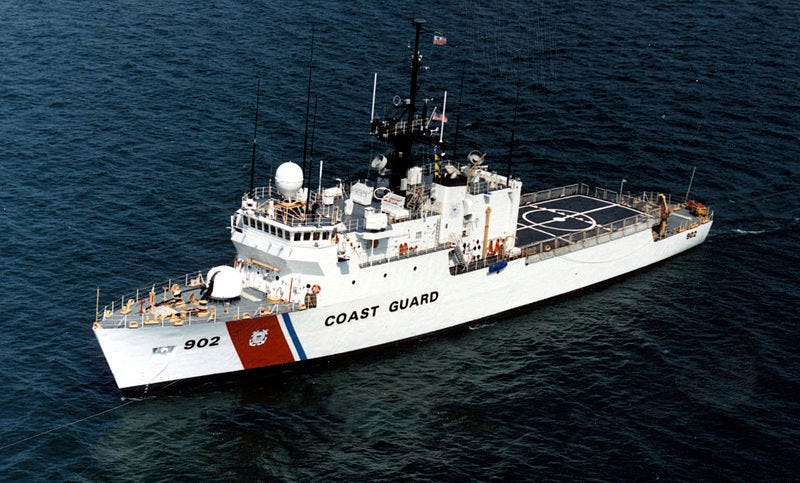
It had just got dark. We were rolling gently and powerless in slight swell, drifting in a gentle easterly-flowing current off the coast of Haiti.
Things were about to get interesting!
Our route
My wife and I were sailing our boat Blue Mist on passage from Cuba to Grenada via the British Virgin Islands, with planned stops at St Martin, Guadeloupe and Martinque. Just the two of us.
The previous afternoon we’d passed the very small and uninhabited island of Navassa en route, almost between Jamaica and Haiti.
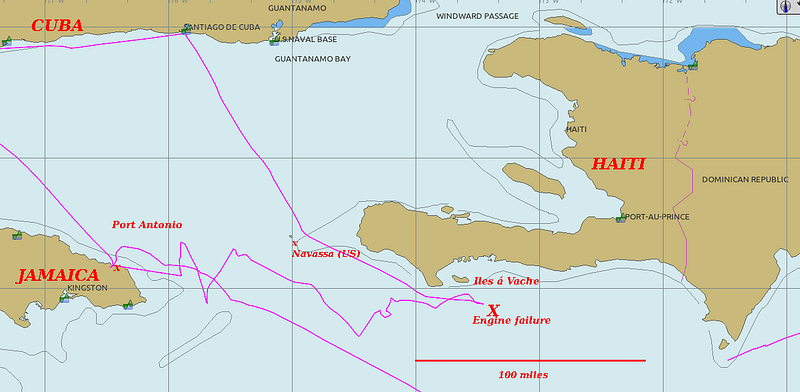
Navassa is US territory (disputed with Haiti), barely more than a rock with a lighthouse. Landing there is prohibited. It’s known to be used for drug trans-shipments using small fast boats. Mainland USA is about 500 miles away.
A bad smell
There had been little wind overnight so we had not been under sail. We’d been making about 5 knots under engine when the mate called me from my bunk. The smell of a burning clutch was ominous and the gearbox finally gave up its ghost at about 05:00 hours. It had been problematic for a few months.
For several reasons Haiti was not a viable option for us to head for and we were becalmed for most of the day about 12 miles south of Île à Vache in international waters.
We were expecting a light wind to come up overnight if the forecast was accurate and then we could sail gently back to Jamaica. We’d had a pleasant conversation on the VHF radio with a passing British cruise ship that afternoon and explained that we were having tea and cake, waiting for wind. They confirmed the forecast.
The plan was to head for Port Antonio on the North East corner about 175 miles away as the crow flies.
We’d spent a great week there a couple of months earlier while on passage from Bonaire to Cuba. We knew the port and I knew we could fix the gearbox there, one way or another. We’d be sailing. Ha!
It turned out it would take us 2 days to get there. The prevailing winds here are from an easterly direction.
How to sail
- Decide where you’re going and the wind will be wrong
- Aim the boat in any other direction and the wind will be wrong
So true, but back to the story.
First Contact
As I said, it was dark by now and then we noticed a ship’s running lights approaching from astern.
I switched on the radar and the ship stopped about 1/4 mile away.
The first ruffles of a breeze were stirring the hairs on the back of my neck, plus I had a nasty feeling as to what was going on with the ship. We got the sails up (4 of them on my old schooner). Concerned about the nearness of the ship I turned on our decklights which illuminated the sails.
We started making slow progress westward towards Haiti, at no more than a knot or so through the water (that’s 1 nautical mile per hour). Slow going.
Then the call came over the VHF radio ‘This is cutter 287 calling Blue Mist, come in please’. Three times they said it, correct radio procedure. They knew our name from the AIS transponder we carry (Automatic Identification System). The voice sounded North American.
But they were not showing on our AIS display, though I could see them on radar.
I relaxed — somewhat — thinking that they were unlikely to be pirates.
Then ensued a 15 minute interaction.
Challenge them?
I knew I was in international waters and quite within my rights to refuse to provide any information. But I strongly suspected that the result would be being boarded by heavily-armed black-clad and unidentifiable sailors. It had happened before to both myself and my wife in a variety of places and vessels.
So, we remained civil and professional.
They demanded our full details — passport details, boat registration and details of our voyage. We’d been to Cuba too, though not to Guantanamo (yet).
It took a while for them to process our data— I guess that they were checking the databases at Homeland Security and the rest of the world.
They inquired in depth about the reasons for us being stopped off Haiti, and I explained in great detail the circumstances of our sojourn.
Tension mounted — at least for my wife and I.
I was envisioning a boarding team in preparation, all hyped up and ready to tear our boat apart in a search for contraband.
Distress
Then, the guy I was communicating with said:
‘Captain, do you consider your vessel to be in distress’?
This got my back up somewhat, as we cross oceans and fix our own problems, in the main. This was far from a critical situation.
‘Certainly not!’ I retorted.
But I knew now that we’d passed the data test.
Last word
As the interaction closed, I asked the other guy:
‘For my logbook, would you please tell me what flag you are sailing under’.
There was a pause for a few seconds.
‘The United States, sir.”
As if I didn’t know.
I go to sea to get away from bureaucracy and officialdom.
The Monroe Doctrine
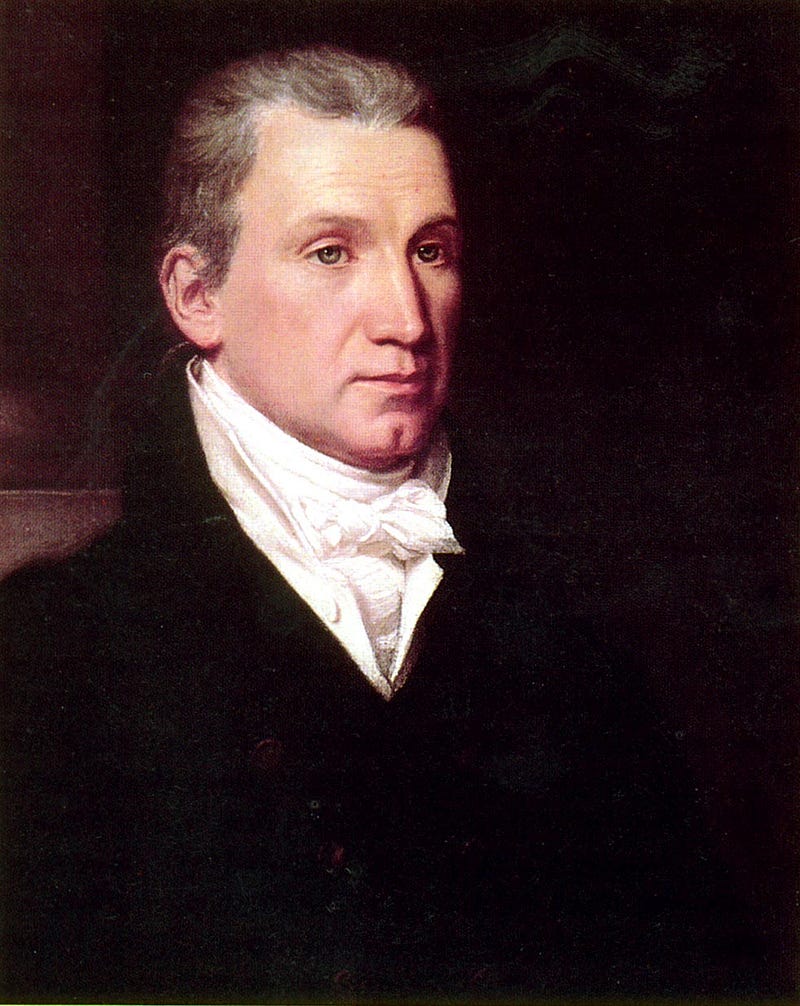
The Monroe Doctrine was a United States foreign policy position that opposed European colonialism in the Western Hemisphere. It held that any intervention in the political affairs of the Americas by foreign powers was a potentially hostile act against the U.S. The doctrine was central to U.S. foreign policy for much of the 19th and early 20th centuries.- Wikipedia
US President Barack Obama’s Secretary of State John Kerry told the Organization of American States in November 2013 that the “era of the Monroe Doctrine is over.”
Then in 2017, Donald Trump floated the possibility of applying the Monroe Doctrine to intervene in Venezuela.
Drugs and Commies?
They are great excuses to intervene anywhere aren’t they?
The US invaded Grenada (British territory) in 1983, without bothering to inform the UK Government.
Later, Russia invaded Afghanistan (oops, so did we), Eastern Ukraine, and now they’ve just sent troops in to Kazakhstan. Of course they were invited. Not drugs, not commies just fraternal concern.
Check the map of the Pacific and look at the US territories there. And Monroe was against colonialism?
Who wouldn't be cynical?
The end of the story
Early in the morning two days later we ghosted (that’s sailing in next to no wind) through the reefs with the first of the flood tide, following the very narrow channel in to Port Antonio.
Port Antonio is in Portland Parish, the safest area in Jamaica.
While there we got to see Errol Flynn’s swimming pool:
Among other things, we thought about swimming:
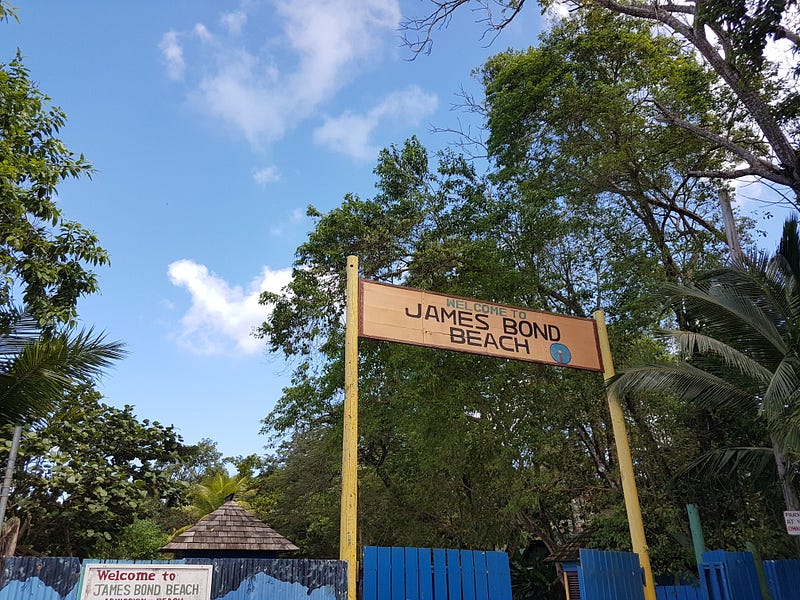
and we thought about smoking…
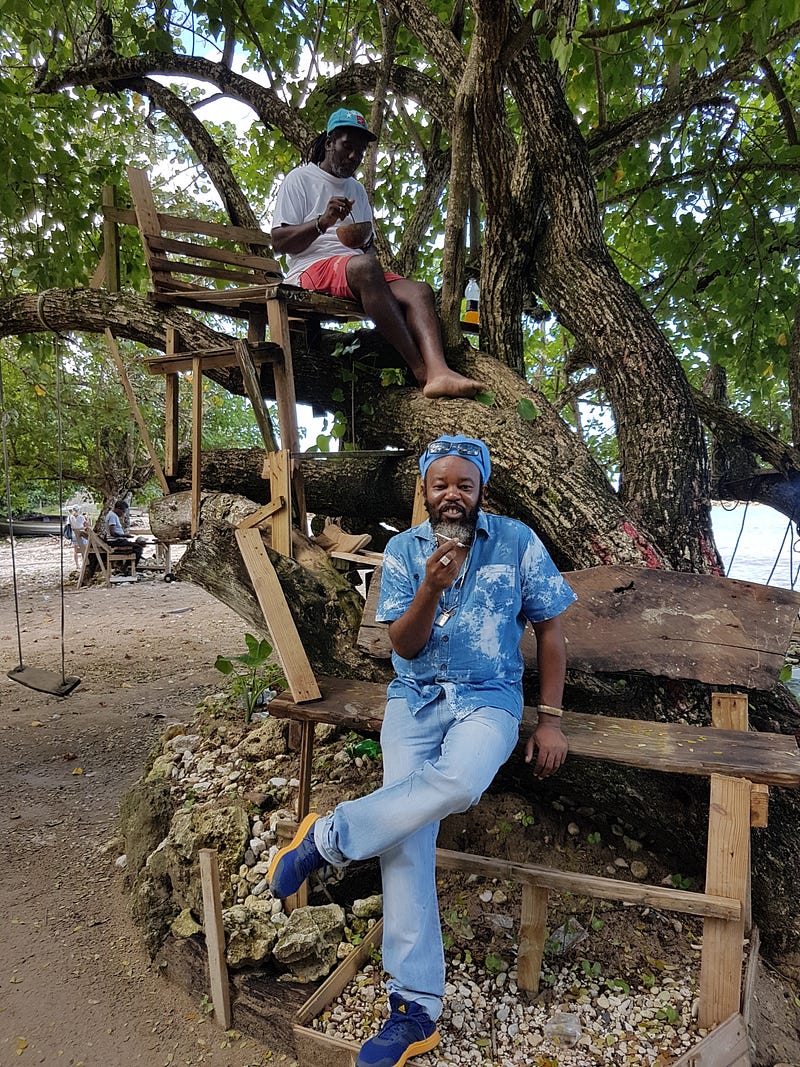
…and sampling the local delicacies…
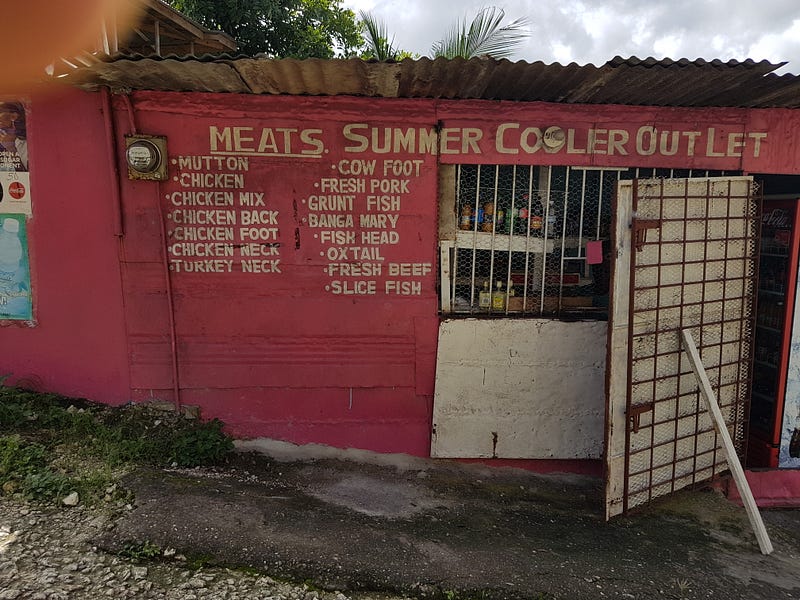
Goat curry, great beer and reggae, fried chicken and festivals.
Attractions aside, it took a month to replace the boat’s gearbox and then I sailed singled handed down to Martinique via the BVIs, St Martin and Guadeloupe.
We left Martinique later that year, headed for the Panama Canal and the wide blue Pacific Ocean.
The Galapagos Islands and Easter Island beckoned.
I don’t think that there are any US colonies in the South Pacific. Yet.
About James Marinero: I write on a variety of topics including humor, tech, geopolitics and travel, together with daily news events and the minutiae of daily life…
…and US foreign policy.
Get access to all the stories in Medium - you might even consider writing yourself! If you join you will contribute to supporting our writing community — and me! Join here:
You can follow me on Facebook Twitter @jamesmarinero . On Pinterest you will find many of my research photos from around the world. Check out my website where I occasionally have a free book on offer.


