
‘Me: Elton John’. The Amazing Man Behind ‘Rocketman’, with His Outlandish Stories and Big Heart
Rocketman is a nice OTT piece of art but as a biopic it has many shortcomings. “Me: Elton John Official Autobiography” remedies that.
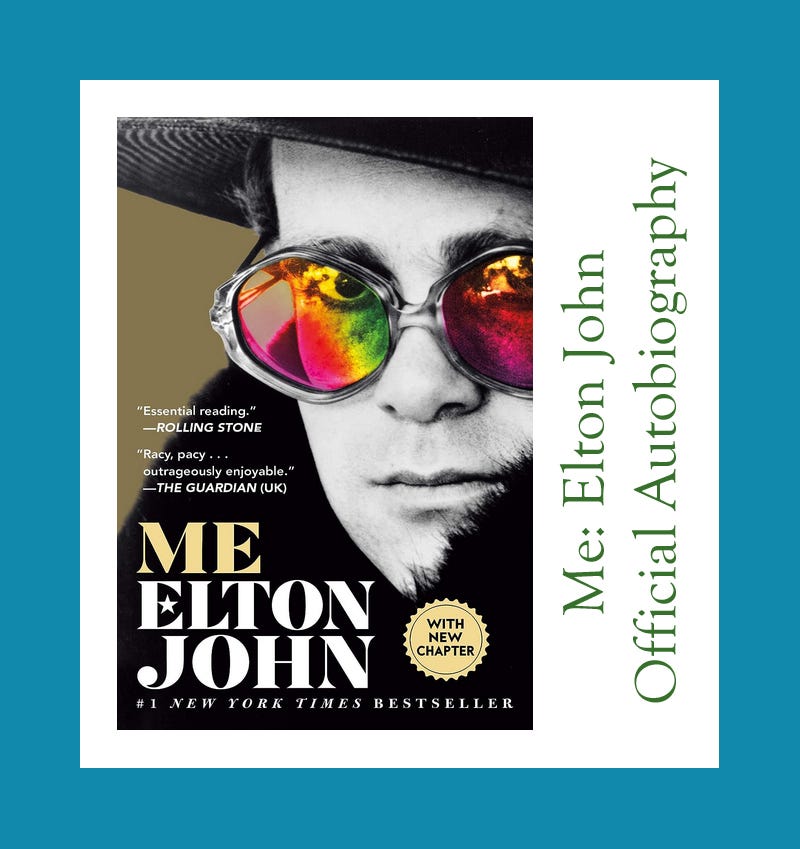
It all started with Rocketman. The movie struck me as strange and over-the-top when Taron Egerton appeared with a devilish costume complete with horns, because, well, up to that point I thought Sir Elton John was a rather avuncular figure, albeit a rather jolly one. It turned out that somehow, when it came to Elton John’s live performances, I’d lived under a rock, completely oblivious to his presence on YouTube.
I’d seen some photos of him in sparkly costumes but no videos of his famous concerts, such as the ones at Dodger Stadium in 1975, or the one in Central Park in 1980 — or his 2022 farewell show at Dodger Stadium, for that matter —, and my only impressions of him on the stage were formed by the video clip of his 1989 song “Sacrifice” and his 1991 duet with George Michael on “Don’t Let the Sun Go Down on Me” at Wembley Arena, which I’d seen on TV growing up as a teenager in the nineties in postcommunist Romania. And when Princess Diana died in 1997, I heard him sing “Candle in the Wind,” the version updated to honor the royal icon’s memory.
Throughout the years I’ve heard many of his songs on the radio and tapes and CDs, and eventually saw him perform in Bucharest in a superb, toned-down (if “Crocodile Rock” can ever be toned down) but magical, concert in 2010. But even then, after the concert, I didn’t get to learn more about how big John’s presence on stage was since the seventies, or anything from his life aside from the fact that he’s always had the same friend as a lyricist and he was happily married and had two sons.
Then I saw the rest of the movie and was drawn into its account of John’s life, a life that the movie presented as bursting with incipient accomplishments and already marred by addictions, without untangling all that in a satisfactory manner. Sure, it made some statements clearly, and I soon saw the costumes that encased Egerton as the vices that had held John in their grip for so long, but after seeing the movie I thought there was a lot more to John’s life that I wanted to learn about, because the little kid in the movie, the prodigy kid, and the young man who made music with his friend Bernie made an impression on me.
And it turned out that reading Me: Elton John, the official autobiography penned by the musician with the help of The Guardian’s head rock and pop critic, Alexis Petridis, was a very good decision. However well done the movie was, it was overly simplified, I think, for the person and persona of Elton John. (For what it’s worth, he liked the movie as it was.)
In my view, Rocketman makes it seem that most of what there was to John outside his music was easy to unpack. First, there was a boy suffering from the emotional distance imposed by his father and the hurtful reactions of a mother with a difficult personality, a boy who was steered toward the right professional path by his grandmother. Second, there was a man who loved making music and was incredibly good at it, writing a song to Bernie’s lyrics in literally minutes. Third, the focus moves on Reginald Dwight as a gay man who was a late bloomer sexually and who then, after becoming famous, indulged in sex (it’s not that simple, and he certainly had many boundaries — he sued The Sun, and he won, when they falsely alleged otherwise — , even though he declares himself in the movie a sex addict). And fourth, we were looking at a young man who, for whatever reasons, took refuge in drugs and other addictions.
All these things come through when reading the autobiography, but John wasn’t only the young self portrayed with aplomb by Egerton in the biopic; he is also a mature man who has lived without drugs and alcohol since 1990 and who has loads of self-awareness. Looking back on his life with the “white lady,” for instance, he appreciates the kind of behaviors cocaine induces and how he and others made bad decisions because cocaine appears to give you a parody of confidence — he was very shy as a young man, he says — when you need the latter while robbing you of a mirror into your soul. It also makes you disregard others and go only for what you want at whatever cost to your relationships — not that you’re very cognizant, he says, of what it is that you’re after: which, it appears, leads you into a tunnel where the only answer seems to be another line of coke.
That said, while struggling with cocaine, alcohol, and other addictions, which both fed his big persona and ate at his soul (well, except for his addiction to shopping, which he’s happy to revel in), the singer was always a phenomenal musician and performer. His penchant for flamboyant clothes, while it may have been intensified by the drugs, was in fact burgeoning well before he started using cocaine in 1974. In advance of his first trip to the US in 1970, he had found a designer, Tommy Roberts, with a shop in Chelsea, and it was his clothes that he piled on top of one another at his famous shows at West Hollywood’s Troubadour, where he performed that famous handstand on the piano — a scene included in Rocketman.
Another great thread in the book is that John has been a very diligent performer all his life. He took his gigs seriously, ever since his stepfather put in a word for Reginald Kenneth Dwight at a pub called Northwood Hills Hotel, where he started working at only fifteen years old. He was successful even then, collecting up to fifteen pounds a week from tips, but the most important legacy of playing in this bar, where fights were regular occurrences and he sometimes had to flee out a window, was, he avers, that he got used to playing over the din and hum of even the most thankless audiences — of which I doubt he had many in the years that followed.
The book is threaded with humor and much of it comes from how he clung to playing even when he wasn’t feeling well or a tarpaulin from the top of the stage fell all over him, or when the rain had completely engulfed the sounds of his piano. He played in more dire conditions as well (I’ll let you read about them in the book), and once tried to do his set while suffering from walking pneumonia — he had to stop when he discovered he couldn’t sing anymore.
As a musician, his relationship with Bernie Taupin, who couldn’t be more different than him, living a rather simple life on a farm, is quite endearing. I wish he devoted more time explaining how they work together, but the process, albeit mysterious, seems to be quite straightforward. In his own memoir, Taupin says that he composes the lyrics using a guitar, and here John shares that when he receives the lyrics, he sits down at the piano and immediately gets a feel for a song to suit them. He never tried to understand the process and is just very thankful for Bernie’s presence in his life — something truly serendipitous, as he acknowledges: he went in for an audition at Liberty Records, where he was received by Ray Williams and promptly sent on his way, but not without being given an envelope from a guy who only wrote lyrics, a guy whose lyrics he really appreciated and who later became his best friend — one who chronicled through his verse both their lives and the times they lived in.
Taupin became his fated partner in a career that has spanned more than six decades so far. They had seven consecutive №1 albums on the Billboard 200 (all in the seventies) — making music history by being the only act to do so, beating Led Zeppelin, The Rolling Stones, and Paul McCartney (and his band Wings) at it — and eight №1 albums in the UK, and numerous hits — among them 18 №1 hits on Billboard’s Adult Contemporary chart — starting with “Your Song” from Elton John (1970), which Bernie Taupin had written at 17, “Tiny Dancer” from Madman Across the Water (1971), “Rocket Man” from Honky Château (1972), “Crocodile Rock” from Don’t Shoot Me I’m Only The Piano Player (1973), “Candle in the Wind,” “Goodbye Yellow Brick Road,” and “Saturday Night’s Alright for Fighting” from Goodbye Yellow Brick Road (1973), “Don’t Let the Sun Go Down on Me” from Caribou (1974), “Sorry Seems to Be the Hardest Word” from Blue Moves (1976) — who knew that all these songs were all from the seventies — to “I’m Still Standing” and “I Guess That’s Why They Call It the Blues” from Too Low for Zero (1983), “Sad Songs (Say So Much)” from Breaking Hearts (1984), “Something About the Way You Look Tonight” from The Big Picture (1997), “Sacrifice” from Sleeping with the Past (1989), “I Want Love” from Songs from the West Coast (2001), and others.
He also collaborated with younger artists. I wish there was more about that in his autobiography. He does say, though, that he’s happy younger musicians help bring his work to new audiences. But there was also “Runaway Train” with Eric Clapton (whom he doesn’t mention enough in the book, I thought; but then again, he’s had such an illustrious career that he couldn’t tell stories about everyone he’s worked with — perhaps that could be the theme of another book?) and “Don’t Let the Sun Go Down on Me” with George Michael (a song John initially thought was so bad that he had qualms releasing it; there’s nothing in the book on John’s singing this with George Michael), and other famous duets that do get mentioned in the book: “Don’t Go Breaking My Heart” with Kiki Dee, “That’s What Friends Are For” with Dionne Warwick, Stevie Wonder, and Gladys Knight, “Sorry Seems to Be the Hardest Word” with Ray Charles, “Lucy in the Sky with Diamonds” with John Lennon, and more.
And then there was, of course, “(I’m Gonna) Love Me Again,” his duet with Taron Egerton recorded for Rocketman, a song that got him an Oscar. John had another Oscar, with lyricist Tim Rice, for Best Original Song for “Can You Feel the Love Tonight,” from the soundtrack of The Lion King (1994). These two songs have also earned him two Golden Globe Awards. He also has a 2000 Tony Award for the score of the musical Aida (also with Tim Rice). He also won five Grammys and five BRIT Awards — not nearly enough for his amazing career. But he was inducted into the Rock and Roll Hall of Fame as soon as he was eligible, and then in the Songwriters Hall of Fame, and has received plenty of other music awards and many other honors, including a CBE in 1995 and a knighthood from Queen Elizabeth II for his charity work in 1998.
John has certainly had his share of hobnobbing with greats, including royalty, and they do add to the charm of the book, as do the vignettes involving other famous musicians — there’s John Lennon, Freddie Mercury, and Rod Stewart — , and friends such as Billie Jean King, Lady Gaga, and Gianni Versace. Then there’s Billy Joel, with whom, to the delight of both their fans, he collaborated (I admit I expected more words about their relationship). Andy Warhol also comes up — as he always did, everywhere, with his camera — as he and John Lennon are coked out of their heads. The Pop artist gets to wait at the door, because Lennon didn’t want any incriminating photos.
Princess Diana, of course, makes more than just an appearance. And then there are bits about many other storied figures in the book, and they are all told in a delightful, engagingly dishy, yet never mean (acerbic, yes, but never base or petty), voice. I loved that voice and the way it looks up at a host of many great musicians while also squaring up with a whole life, ready to embrace all of it, because, as he says, it was both his good deeds and his mistakes that brought him where he is now. That said, he did say on CBS Sunday Morning in 2019 that drugs were a mistake — and I’m sure he said it many times while attending NA meetings too.
There are also mistakes, for sure, in the way he treated some of his lovers, but then again, he was struck by fame when he was still very young and dealing with a distant father and a difficult mother, and, as he says, cocaine compounded the problems. Then there’s also the fact that he didn’t seem to have had any role models for the kind of gay relationship he would have wanted, and instead found himself two-timed by John Reed, his first lover, a man he really fell for and whom he must have had a hard time deal with as manager later. Rocketman shows this dynamic in their relationship rather well, I think/imagine. Then there was also his outlandish behavior which could have ended quite poorly for others, such as when he shoved a piano into the audience.
But there are certainly plenty of good deeds, too, in the book. After getting sober he repeatedly tried to help other musicians struggling with addictions (he failed with George Michael, who wouldn’t hear him), and he also set up the Elton John AIDS Foundation, among other things. His support for Ryan White, in particular, stands out, one teenager who then changed John’s life in several ways, including by leading him to Lev, a fourteen-month-old orphan in South Africa. It was Lev who first made him feel, quite unexpectedly (and he unpacks that in the book), that he wanted to become a father.
The autobiography shares John’s great love and devotion for his partner David Furnish and their two boys (born via a surrogate). Being a father, he says, is the best thing of his life — and that’s saying a lot, considering how much of his life he dedicated to making music and sharing it with his fans. His sons, Zachary and Elijah, are the ones that made it worth it for him to give up performing.
And, as I mentioned, John saw himself first and foremost as a performer. He lived not only to compose, but also to perform; and he did the latter both with diligence and with great love — and love of fun. But then he contracted a rare infectious disease in South America and he realized that if he wanted to spend more time with his family he should put touring behind him (too) — but not before taking his sons on a farewell tour, which started in 2018, was interrupted by Covid, and concluded this summer of 2023 at 328 concerts plus two festival gigs, including a massive one at Glastonbury, attended by 120,000 people.
His fans will certainly miss him — but John avers that retirement from touring doesn’t mean he will stop making music. I certainly look forward to his future artistic compositions.
All in all, Me: Elton John portrays an amazing fun and loving man, not to mention bluntly honest at times. I am in awe of his accomplishments — not only with his music but also with other endeavors, such as his chairmanship of the Watford football club in England, for instance — and, I have to say, very thankful that he made it to older age given his abuse of drugs in his youth. I am also in awe of his big heart and the way he showered loved ones not only with gifts but also with great affection, be they family members or friends. And then I have to applaud his over-the-top stage costumes, which all have such a great vibe about them, from the sequined baseball costume at Dodger Stadium in 1975 to his glitzy and whimsical glasses — including a pair that lit up to spell ELTON, which sold at auction for $16,830 (The Hard Rock Cafe in LA bought them) — and the 1980 Central Park show duck costume that he could barely walk in or take a seat at the piano with.
And the devil costume in Rocketman? It’s an original by Rocketman costume designer Julian Day, loosely based on the musician’s 1986 one for his Ice on Fire tour, designed by Bob Mackie. While it may strike one as inappropriate for John’s character with those horns, you don’t have to look too closely to see those heart-shaped glasses or the heart-shaped wings. And again, I think those horns don’t reflect on the musician but on his addictions.
One of his addictions was, and still is, shopping. In fact, he shares in the book that at one point he managed to fill Woodside, his main home in England, with possessions, to the point where guests had to be careful not to knock things over and had to forget about playing squash on the squash court because that, too, was filled with boxes of stuff. Some of this stuff was quite expensive, which is why when he decided to get Sotheby’s to sell them, they were more than eager to help. But, not surprisingly, some of the cheaper stuff went for high amounts too.
Elton John’s life, as it’s shared in the book, is much larger than what I’ve sketched here, and there are many more juicy details to discover about events in his life and personality. The book is also well-paced and written with flair and vitality. I truly felt I was hearing John’s voice — or, rather, that bubbly personality I figured gives rise to his amazing music and gorgeous interpretations.
If you’re a fan of Elton John’s I highly encourage you to get to know the man behind the music in his autobiography. You may think you got much of it in Rocketman, but that was nothing compared to this book.
Thank you for reading. If you’d like to stay abreast of my new pieces on Medium, you can follow me and sign up for email notifications.
To a happier, healthier life,
Mira