
Me Don’t Deh Pon Nobody’s Side: The Racial Identity of Bob Marley
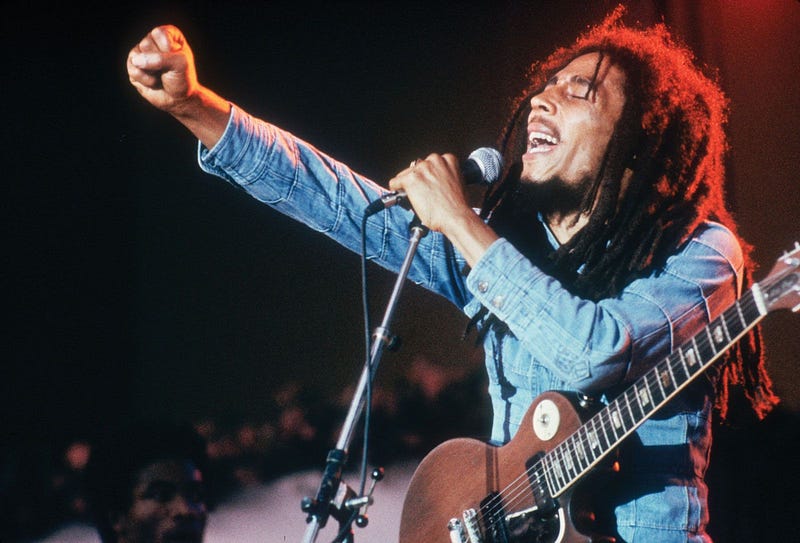
Bob Marley once stated: “My father is a white and my mother black. Now them call me half-caste or whatever. Well, me don’t deh pon nobody’s side. Me don’t deh pon the black man’s side nor the white man’s side. But, upon God’s side, the man who create me, who cause me to come from black and white.”
In that remark, Marley was pointing out that due to the fact that he was biracial, he did not believe that he was on the black man’s side, nor the white man’s side. He embraced a spiritual approach of aligning himself with God, yet his decision to do so was not as racially neutral as it may appear from this quote. Marley was a Rastafarian. He belonged to a religious movement which declared that God was a black man. Rastas take their name from the Ethiopian emperor Ras Tafari, who was coronated as Haile Selassie. Rastas believe that Haile Selassie is a divine figure and that through him black people will find salvation. This doctrine was first preached by Leonard Howell, who preached a doctrine of black supremacy.
God for Rastas was not a racially neutral concept. The Rastafarian religion is rooted in an African-centered interpretation of Christianity. It was also a religion which was heavily influenced by Marcus Garvey. Many Rastas, including Marley, viewed Garvey as a prophet. Garvey was the founder of the Universal Negro Improvement Association. Garvey’s aim was to unite African people around the world for the goal of liberating all African people. Garvey was particularly concerned about liberating Africa from colonial rule. His vision was an anti-colonial one.
Garvey’s Pan-African and anti-colonial vision were significant influences for the Rastas. This can be demonstrated by the group known as Youth Black Faith, which was an anti-colonial Rastafarian group which supported the liberation struggle in Kenya. The Rastafarian movement began was a radical anti-colonial religious movement.
These influences can be demonstrated in the music of Bob Marley. For example, his song “Africa Unite” Marley calls for the unification of Africa. In a live performance of the song — which was performed in front of a mural of Garvey — Marley invoked Garvey’s vision for the unity of Africa. As a Rastafarian and a Pan-Africanist, Africa was central to Marley’s identity. In “Buffalo Soldier,” Marley invokes the history of the Middle Passage which stole Africans away from Africa and brought them to America and the Caribbean where they struggled for survival. “Slave Driver” is another song about the hardships of the Middle Passage.
Marley’s music became the voice of the Jamaican people, reflecting their struggles and hopes for a better future. He used his songs as a powerful tool to address social and political issues, advocating for equality, justice, and peace. Songs like “One Love,” “Get Up, Stand Up,” and “Redemption Song” became anthems for social change and continue to inspire generations.
In Marley’s view, the struggle for upliftment in Jamaica is connected to the wider struggle for Pan-African liberation. Marley himself affirmed in an interview with Gil Noble that he saw himself as being an African first and foremost. He understood that Africans in Jamaica arrived there through slavery. They arrived in a nation which was already populated by the Arawak people. Marley’s view was that Jamaica was truly land which belonged to the original settlers and that as a Rasta the land which rightfully belonged to him was Africa.
Marley rose to prominence not long after Jamaica had become independent from colonial rule, so Jamaican society itself was still wrestling with its own identity. In 1962, Jamaica finally gained independence from Britain, becoming a sovereign nation within the Commonwealth. In the 1960s, the Black Power movement which emerged in the Caribbean was heavily opposed by the government of Jamaica, which is why Walter Rodney was deported from Jamaica. He was a prominent advocate for Black Power, which made the government of Jamaica very comfortable with him and his views.
Jamaica’s colonial history began in 1494 when Christopher Columbus claimed the island for Spain during his second voyage to the New World. The Spanish initially viewed Jamaica as a strategic base for further exploration and conquest. However, they soon realized the island’s potential for agriculture and established large-scale plantations, primarily cultivating sugarcane.
The Spanish colonization of Jamaica was marked by harsh treatment of the indigenous peoples, who were subjugated and forced into labor. This brutal exploitation, combined with diseases brought by the Europeans, led to the decimation of the indigenous population. By the early 17th century, the Spanish presence in Jamaica had significantly diminished, opening the door for the arrival of the British.
In 1655, the British seized Jamaica from the Spanish, ushering in a new era of colonial rule. The island’s fertile soil and favorable climate made it an ideal location for the establishment of plantation colonies. The British transformed Jamaica into a major sugar-producing hub, bringing in enslaved Africans to work on the plantations.
Under British rule, Jamaica became one of the most lucrative colonies in the Caribbean, generating immense wealth for the British Empire. However, this prosperity came at a great cost. Enslaved Africans endured unimaginable suffering and were subjected to brutal conditions on the plantations. The transatlantic slave trade reached its peak during this period, with thousands of Africans forcibly brought to Jamaica against their will.
The slave trade had a profound impact on Jamaica, shaping its demographics, culture, and social structure. The enslaved Africans brought with them their languages, religions, and traditions, which blended with the existing indigenous and European influences to create a vibrant and diverse Jamaican culture.
However, the legacy of slavery also left deep scars on the island. The harsh conditions and brutal treatment of enslaved Africans led to numerous rebellions and acts of resistance. One of the most significant uprisings was the Tacky’s Rebellion in 1760, led by an enslaved African named Tacky. Although ultimately suppressed, the rebellion showcased the resilience and determination of the enslaved population to fight for their freedom. One of the most notable rebellions was the Baptist War of 1831–1832, led by the Baptist deacon Samuel Sharpe. This widespread revolt involved tens of thousands of enslaved Africans demanding emancipation. Although brutally crushed by the colonial authorities, the Baptist War played a pivotal role in raising awareness about the injustices of slavery and paved the way for its eventual abolition. Marley’s music was also largely inspired by this history of rebellion.
As a Rasta, Marley saw Selassie as a divine figure and believed he was the long-awaited messiah. In 1978, Marley visited Ethiopia, a pilgrimage that deepened his connection to the country and its people. Marley’s song “War” was inspired by a speech which was delivered by Haile Selassie. Haile Selassie is himself a very controversial figure in African history. He is remembered both as an emperor who promoted Pan-African unity and supported anti-colonial struggles in Africa, yet very serious abuses also took place under his rule as well. Despite this, Marley and many other Rastas viewed Haile Selassie as a divine figure.
To return to Marley’s quote from the beginning of the essay, Marley was a biracial man, but he was not as racially neutral as his statement would imply. For Marley being on God’s side meant being on the side of the oppressed African masses. It also meant advocating for the unity of Africa and the liberation of Africa from colonial rule. He also denounced Babylon. For Rastas, Babylon is the representation of Western colonialism which keeps African people impoverished and oppressed. Marley was an important voice for the Pan-African struggle. This is what being on God’s side meant for Marley.
—
Dwayne is the author of Malcolm X, Bob Marley, and Other Essays