
Sparks #30: World Poetry Prompt
Me and Poetry, We’ve Got a Thing Going On, Though It’s Not Exclusive
But it is luscious, juicy, and hot!
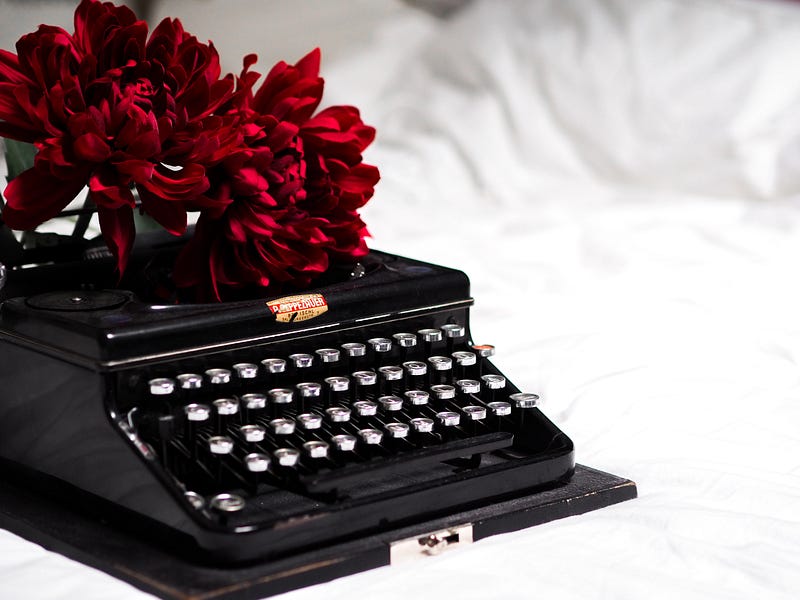
It started out as a casual fling.
As romances often do. A little bit on, lots of time off and out of each other’s sights. I’d write a poem for a homework assignment in class. Or to acknowledge someone’s milestone birthday. Or a Dr. Suessian satire of a current event. And that was pretty much it for years.
Until one day…
I was driving to a physical therapy appointment listening to poet Jack Foley’s program on KPFA.
His guest, a southern California poet, named G. Murray Thomas, recited a poem in his breathy voice, animating first the George side of himself — the dialysis patient desperately in need of a new kidney, then the Murray side — the poet desperately in need of a big book deal.
“Murry spends his evenings hooked up to a microphone at poetry readings. George spends his evenings hooked up to a dialysis machine.”
He danced back and forth between the man with physical limits and the man with boundless imagination. Both hoping with the upcoming transplant, everything will change.
“And they’re both waiting: Murray for his big book contract. George for his kidney transplant’ They both believe that then Everything will change.”
I pictured G. Murrey with oxygen cannulas in his nostrils. The shortness of breath added depth to the reading. But more importantly, it was clear, simple, funny, and outrageously captivating. I was in love. With this man and his understated way of expressing that spoke volumes both in and between the lines.
Organ Transplant Poetry
He then recited his poem about the organ on its way to him for a transplant. The title, Your Kidney Has Just Arrived at LAX — is the actual pronouncement spoken by his doctor as he was being prepped for the surgery.
In the poem, he imagines a plane full of organs on their way to new bodies:
Livers splurging on one last drink They don’t think they’ll be allowed where they’re going…
And last but not least…
And there’s my kidney, No doubt reading a book to pass the time Something classic: As I Lay Dying, Or Great Expectations, Or The Stranger.
(You can watch and listen to G Murray read his work here. And/or order his books. He had a successful transplant, no longer sounds breathy, and appears full of vitality.)
So that’s poetry? So simply stated. And yet so eloquent.
Not with fancy, flashy metaphors. Not brimming over with literary alliterations or philosophical lamentations. Just telling it like it is in everyday easy-going words we can all relate to. The stripped-down language connects straight to the heart.
One of the secrets poetry revealed to me, on our first official date.
Shortly thereafter, we had our first KISS.
Not kiss, but KISS. Keep it Simple, Sweetie! Or, as my favorite poetry teacher, the late June Jordan, said constantly, minimal words, maximal impact.
Her Poetry for the People sessions at San Francisco’s Glide Memorial Church taught hundreds of us how to strip our poems bare. Get rid of all the adverbs straight away. And most of those little connecting words–the if’s, and’s, and but’s. The so’s and then’s and therefore’s. Gone.
Even adjectives. Maybe not all. But as many as we can. Till we’re left standing in our foundational garments of writing. Specifics nouns and strong verbs.
Getting raw, naked, and vulnerable. A great, but scary place for new lovers and poets to be.
We were falling in love.
That meant turning quantity time into quality time. By spending time together. Lots of time. As in making poetry a daily practice.
How many couples’ connection goes stale when they stop dating? Yes, they might live together, be married even. But keeping the chemistry going requires investing time in each other. I.e. Going on dates.
Thanks to my propensity toward prompts, opportunities for dating poetry fell into my lap. A huge one came from the publication The Bad Influence. Its founder ran a daily prompt called Ideastream.
The one I played with listed ten words we were to incorporate into a poem. I did this every day for 100+ days. Sometimes poetry and I languished together in the afterglow of our love-making for hours.
Other days, time only afforded us a quickie.
But we consummated our relationship daily, getting to know each other’s bodies and how they roll, and flow, and like to be pleasured.
Poetry taught me that if I get quiet and listen, really listen, the words begin to speak. They like to gather together in groups. If I let them, they will pick their partners. Then I can arrange those groupings in a process I call playing by ear. By the sounds of the words, more so that their meaning.
Cause poetry taught me that it was an oral tradition, long before it came to be written. Delighting the ear with rhythms and rhymes stands the test of time. A practice I enjoyed making mine.
Poetry taught me that when you focus on quantity, quality emerges. If we’re paying attention, keeping an open mind, we get better and better.
Once I’d gotten through the trial by fire emersion boot camp at TBI, I upped my game over at P.S. I Love You.
There’s was a weekly love tryst.
But always featuring love. A chance to go even deeper and get even more intimate. By this time, I’d discovered and subscribed to Rattle, a poetry magazine that was right up my aesthetic alley.
I rattled my love life by exploring polyamory here. In a metaphorically similar way some couples use sex toys or erotica to enhance their lovemaking, I brought my favorite Rattle poets into our bedroom to shake up our romance.
Heather Bell’s a rattler whose poem, Urgent Care captivated me. I asked myself, what was it about this amazing work that tantalized me so much?
It might have been her image-rich use of language, evidenced by phrases such as the bone saw of the moon, the scent of jaws in milk. Or the way one unfinished line jumps over to the next verse. Enjambment, I think they call it.
That’s what leaps off the page into my heart today.
But on first blush it was the rhythmic power generated by repeating, I begin to see a therapist, over and over. Followed by a surprising reveal. No spoiler alters, go see for yourself, please.
So that’s how I brought Heather to our bed. By borrowing her, I begin and searching for a line that spoke to me, called to me to play with it, caress it, massage it through the magic of repetition. The result was my poem, I Begin to Write my Memoir on the Sidewalk in Kids’ Chalk.
Here’s the first verse:
I begin to write my memoir on the sidewalk with kids’ chalk. Someone left a box on the grass, and it just feels right. I begin to write my childhood inside the rickety hopscotch squares, willing windows for glimpses of roller skates, dislocated shoulders, and being picked last.
Oh, look. There’s even some enjambment in it.
No, that one wasn’t in P.S. I Love You. But after this initial three-way, I brought Rattle with me when creating those love poems. Finding an element, just one, to play with, to enhance the experience.
Every poem is unique.
If I get real quiet, breathe with its rhythm, and read it out loud a few times, it reveals its special secret to me. Something I can infuse and impregnate my own poems with.
So by now, Poetry and I are not just lovers, we’re parents. He or she or they’ve helped me hatch hundreds of baby poemlettes over these past few years.
Come to find out, poetry is a fierce lover, but not faithful. He, she, or they’ve visited many other creative besides besides mine. That’s how poetry invented the terms baby mama and baby daddy. Cause that’s what it did!!!
You may have experienced what I’m talking about.
Don’t feel bad or jaded or jealous. Poetry has plenty of muse-ical libido to go around. Not to mention the most exquisite orgasms I have ever experienced.
Ripples of delight, access every single night, sensuously succulent and sinfully indulgent, with prosodic progeny awaiting me by dawn’s early light.
But don’t take my word for it. Taste and see for yourself.
Here are some of my favorite P.S. I Love You poems:
Thanks, Ellie Jacobson for this provocatively poetic prompt!
Marilyn Flower writes humor to laugh the changes she wants to see and make. She’s the author of Creative Blogging: Ninja Writers Guide to Character Development and Bucket Listers, Get Your Brave On: How to Do the Thing You’re ‘Too Old’ & ‘Too Scared’ to Do. Clowning and improvisation strengthen her resolve during these crazy times. Follow my Sacred Foolishness and Stay in touch!


